


To strengthen prevention and response to infectious risks.
Last updated on 30 July 2026
Innovation, understood as all actions that lead to a product based on a discovery, is at the heart of ANRS MIE’s strategy to respond to the challenges associated with infectious diseases within its scope: HIV/AIDS, viral hepatitis, tuberculosis, sexually transmitted infections and emerging infectious diseases. With this in mind, the agency has created an Innovation Department, responsible for stimulating and structuring the innovation ecosystem and supporting project leaders in the development of their products. It also aims to ultimately enrich the ANRS MIE’s clinical portfolio with new therapies or vaccines.
To maximise the chances of success for the most promising projects, it is essential to anticipate the often complex and highly diverse stages of development. In this context, ANRS MIE offers project leaders who wish to do so the opportunity to present their initiative to an independent committee of experts in order to benefit from strategic insights, informed recommendations, and personalized support throughout their innovation process. This approach also seeks to foster an active and committed community around innovation in the field of infectious diseases.
ANRS MIE invites project leaders to present their initiatives to an independent committee of experts in order to benefit from strategic insights, informed recommendations, and personalized support throughout their innovation process.
Comprising around ten experts, this committee is tasked with formulating scientific, regulatory and strategic guidelines for project leaders from academia and industry. It can also guide them towards the most appropriate funding mechanisms and, where necessary, support them in the subsequent stages of their development.
The members of the Innovation Committee come from a variety of backgrounds: funding agencies, regulatory authorities, academic research, start-ups, the pharmaceutical industry, technology transfer organisations, etc. This diversity ensures a rich and multidimensional analysis of projects, combined with a thorough set of strategic considerations. Networking is also an essential lever of this initiative.
The members of the Innovation Committee serve in a personal capacity and without remuneration: they receive no compensation and do not represent their institution, company or supervisory authority. Their commitment is based on a shared desire to support innovation in the field of infectious diseases, in a spirit of independence, high standards and goodwill.
The committee’s role is to:
Submitted projects are selected by the ANRS MIE Innovation Department based on their potential, their alignment with the agency’s strategic priorities, and their relevance.
The committee meets four times a year, examining two projects per session. Meetings are held in an ‘after-work’ format, from 6pm to 10pm, in a friendly and informal setting conducive to open and constructive discussions.

I participate, as an expert, in the work of the ANRS MIE Innovation Committee. This committee’s mission is to advise project leaders in their efforts to develop therapeutic, vaccine, or diagnostic solutions. My role is to analyze projects, identify risks and opportunities at the scientific, technical, regulatory, and financial levels, and propose concrete approaches to mitigate these risks and anticipate key stages of development. This collective approach also aims to structure an innovation ecosystem around infectious diseases. It fosters exchanges between the various stakeholders involved in drug development and addresses a strategic need for support and valorization in a field that still lacks sufficient dedicated mechanisms.
Antonin Weckel
(Venture Capital Analyst, Sofinnova Partners)
Eric Quemeneur
(Coordinateur France vaccins)
Georges Azar
(Head of in vivo Pharmacology R&D, Institut Servier d’Innovation Thérapeutique (ISIT))
Golriz Pahlavan
(Présidente du comité scientifique, MSDavenir )
Jade Ghosn
(PU-PH infectiologue, hôpital Bichat – Claude-Bernard)
Jean-Philippe Herbeuval
(DR1 CNRS, fondateur scientifique Ermium therapeutics)
Jérémy Berthuin
(Responsable sectoriel santé, BPI)
Nabila Seddiki
( Directrice de recherche, IDMIT)
Nathalie Morgensztejn
(Coordinatrice scientifique, direction Europe et innovation, ANSM)
Pascale Augé
(Présidente du directoire, Inserm transfert )
Valérie Taly
(DR1 CNRS, CSO et co-fondatrice de METHYS Dx)
Guillaume Voiroit
(PU-PH, AP-HP Hôpital Tenon, Paris · Pneumologie / Réanimation)
Brahim Sennane
(Transfer & Licensing Manager, CNRS Innovation)
Nicolas de Prost
(PU-PH AP-HP. Hôpital Henri-Mondor, Créteil. Pneumologie / Réanimation)
Antoine Alam
(VP and Head of Antiviral Research, Evotec)

The presentation of our project to the ANRS MIE innovation committee led to a rich and particularly constructive exchange. The committee members, who have a wide range of expertise and excellent scientific knowledge, made valuable contributions. The discussions, which were supportive and focused on the success of the project, enabled us to anticipate the next steps as accurately as possible and to adjust certain strategic directions. This initiative will undoubtedly benefit many innovation project leaders.
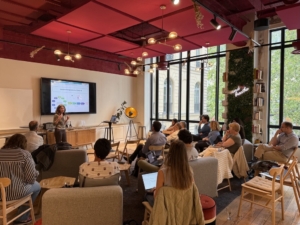 The 4th meeting of the ANRS MIE Innovation Committee was held in Paris on 2 June 2026. On this occasion, the committee members welcomed Antoine Alam, ‘VP and Head of Antiviral Research’ at Evotec, who came to share his expertise in the development of antivirals.
This meeting provided an opportunity for two research teams to present their projects to the Committee members:
The discussions were, once again, particularly informative and constructive for the project leaders, who thus benefited from valuable scientific and strategic recommendations for the continuation of their work. The Committee also invited the teams to return to present the progress of their projects within one to two years, in order to further the discussions initiated and provide a progress update on the advances made.
To kick off the new year, the ANRS MIE Innovation Committee met once again on 28 January in Paris.
Two teams benefited from the combined expertise of the Committee members, with in-depth discussions on scientific issues, intellectual property and development strategy – key levers for advancing innovative drug candidates.
This meeting fully illustrated the Innovation Committee’s ambition:
Projects presented:
On Tuesday, 28 October, in Paris, three new experts joined the Committee, including clinicians and technology transfer specialists.
This second meeting provided an opportunity for two research teams to present their initiatives to the Committee members:
The first meeting of the ANRS MIE Innovation Committee was held on Monday, 26 May 2025, in Paris. Two projects, funded under the Priority Research Programmes and Equipment (PEPR MIE), were presented and benefited from in–depth discussions and concrete recommendations for their advancement.
Projects presented during this first session: