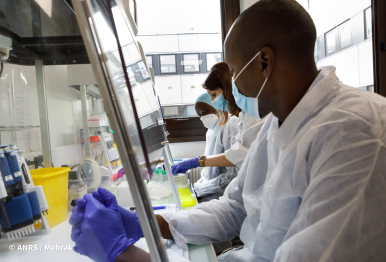
The aim of the Start programme is to support the next generation of scientific researchers in the agency's research areas.
Last updated on 15 October 2026
The Start programme aims to support and mentor junior scientists (particularly Master’s students, PhD students and postdoctoral researchers) working on the research themes of the ANRS MIE (HIV/AIDS, viral hepatitis, tuberculosis, STIs and emerging infectious diseases).
Launched in 2024, it brings together all the funding, training, promotion and networking initiatives offered or coordinated by ANRS MIE for the next generation of researchers.
This support has been defined as a strategic priority (Objective 7 of the ANRS MIE 2023-2027 Strategic Framework) and is based on three areas of support:
 The Start programme offers grants and training opportunities for junior scientists wishing to gain the skills needed to embark on a career in research.
The call for applications for ‘Master’s grants – International Network’ is aimed at early–career scientists from low– and middle–income countries (LMICs) and aims to enable successful candidates to undertake a Master’s I, Master’s II or a Specialised Master’s programme, and to open up opportunities for further careers in research in close collaboration with the Partner Sites and International Research Platforms in Global Health (PRISME) of the ANRS MIE’s International Network.
2025 Laureates Discover the 2026 editionSince 2012, ANRS MIE has funded an annual grant of excellence, the “Françoise Barré-Sinoussi, Nobel Prize in Medicine” grant, to enable French-speaking healthcare professionals from sub-Saharan Africa or South-East Asia to undertake the Master 2 programme in “Global Health in the Global South – Global Health” at Isped / University of Bordeaux, and thereby conduct research in their home countries on topics relevant to the ANRS MIE.
Since 2023, this programme has been supplemented by a scheme offering supplementary grants to enable students to undertake the university diploma (DU) in ‘Methods and Practice in Epidemiology’ offered by Isped. This scheme is aimed at candidates wishing to consolidate their foundational knowledge in epidemiology and statistics in order to apply for the Master’s programme.
Know more on the 2026-2027 LaureateThe call for applications for ‘Research Grants – Emerging Infectious Diseases’ is aimed in particular at early–career researchers wishing to undertake a PhD or a fourth year of their PhD research focusing on emerging infectious diseases.
This scheme, which was initially open only to PhD projects, is also supporting, for the first time in 2026, fourth-year PhD projects and postdoctoral research projects (see below).
The 2026 edition of this call was open to all disciplines and research approaches and to all emerging infectious diseases, with a priority given to arboviral diseases, viral haemorrhagic fevers and respiratory viral infections. The emerging or re-emerging nature of the diseases or pathogens under study had to be justified.
2025 Laureates 2026 LaureatesThe ‘generic’ call for proposals on ‘HIV/AIDS, STIs, viral hepatitis, tuberculosis’ enables early–career researchers to undertake a PhD thesis on the topics of HIV/AIDS, STIs, viral hepatitis and tuberculosis.
In 2026, the ‘New Technologies’ group of the ANRS MIE Virology and Pharmacology Network launched a call for applications for mobility grants dedicated to training in innovative technologies.
This is aimed at early-career researchers (junior doctors, assistants, clinic heads, PhD students, postdoctoral researchers, within 10 years of completing their thesis) wishing to undertake a one-week placement in a partner laboratory specialising in the ‘New Technologies’ group’s field.
The partners of the ANRS MIE International Network are committed to supporting early-career researchers, in particular by providing guidance on career development and offering a diverse range of training programmes.
Two training programmes are specifically aimed at junior healthcare professionals in Africa:
 The Start programme offers grants enabling junior researchers to pursue a postdoctoral career or to take up their first research chair.
The call for applications ‘Research Grants – Emerging Infectious Diseases’ is aimed in particular at early-career scientists wishing to undertake postdoctoral research on emerging infectious diseases.
The 2026 edition of this call was the first to be open to funding for postdoctoral grants.
The 2026 edition of this call was open to all disciplines and research approaches and to all emerging infectious diseases, with a priority given to arboviral diseases, viral haemorrhagic fevers and respiratory viral infections. The emerging or re-emerging nature of the diseases or pathogens under study had to be justified.
2026 LaureatesThe ‘generic’ call for proposals on ‘HIV/AIDS, STIs, viral hepatitis and tuberculosis’ enables early-career researchers to undertake a postdoctoral project on the themes of HIV/AIDS, STIs, viral hepatitis and tuberculosis.
As part of the Priority Research Programme and Equipment for Emerging Infectious Diseases (PEPR MIE), Measure 2 of the national acceleration strategy ‘Emerging Infectious Diseases (MIE) and Nuclear, Radiological, Biological and Chemical Threats (MN)’, which forms part of the France 2030 plan, the ANRS MIE has launched its first call for applications for junior research chairs.
The aim of this call was to stimulate the development of innovative research within the scope of the PEPR MIE:
Five successful applicants received funding for their first research chair on arboviral diseases, totalling 4.6 million euros.
2025 Junior chairs of the PEPR MIE The Start programme facilitates and supports a community of junior researchers working on HIV/AIDS, viral hepatitises, STDs, tuberculosis and emerging infectious diseases through a range of networks, awards and mobility grants.
The Start Network is a cross-disciplinary network aimed at junior scientists supported by the agency, as well as anyone interested in the ANRS MIE’s areas of focus.
Its aim is to help build a scientific community by encouraging exchanges and collaborations across different disciplines and research areas.
The network relies on the involvement of junior researchers, who are invited to share their ideas and needs in order to enrich and co-create the initiatives put in place.
There are also two thematic networks that complement the Start network:
Founded in 2021 on the initiative of four junior researchers funded by ANRS MIE, its aim is to bring together junior scientists engaged in basic research on HIV, viral hepatitis, STIs, tuberculosis and emerging infectious diseases.
Support for the publication of articles, as well as mobility grants to facilitate participation in international conferences, are, for example, offered in collaboration with this network.
Contact: amyb.pwc@anrs.fr
Established in 2008, this network aims to pool information and expertise, provide support in responding to calls for proposals, and promote scientific exchange on topics related to HIV/AIDS, and more recently to other conditions falling within the agency’s remit. It facilitates collective reflection on the political, ethical and operational implications of research work.
With a view to integrating junior scientists into the agency’s activities, ANRS MIE seeks and encourages their participation in the work and organisation of its coordinated initiatives, research networks and working groups.
Furthermore, junior researchers are invited to join scientific evaluation committees for the ANRS MIE’s various programmes and support schemes.
The coordinated actions (AC) of ANRS MIE help to support early-career researchers: in particular, the agency and the French Society of Virology (SFV) have joined forces to award thesis prizes to junior scientists whose doctoral research has made a significant contribution to the field through its high quality, originality and innovative nature.
These prizes cover various fields of virology:
Since 2006, the International AIDS Society (IAS) and ANRS Emerging Infectious Diseases (ANRS MIE) have joined forces each year to recognise the work of young researchers for its quality, innovation and originality in the field of HIV/AIDS research.
This IAS/ANRS MIE prize was renamed the ‘Joep Lange & Jacqueline van Tongeren’ Prize in 2015, in tribute to the Dutch researcher Joep Lange and his wife, Jacqueline van Tongeren, who died in the crash of Malaysia Airlines flight MH 17 the previous year.
2026 LaureatesThe ANRS MIE regularly funds mobility grants inviting junior scientists to participate in and present their work at international conferences such as:
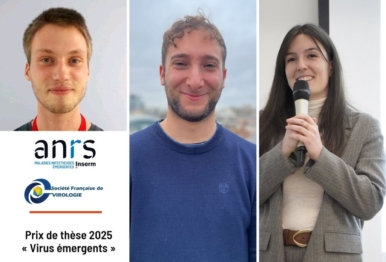
In April 2026, the ANRS MIE and the SFV awarded three thesis prizes to Morena Gasparine, Riccardo Vernuccio and Konrad M. Wesselmann.
18 May 2026

Dr Joe McKellar, whose postdoctoral research was funded by ANRS MIE as part of the Start Programme, discusses his contribution to advancing our understanding of deltaviruses.
17 April 2026
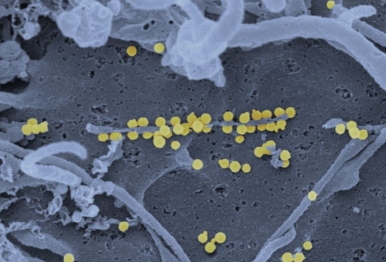
Dr Solène Denolly, whose work is supported by ANRS MIE, discusses a study combining clinical and basic research.
22 April 2026