

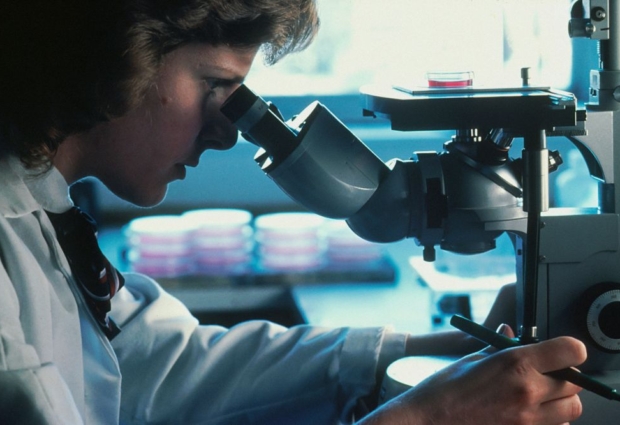
Francesca di Nunzio and Vincent Parissi, who are involved in two new studies on HIV published in Science Advances, make the case for basic research.
Last updated on 02 November 2026
Specialising in basic research into retroviruses, and in particular HIV, Francesca di Nunzio and Vincent Parissi discuss their latest work, published in the journal Science Advances and partly funded by the ANRS Emerging Infectious Diseases (ANRS MIE), their future projects in collaboration with the agency, and their concerns regarding the future of their discipline.
 Francesca di Nunzio is a research director and head of the Advanced Molecular Virology Laboratory within the Department of Virology at the Pasteur Institute. She also co-chairs, alongside Nicoletta Casartelli (Pasteur Institute), the Group for AIDS Research (GRS), founded by the Pasteur Institute and funded by ANRS MIE.
 Vincent Parissi is a research director and head of the MobilVir (Mobility of pathogenic genomes and chromatin dynamics) team at the Fundamental Microbiology and Pathogenicity (MFP) laboratory of the CNRS and the University of Bordeaux. He also co–leads, alongside Stéphane Emiliani (Institut Cochin), the research group (GDR) DynaVir, hosted by the CNRS and supported by the ANRS MIE as part of its Coordinated Action ‘Host–virus interactions: Basic and translational research on HIV’ (AC41).
Vincent Parissi: Our two studies focus on one of the early stages of viral replication: the virus’s entry into the cell nucleus. Several research projects have already examined other stages of the viral cycle, such as integration (the phase during which the HIV-1 viral RNA is reverse-transcribed into double-stranded DNA, enters the nucleus and integrates into the target cell’s genome before being transcribed into RNA) or assembly (the phase during which the virus is reassembled within the target cell before being released to infect other cells), but far too little has been done on this rather obscure window of viral replication. Yet it is this phase that governs all stages of the virus’s integration and subsequent expression within the target cell. It is therefore vital to understand how it works.
Both studies focus on the discovery of new mechanisms involved in the early stages of HIV infection. In the study published on 7 August 2026, Francesca’s team focused on the fate of the capsid – the shell that protects the viral genome – under the effect of the antiretroviral drug lenacapavir as it enters the cell nucleus. In the study, published on 24 July 2026, my team examined the phase preceding integration and, in particular, the cellular control mechanisms involved as soon as the virus enters the cell.
We have identified which factors, involved in certain homologous recombination repair pathways of cellular DNA, play a role in the reverse transcription of HIV–1 viral RNA, as well as in which cases these cellular factors contribute to the synthesis of viral DNA that is either competent or non–competent. In other words, host proteins and molecules that target these specific factors and repair pathways could affect the virus’s integration phase and halt the rest of its life cycle. Furthermore, our characterisation, using HIV-1 as a model, may potentially have wider implications, particularly in research into anti-cancer drugs targeting these repair pathways.
In future, my team hopes to investigate another poorly characterised phase of the viral cycle: the events that occur between integration, entry into latency or the viral reservoir, and subsequent viral transcription.
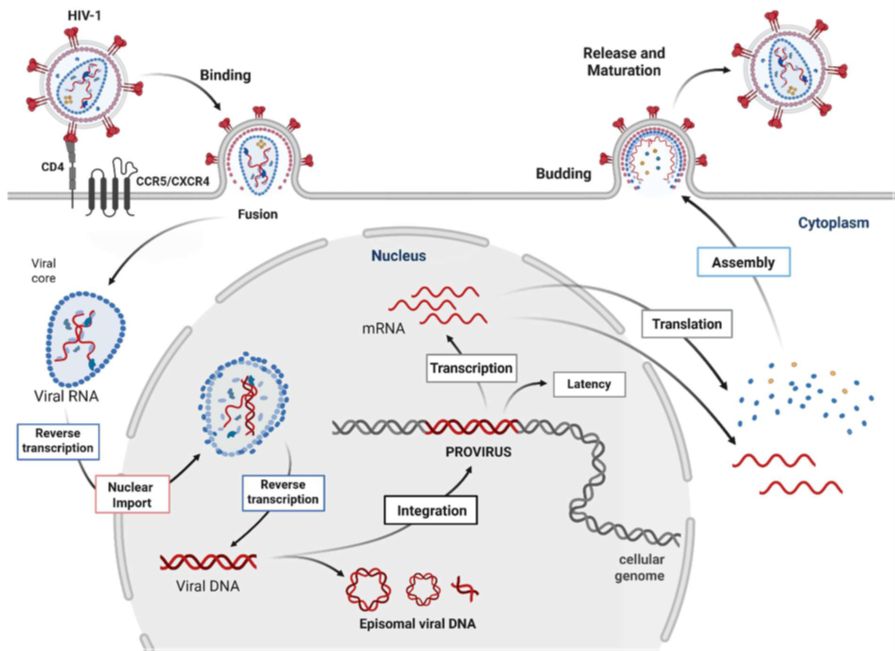
The HIV-1 viral life cycle (visual generated by Francesca Di Nunzio with the help of BioRender AI).
Francesca di Nunzio: Our study, for its part, focused on the mechanism of action of lenacapavir. The initial aim of Gilead Sciences, the US pharmaceutical company that developed this treatment, was to block the assembly of the viral capsid. It is only recently that the persistence of the capsid right into the nucleus of infected cells has been demonstrated, thanks in particular to the work of the team led by Francesca. We therefore sought to characterise the structures of this capsid during the early stages of HIV-1 replication, with and without lenacapavir.
Using state-of-the-art imaging techniques developed at the Pasteur Institute, we were able to observe the interior of the nuclei of infected cells in great detail. Without treatment, the capsids empty their contents into the nucleus. In the presence of lenacapvir, the viral capsids remain almost intact but are stabilised in regions of the nucleus known as membrane-less organelles. Lenacapvir redirects the viral genome to regions of the nucleus that are unusual for HIV, where the chromatin is more compact and less active. In the presence of lenacapavir, integration of the viral genome is reduced, and the few integrations observed occur in regions of chromatin that are less favourable for transcription.
This observation serves as the starting point for our LENAshape research project, launched in 2025 and funded by ANRS MIE. Its aim is now to understand how lenacapavir stabilises the capsids and to determine its effect on the organisation of the hexamers and pentamers that make them up. We also plan to develop, following our in vitro results, an in vivo cell therapy.
To find out more:
F.d.N.: By deepening our understanding, for example, of the mechanisms involved in nuclear pores, through which all molecules passing through the cell nucleus are transported. Recently, by using the HIV capsid as a probe, researchers have been able to gain a better understanding of the actual dimensions of nuclear pores and highlight possible differences in how they function. The same applies to understanding the SARS-CoV-2 spike protein, which enables the COVID-19 virus to enter lung cells and shares similarities with a corresponding protein in HIV-1.
Furthermore, the knowledge accumulated on HIV and condensates – clusters of proteins that protect the viral genome – may also have implications for research into neurodegenerative diseases, cancers or simply the physiological functioning of cells and their nuclei. It should not be forgotten that several innovative therapeutic approaches rely on tools derived from HIV, notably lentiviral vectors used in gene therapy and to produce certain CAR-T cells, intended for the treatment of cancers and, more recently, being explored for autoimmune diseases.
V.P.: For over thirty years, basic research into retroviruses, and in particular HIV, has also led to numerous therapeutic solutions. Research into the integration and the oligomerisation involved in this specific phase has shed light on the mechanisms of inhibition, and the associated resistance, in many antiretroviral treatments targeting this phase.
Furthermore, the reverse is also true. The study of foamy viruses (FVs)—complex zoonotic retroviruses with atypical characteristics that can infect humans, although non-pathogenic—has filled gaps in our understanding of the microbiology of HIV-1, particularly with regard to the mechanisms of viral inhibitors.
F.d.N.: There is considerable concern amongst French researchers regarding national funding for basic research. In Italy, whilst I was doing my PhD, I witnessed the impact of budget cuts on basic research, which was sidelined in favour of work on vaccines and therapeutic solutions. The most innovative therapeutic advances stem from basic research: messenger RNA (mRNA) vaccines, lenacapavir, integrase inhibitors, antisense oligonucleotides (ASOs) and CRISPR-based genome editing – already used to treat certain genetic blood disorders – are all examples. Without basic research or an understanding of biological mechanisms, there can be no therapeutic innovation. Unfortunately, the same trend is becoming apparent in France, where support for basic research is declining compared with the United States (where the most significant cuts are affecting clinical research). This is particularly ironic for a country where the HIV virus was first isolated!
V.P.: I fully agree with this assessment. For nearly forty years, ANRS MIE has supported, and continues to support, basic research into HIV. But that is not enough. In recent years, in many countries, including France, we have observed a gradual political and financial withdrawal due to a lack of understanding of what basic research can contribute to research in general. Yet, as with our work on retroviruses and HIV-1, the knowledge it generates extends far beyond its own field.
F.d.N.: Fortunately, we still have groups and networks that form the backbone of our community in France and across Europe. Admittedly, we no longer have the American bodies that historically served as a unifying force for our disciplines, but we continue to rely on international conferences and meetings, such as those organised by the AIDS Reflection Group, to foster collaborations – this time, without the influence of a single dominant player imposing its own vision of research. For the time being, this is our way of avoiding an extinction on a par with that of the dinosaurs!
V.P.: The risk, however, is that we may lose this basic structure as our researchers gradually shift their focus to other fields in search of funding. A network of around thirty teams, such as that of the DynaVir research group, remains vital for organising research and launching large-scale collaborative projects, for which funding is lacking.
Dr Joe McKellar, whose postdoctoral research was funded by ANRS MIE as part of the Start Programme, discusses his contribution to advancing our understanding of deltaviruses.
17 April 2026
Dr Solène Denolly, whose work is supported by ANRS MIE, discusses a study combining clinical and basic research.
22 April 2026

Interview with the co-chairs of the Coordinated action, Bruno Canard and Delphine Planas
17 June 2025