20 August marks World Mosquito Day, commemorating a critical discovery made by Dr Ross in 1897, who first made the link that female mosquitoes transmit malaria between humans. Above all, it is an opportunity to raise public awareness of the health risks associated with mosquitoes and the diseases they carry, such as chikungunya, several cases of which have occurred in mainland France this summer.
Last updated on 20 August 2025
As every year, the aim of this day is to raise public awareness of mosquito-borne diseases and the efforts being made to eradicate them. This year has been marked by the early threat of arboviruses in mainland France.
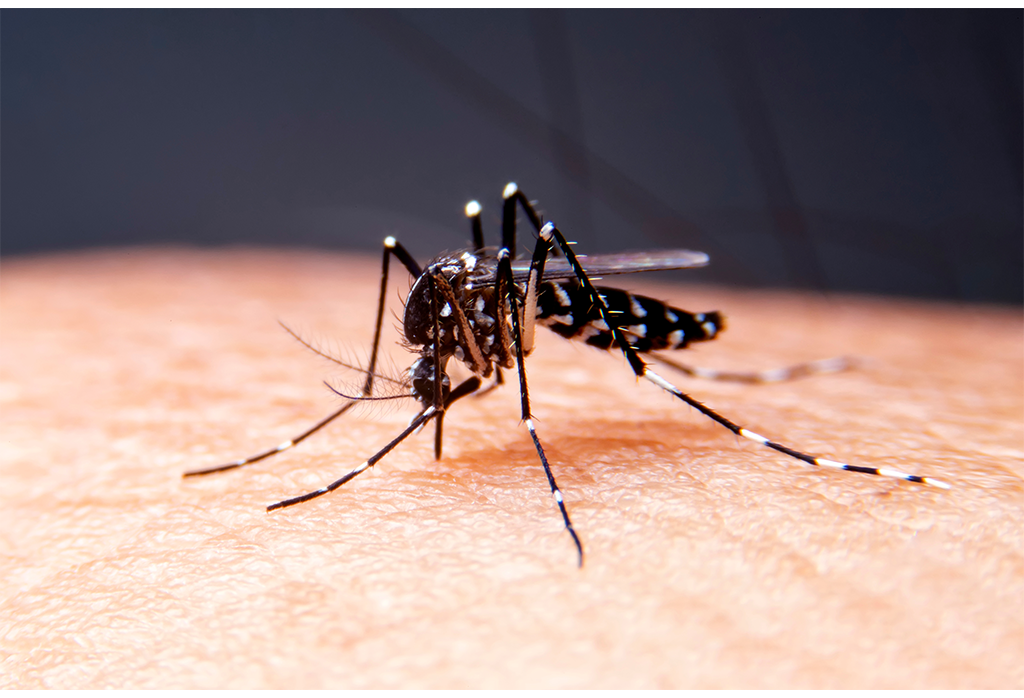
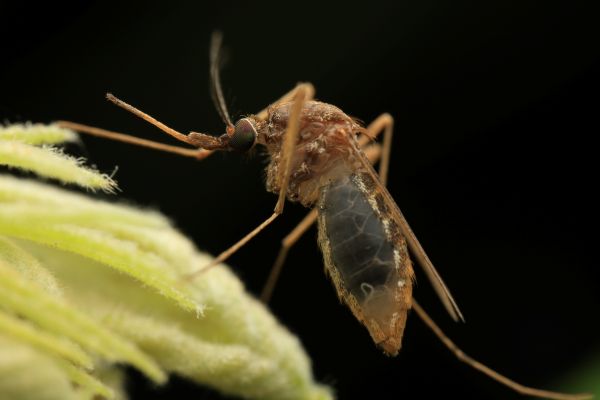
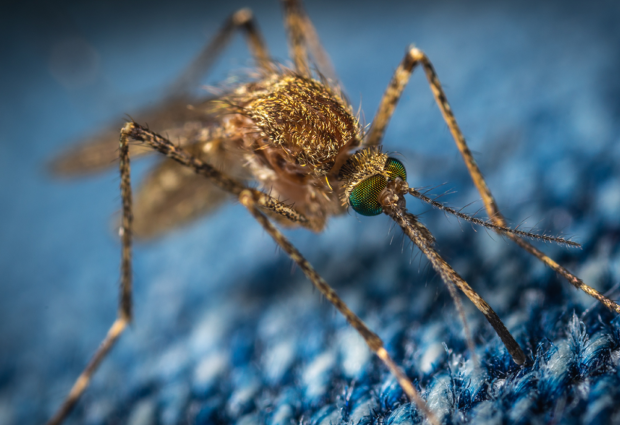
There are more than 3,000 species of mosquitoes, but only three are responsible for transmitting viral and parasitic diseases to humans: Aedes mosquitoes, Anopheles mosquitoes and Culex mosquitoes.1,2
Dengue, Chikungunya, Zika and yellow fever are arboviral diseases transmitted by these vectors:2,3
Climate change, globalised travel and trade are contributing to the emergence of arboviruses. Their geographical range and that of their vectors are now expanding beyond their natural limits and reaching new regions that were previously unaffected.3,4
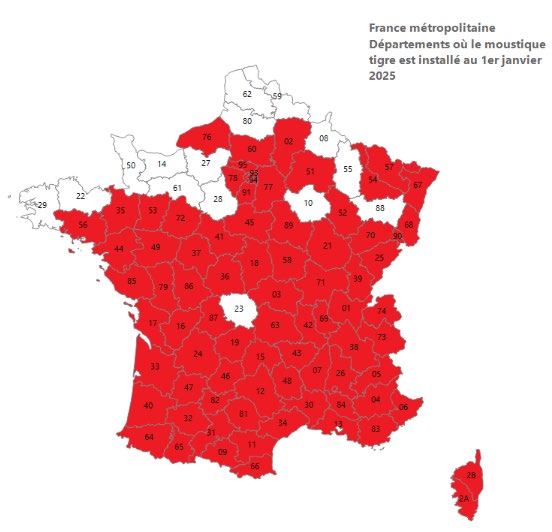
Introduced to mainland France in 2004, Aedes albopictus, or “tiger mosquito”, continues to colonise the country.5,6
From 78 departments on 1 January 2024, it expanded to 81 departments (out of 96) by early 2025, representing 84% of metropolitan departments.6
More than three-quarters of departments were colonised in less than 20 years.7
2025 is marked by the early active circulation of certain arboviruses in mainland France.
A total of 914 travel-associated cases of chikungunya, 746 of dengue and 4 of Zika were reported between 1 May, when enhanced surveillance began, and 12 August 2025.8 2024 saw 4,683 travel-associated cases of dengue, 34 of chikungunya and 8 of Zika.9
However, 2025 has mainly been characterised by a rise in local chikungunya cases: 115 to date, compared with only one identified in 2024. The number of locally acquired dengue cases currently stands at 11, compared with 83 at the end of 2024.
Seven local cases of West Nile fever have also been reported for the first time in mainland France.8,9
Chikungunya local cases are mainly found in Provence-Alpes-Côte d’Azur, Corsica, Occitanie and Auvergne-Rhône-Alpes regions, which were already affected in previous years, and for the first time in Grand Est, Nouvelle Aquitaine and Bourgogne-Franche-Comté.8
There is currently no epidemic of dengue, chikungunya or Zika in mainland France, but dengue is actively circulating in Guadeloupe and Réunion Island faced a major chikungunya outbreak.10 Between 2010 and 2024, no cases were detected in Réunion. Since the beginning of 2025, nearly 54,340 confirmed local cases of chikungunya have been recorded. The end of the epidemic was declared on 24 June 2025 by health authorities.11
In mainland France, the majority of reported cases remain travel-associated cases.10
In 2024, ANSES issued an opinion stating that the risk of an arbovirus epidemic in mainland France was very high within five years, with a score between 6 and 7 on a 9 point risk scale. According to experts, the two determining factors in the emergence of an epidemic during periods of Aedes albopictus activity are very high travel flows, which facilitate the circulation of viruses and vectors, and favourable climatic conditions.7
Arbo-France, under the aegis of ANRS MIE, is a French network for the study of arboviruses, the aim of which is to facilitate preparedness and response to human and animal arbovirus epidemics in mainland France and overseas territories.
This year, Arbo-France’s Scientific Days were dedicated to strategies for using alternative vector-control methods against arboviruses.
In November 2024, Arbo-France proposed a scenario for the emergence of yellow fever in the Antilles to serve as a basis for improving French research preparedness and response to an arboviral outbreak.
This consortium brings together French medical and scientific teams from Guadeloupe, Martinique, French Guiana, Réunion, French Polynesia, New Caledonia and mainland France. Its aim is to identify new prognostic biomarkers for severe forms of dengue fever from the CARBO cohort. It is funded under the Priority Research Programme and Equipment for Emerging Infectious Diseases (PEPR MIE).
This project, closely linked to LSDengue, is based on the collection of dengue virus (DENV) genomes circulating in French overseas territories and mainland France, and aims to identify virus genetic determinants involved in the severity of the disease. This project is funded by MSDavenir.
This call for proposals aims to support collaborative research projects between a French team and a team from a low- or middle-income country (LMIC) on global issues related to emerging infectious diseases, including arboviral diseases. It promotes an integrated approach, mobilising basic, translational, clinical, public health, humanities and social science research.
One of the projects supported by the 2024 Emergence LMIC call for proposals aims to anticipate the emergence of diseases transmitted by Culex mosquitoes in the Mediterranean basin. This will involve improving knowledge of the circulation and transmission dynamics of arboviruses transmitted by these mosquitoes.