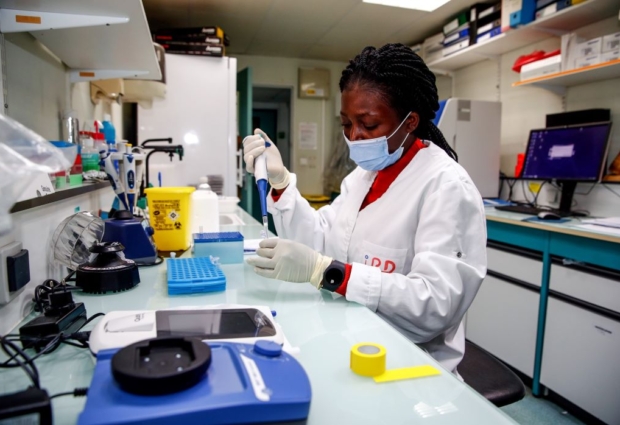
The AFROSCREEN programme aims to establish a genomic surveillance network that helps build laboratory capacity for the diagnosis, detection and surveillance of SARS-CoV-2 variants and other emerging pathogens.
Last updated on 14 May 2026
Implemented as part of the “Health in Common” initiative in 2021, AFROSCREEN is an international, inter-institutional consortium, demonstrating a voluntary, committed approach to collaborations with major scientific and societal implications. The project has received a share of 10 million euros by the Agence Française de Développement (French Development Agency), coordinated by ANRS | MIE, IRD and Institut Pasteur. It has been implemented by an international network of 25 research centres and laboratories across 13 African countries.
The three main objectives of the project are as follows:
Depending on partners’ skills, the planned actions will ensure the sustainable development of genomic surveillance capabilities in the country. These actions are provided for the identification of emerging pathogens, for surveys carried out as part of the “One Health” approach (in wildlife, domestic fauna, waste water, etc.) and for research projects.
Three years after its launch, the AFROSCREEN programme has achieved all its objectives by developing an effective genomic surveillance system to tackle epidemics in sub-Saharan Africa. Read about the project’s achievements in the AFROSCREEN press release dated 28 May 2024
See the press releaseUnder the MEAE’s Fonds Équipe France (FEF), the project is coordinated by a consortium of three French institutions led by ANRS MIE, an autonomous agency of INSERM, and comprising the Research Institute for Development, the Pasteur Institute, and institutions in the project’s partner countries, notably the Pasteur Institute in Dakar and the Centre for Research and Training in Infectious Diseases in Guinea (CERFIG).
This funding aims to consolidate the achievements of the initial project by ensuring the continued operation of the sequencing platforms installed and by strengthening the skills of national staff. It also ensures the continuation of investigations into other emerging and re-emerging zoonotic infectious agents of epidemic potential, such as arboviruses and haemorrhagic fever viruses, the response to which often requires multidisciplinary and multisectoral action. Finally, this funding will enable the continued training of staff from national partners, involving universities in partner countries as well as veterinary laboratories, in line with the ‘One Health’ approach, as part of efforts to consolidate the existing AFROSCREEN network and expand it to include other areas of expertise.
These efforts are aligned with the strategic initiatives of the Africa Centres for Disease Control and Prevention (Africa CDC) and the World Health Organisation (WHO) to establish genomic surveillance networks at national, regional and global levels.
Read the press releaseOver a three-year period, the AFROSCREEN programme enabled the procurement and delivery of next-generation sequencing platforms adapted to local contexts, the training of more than 250 professionals in sequencing and bioinformatics analysis, and the establishment of a network of 25 public health and research institutions — all of which represent capacities that are now sustainably embedded at local level.
One of the programme’s key contributions has been to demonstrate that strengthening genomic surveillance capacity is not solely a technical challenge. It is also a fundamental issue of health equity. Prior to this project, many African countries relied heavily on laboratories abroad to carry out genomic sequencing. This dependence led to significant delays, limited access to data, and reduced its usefulness for rapid public health decision-making. By enabling sequencing capacity to be developed directly within participating countries, the AFROSCREEN programme helped reduce this dependency.
Building effective and equitable surveillance systems requires a comprehensive approach that incorporates technical, human and political dimensions alike. By addressing this threefold challenge, the objective is to ensure that the next epidemic alert can be detected, sequenced and interpreted by AFROSCREEN network member institutions, enabling them to support their respective health authorities with evidence-based data.
Read the article