
Last updated on 03 September 2026
The Coordinated Action on Long COVID (CA), established in 2022, leads, develops and supports research projects in the field of Long COVID, with the aim of facilitating their submission to calls for research proposals. Its operational objective is to foster the emergence and development of collaborative and multidisciplinary research projects, addressing scientific issues identified as priorities. To this end, the Long COVID Coordinated Action provides scientific coordination to stimulate research in this field, notably by fostering connections between researchers and the development of collaborations at both national and international levels.
The Long COVID Coordinated Action (AC54) develops its work and reflections across several complementary areas:
The Coordinated Action brings together a broad range of complementary expertise, including clinicians working in hospital and outpatient settings, epidemiologists and public health specialists, researchers in basic research and social sciences and humanities, health economists, as well as patient representatives. This diversity of expertise enables different perspectives to be brought together and fosters an integrated approach to the various research challenges related to Long COVID.
Led by a small executive committee, AC54 brings together around forty members who collectively contribute to its discussions, the definition of its scientific priorities, and the development of its activities.
Since 2025, following the Long COVID Scientific Day organised in partnership with Santé publique France and the French National Authority for Health (Haute Autorité de santé, HAS), AC54 has decided to place particular emphasis on two areas:
Within this framework, AC54 supports scientific coordination, contributes to the emergence and development of research projects, and participates in the dissemination of scientific knowledge, notably through the organisation of events dedicated to Long COVID.
At the same time, AC54 is considering the possibility of expanding its scope to include other post-infectious syndromes. This potential development is being considered with several key points in mind: preserving the visibility of Long COVID, both in the research field and in healthcare policies and provision; maintaining close links between research and the clinical care of patients; and ensuring the continued involvement of patient representatives in the discussions and activities undertaken.
Michel Carlès
(CHU Nice)
Joël Coste
(Ecole Pratiques des Hautes Etudes, Paris)
Aurélie Morand
(Assistance publique – Hôpitaux de Marseille, Marseille)
Pauline Oustric
(Association Après J20)
Sophie Trouillet-Assan
(Recherche Hospices Civils de Lyon – BioMérieux, Lyon)
Fatoumata Coulibaly
(ANRS MIE)
Robert Manfredi
(ANRS MIE)
Eric Rosenthal
(ANRS MIE)
Chloé Duquesnay (Coordinator of scientific bodies)

In 2026, ANRS MIE is part of the organising committee of the 4th Long COVID International Conference, which will be held in Nice on 12 and 13 November 2026.
On this occasion, ANRS MIE, together with the Long COVID Coordinated Action (CA54), is organising an institutional symposium dedicated to potential biomarkers of Long COVID and their implications for therapeutic management: “Hallmarks and potential biomarkers of Long COVID: implications for patient treatment”.
This symposium will bring together international experts to discuss the latest advances in Long COVID biomarkers and their potential to improve patient care. The programme will include presentations of four French studies focusing on potential Long COVID biomarkers, three of which have received support from ANRS MIE. These presentations will be followed by a round-table discussion to put the findings into perspective and discuss future directions and their implications for patient care.
More information about the symposiumFaced with the health ch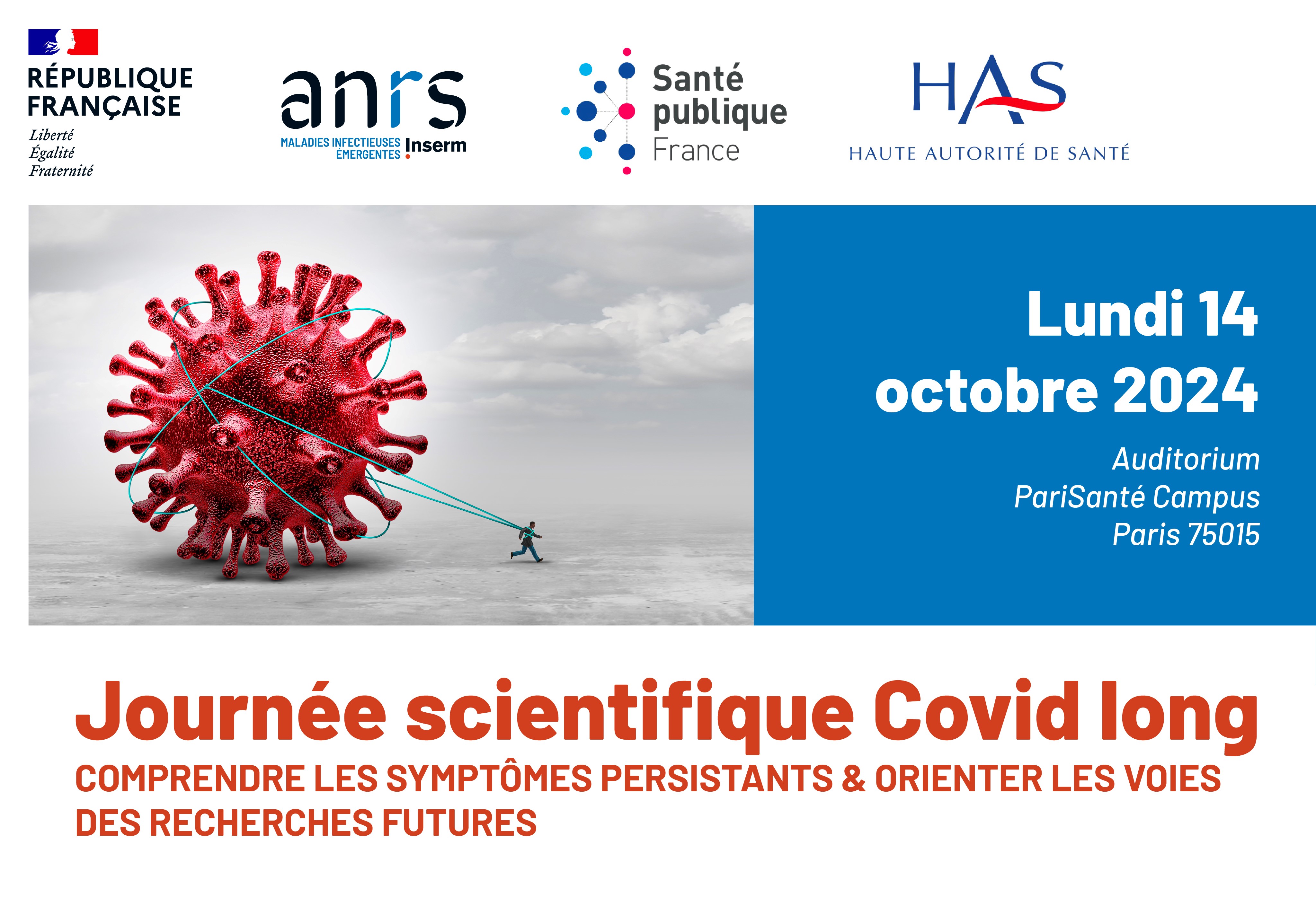 allenges for affected individuals, public health and healthcare professionals, the French National Agency for Research on AIDS and Viral Hepatitis – Emerging Infectious Diseases (ANRS MIE), Santé publique France and the French National Authority for Health organised a scientific day on 14 October 2024 at PariSanté Campus.
During this day, several areas of research were covered: epidemiology, pathophysiology and clinical trials. Researchers and clinicians presented the progress made in their studies on the underlying mechanisms of the disease, which will help to better characterise post-COVID syndrome(s), understand its clinical manifestations, improve diagnosis and provide more appropriate care. Following these discussions, three priority research areas were identified by ANRS MIE:
Since 2020, research teams partnering with ANRS MIE have obtained funding through the Agency for 28 research projects dedicated to Long COVID. These projects were supported through two dedicated calls for research proposals (AAP) in 2021 and 2022, followed by the ReCH MIE programme established in 2022.
Two flash calls for research proposals (AAP) were specifically dedicated to Long COVID in 2021 and 2022. These calls were launched by ANRS MIE in collaboration with the French Foundation for Medical Research (FRM), with the support of the French Ministries of Higher Education, Research and Innovation and of Solidarity and Health, via CAPNET. In 2022, ReCH-MIE, a hospital-based clinical research programme dedicated to emerging and re-emerging infectious diseases, was established by ANRS MIE on behalf of the French Directorate General for Healthcare Provision (DGOS).
These calls for research proposals have enabled the funding of 28 research projects dedicated to Long COVID. The 28 funded projects comprise 10 clinical research projects, 10 fundamental research projects and 8 research projects in the fields of Humanities and Social Sciences/Public Health. These studies cover a wide range of topics: cardiovascular and cognitive function, fatigue, consequences in children of infection during pregnancy, inflammation and immune response, pathophysiological mechanisms and biomarkers, as well as epidemiological and sociological dimensions, particularly care pathways. These research projects have resulted in 17 publications in international journals.
The research projects and associated publications are presented below. [FR]
| Project name | Principal investigator | Call for research proposals | Publication / Communication |
|---|---|---|---|
| ANRS0171-LongNeuroCOVID Olfactory disorders, neuroinflammation and neuroinvasion in post-COVID-19 syndrome |
Guilherme DIAS DE MELO | Long COVID 2021 | Coleon A, Larrous F, Kergoat L, et al. Hamsters with long Covid exhibits a neurodegenerative signature in the brainstem. Nature Communications, 2025. DOI |
| ANRS0169-PSY²COVID Psychological factors and persistent symptoms following an episode of COVID-19 |
Cédric LEMOGNE | Long COVID 2021 | • Pignon B, et al. Psychological burden associated with incident persistent symptoms and their evolution during the COVID-19 pandemic: a prospective population-based study. BMJ Mental Health, 2024;27:e300907.• Lemogne C, Ranque B. Rôle des facteurs psychologiques dans l’affection post-COVID-19. Bulletin de l’Académie Nationale de Médecine, 2023;207:954–960. DOI
• Lemogne C, Gouraud C, Pitron V, et al. Why the hypothesis of psychological mechanisms in long COVID is worth considering. Journal of Psychosomatic Research, 2023;165:111135. DOI • Matta J, et al. Trust in sources of information on COVID-19 at the beginning of the pandemic’s first wave and incident persistent symptoms in the population-based CONSTANCES cohort: a prospective study. Journal of Psychosomatic Research, 2023;169:111326. DOI • Pignon B, et al. Somatic Symptom Disorder-B criteria scale (SSD-12): Psychometric properties of the French version and associations with health outcomes in a population-based cross-sectional study. Journal of Psychosomatic Research, 2024;176:111556. DOI • Lemogne C, et al. National committee statement as a missed opportunity to acknowledge the relevance of a biopsychosocial approach in understanding long COVID. Journal of Psychosomatic Research, 2024;186:111596. DOI • Matta J, et al. Depression and anxiety before and at the beginning of the COVID-19 pandemic and incident persistent symptoms: a prospective population-based cohort study. Molecular Psychiatry, 2023;28:4261–4271. DOI • Matta J, et al. Depressive symptoms and sex differences in the risk of post-COVID-19 persistent symptoms: a prospective population-based cohort study. Nature Mental Health, 2024;2:1053–1061. DOI • Pignon B, et al. SARS-CoV-2 infection and the risk of depressive symptoms: a retrospective longitudinal study from the population-based CONSTANCES cohort. Psychological Medicine, 2024;54:3939–3948. DOI |
| ANRS0168-ETOC Study of the evolution of olfactory and psychiatric disorders in Long COVID patients with persistent loss of smell |
Pierre-Marie LLEDO | Long COVID 2021 | |
| ANRS0173-UCRAH Understanding the origin of prolonged anosmia associated with COVID-19 using the golden Syrian hamster model |
Nicolas MEUNIER | Long COVID 2021 | Oral presentation: European Congress of Virology, May 2023 (Poland), by Clara Bourgon |
| ANRS0167-SIGNAL SARS-CoV-2 infection of GnRH neurons, neuroinflammation, ageing and long-term consequences |
Vincent PREVOT | Long COVID 2021 | • Cecon E, Fernandois D, Renault N, et al. Melatonin drugs inhibit SARS-CoV-2 entry into the brain and virus-induced damage of cerebral small vessels. Cellular and Molecular Life Sciences, 2022;79:361. DOI• Chachlaki K, Le Duc K, Storme L, Prévot V. Novel insights into minipuberty and GnRH: Implications on neurodevelopment, cognition, and COVID-19 therapeutics. Journal of Neuroendocrinology, 2024;36:e13387. DOI
• Delval L, Hantute-Ghesquier A, Sencio V, et al. Removal of senescent cells reduces the viral load and attenuates pulmonary and systemic inflammation in SARS-CoV-2-infected, aged hamsters. Nature Aging, 2023;3:829–845. DOI • Sauve F, Nampoothiri S, Clarke SA, et al. Long-COVID cognitive impairments and reproductive hormone deficits in men may stem from GnRH neuronal death. eBioMedicine, 2023;96:104784. DOI |
| ANRS0170-Appui formation MG Evaluation of a training and support intervention for general practitioners caring for patients with persistent symptoms following an episode of COVID-19 |
Brigitte RANQUE | Long COVID 2021 | |
| ANRS0174-DECIMAL Immune alterations leading to Long COVID |
Sophie TROUILLET-ASSANT | Long COVID 2021 | Mouton W, Djebali S, Villard M, et al. Immunological and Clinical Markers of Post-acute Sequelae of COVID-19: Insights from Mild and Severe Cases 6 Months Post-infection. European Journal of Immunology, 2025;55:e51948. DOI |
| ANRS0172-COVI-LIPI-D Qualitative and functional exploration of lipids in patients who have experienced SARS-CoV-2 infection – Searching for atherogenic sequelae |
Alexia ROULAND Bruno VERGES |
Long COVID 2021 | |
| ANRS0271-COROPREG-FOLLOW UP Population-based cohort of women and children exposed to maternal SARS-CoV-2 infection during pregnancy |
Pierre-Yves ANCEL | Long COVID 2022 | |
| ANRS0280-COGNI-COVID 2022 Comparison of cognitive and neurobiological profiles in Post-COVID-19 Syndrome and Myalgic Encephalomyelitis/Chronic Fatigue Syndrome |
François AUTHIER | Long COVID 2022 | |
| ANRS0282-COVILEV Long COVID: study of quality of life, clinical progression and healthcare use. Cohort in general practice and the general population in mainland France between September 2022 and August 2024 |
Thierry BLANCHON | Long COVID 2022 | |
| ANRS0283-SPACO+ Effect of a care pathway for people aged 40 and over suffering from persistent symptoms following COVID-19: a multicentre randomised study |
Bienvenu BONGUE | Long COVID 2022 | Kamdem OL, Dupre C, Heugno V, et al. SPACO+: a mixed methods protocol to assessing the effectiveness of an educative intervention in patients with Long Covid. BMC Infectious Diseases, 2025;25:623. DOI |
| ANRS0281-COCO-LongRun Randomised controlled trial evaluating the effectiveness of cardiac coherence on Long COVID symptoms at La Réunion University Hospital |
Léa BRUNEAU | Long COVID 2022 | |
| ANRS0262-PERSICOT Role of T-cell responses in Long COVID: impact on residual inflammation and viral persistence |
Lisa CHAKRABARTI | Long COVID 2022 | Kervevan J, Staropoli I, Slama D, et al. Divergent adaptive immune responses define two types of long COVID. Frontiers in Immunology, 2023;14:1221961. DOI |
| ANRS0278-FARDEAU MEDICO-ECO Assessment of the medical and economic burden of SARS-CoV-2 infections and the impact of therapeutic and preventive strategies in mainland and overseas France |
Sylvie DEUFFIC-BURBAN | Long COVID 2022 | |
| ANRS0277-LoCo-ImMet Characterisation of the immunometabolic signature of Long COVID |
Vincent DUBÉE | Long COVID 2022 | |
| ANRS0264-SynaptoCoV Characterisation of SARS-CoV-2 brain infection and its consequences for neuronal synaptic clefts |
Raphael GAUDIN | Long COVID 2022 | Partiot E, Hirschler A, Colomb S, et al. Brain exposure to SARS-CoV-2 virions perturbs synaptic homeostasis. Nature Microbiology, 2024;9:1189–1206. DOI |
| ANRS0273-Biomarqueurs-persist Biomarkers associated with persistent symptoms following acute SARS-CoV-2 infection in the national French COVID cohort |
Jade GHOSN | Long COVID 2022 | Poster: “Soluble thrombomodulin: a new biomarker of persistent neurological symptoms after COVID-19”, International Society on Thrombosis and Haemostasis, June 2025, by Dorothée Faille |
| ANRS0272-Vivre CL/Trajectoires Living with Long COVID? Individual trajectories and collective mobilisations around a disease that remains uncertain and poorly defined |
Gabriel GIRARD Roch GIORGI |
Long COVID 2022 | |
| ANRS0269-COVID TSPO PET imaging of in vivo expression of the mitochondrial TSPO protein targeting neuroinflammation associated with microglial activation in neurological Long COVID: clinical-biological correlations and individual diagnostic/prognostic value |
Eric GUEDJ | Long COVID 2022 | |
| ANRS0266-IMPP-Long Covid Immunometabolic pathophysiological study of Long COVID |
Mireille LAFORGE | Long COVID 2022 | Poster: “Novel Plasma Biomarkers for the Detection of Long COVID Defined by Multiapproach Analysis”, CROI 2025, by Mohamed Joma. Link to the poster |
| ANRS0268s-POSTCOVIET Persistent symptoms following COVID-19: an observational study in Vietnam Learn more about the project |
Didier LAUREILLARD | Long COVID 2022 | |
| ANRS0284-MuscleCOV Long-term impact of SARS-CoV-2 infection on muscle physiology and function: use of a conditional humanised mouse model |
Frederic RELAIX | Long COVID 2022 | Poster: “Étude du potentiel infectieux du SARS-CoV-2 sur des cellules musculaires humaines ”, Myology 2024 (May 2024), by Rakel Mellul |
| ANRS0275-LoCoS PPub L Puberty as a consequence of paediatric Long COVID: a question of (no) smell |
Nuria ROMERO | Long COVID 2022 | Posters:• “The olfactory system regulates developmental timing”, EDRC – October 2023, by Nuria Romero
• “Smells like larva spirit: juvenile-to-adult transition timing controlled by olfaction?”, European Symposium for Insect Taste and Olfaction – September 2023, by Raphaël Bonche • “Sensing the developmental timing”, 5th Labex SIGNALIFE Meeting – November 2022, by Nuria Romero • “Senses like teen spirit: juvenile-to-adult transition timing controlled by environmental cues”, 5th Labex SIGNALIFE Meeting – November 2022, by Raphaël Bonche |
| ANRS0274-PARCOV-LONG-MG Improving the care pathway for Long COVID in outpatient general practice: co-construction of a multi-component programme |
Pierre VERGER | Long COVID 2022 | |
| ANRS0279-Neuro-COVID Investigation of SARS-CoV-2 persistence in the olfactory mucosa of patients with prolonged COVID-19 symptoms and neurocognitive complaints: a prospective multicentre cross-sectional case-control study |
Mathieu VEYRAT | Long COVID 2022 | |
| ANRS0580-CLIIM Long COVID Immunity Imaging – Identification of mechanisms involved at the brain and immune levels – Definition of diagnostic tools |
Michel CARLES | ReCH-MIE 2023-1 |