Status : active - level 1
Last updated on 28 August 2026
Since 2023, the ANRS Emerging Infectious Diseases (ANRS MIE) has had a level 1 Outbreak Response unit for avian influenza A (H5N1), as well as a multi-institutional working group on the situation of this virus.
On 23 January 2026, due to the very active circulation and considerable impact in terms of morbidity and mortality of the H1N1 and H3N2 subtypes of influenza A in France and Europe over the past two years, ANRS MIE decided to extend this level 1 Outbreak Response unit to these two subtypes of human ‘seasonal influenza’.
Several of ANRS MIE’s coordinated actions (AC) focus on seasonal influenza viruses in different disciplinary fields, including the AC Respiratory Viruses, the AC Respiratory Virus Vaccine, and the AC Human-to-Human Transmission of Respiratory Viruses.
In addition, the ANRS MIE expert advisory group AvATher provides evidence-based advice on antiviral molecules and monoclonal antibodies targeting Covid-19, as well as other respiratory viruses such as influenza, in the final stages of preclinical and clinical development.
On 23 January 2026, ANRS MIE organised a research meeting on seasonal influenza (H1N1 and H3N2 viariant K viruses), with the aim of reviewing the epidemiological, virological and clinical situation and discussing key research issues. In addition, the monthly scientific watch (available at the bottom of this page) now covers seasonal influenza.
Finally, ANRS MIE supports numerous research projects on influenza viruses, including subtypes H3N2 and H1N1, as well as avian influenza A (H5N1).
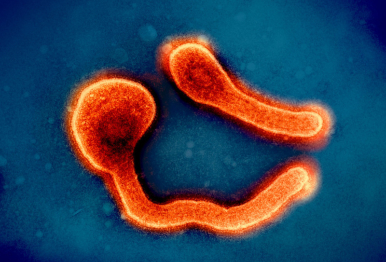
Influenza is an acute respiratory infection caused by influenza viruses belonging to the Orthomyxoviridae family. Three types of influenza virus infect humans:
Seasonal human influenza is caused by the Influenza A (H1N1) pdm09, A (H3N2) and Influenza B (Victoria/Yamagata) viruses.
According to Santé publique France, in mainland France for the 2024-2025 season, there were more than 3 million consultations in private practice, more than 29,000 hospitalisations and approximately 9,000 deaths related to seasonal influenza, concentrated over an average epidemic duration of ten weeks, with significant variations from one epidemic to another and according to age. [1,2]
The 2025-2026 winter season began in an international context marked by several reports from Asian, European and Oceanic countries indicating a disrupted epidemiology of seasonal influenza with a very early start to the epidemic (Japan, South Korea, China, England, Spain) or, conversely, a spring epidemic rebound (Australia, New Zealand). [3,4,5]
In mainland France, the seasonal influenza epidemic began this season during the first week of December, earlier than average. The use of healthcare services increased rapidly, reaching a peak of high activity in emergency departments during the last week of December. Influenza activity then decreased across all age groups, remaining at a moderate level in emergency departments until the end of January 2026, then returning to a low level in February. [6]
The 2025-2026 influenza epidemic was characterised by a moderate impact in the community but a high impact in hospitals, particularly among children under 5 and people aged 65 and over. This is the third large-scale flu epidemic in France since the COVID-19 pandemic, following the 2022-2023 and 2024-2025 seasons.
This highlights the considerable burden that seasonal influenza continues to place on the French population and the healthcare system, and the importance of maintaining and strengthening prevention campaigns, primarily those concerning vaccination and barrier measures.
Avian influenza A is an infectious disease caused by an influenza virus of type A, subtype H5N1.
The route of introduction of the avian influenza virus into cattle remains uncertain, but is potentially linked to dairy cows consuming litter contaminated with faeces from infected birds.
These sporadic human infections are accompanied by infections in new species of wild and domestic mammals that had previously been unaffected. This follows the continued circulation of the virus in wild bird colonies, leading to an unprecedented increase in the number of outbreaks in poultry farms in many countries in Africa, Asia, Europe and North America.
From 1 January 2003 to 22 January 2026, 993 human cases of avian influenza A(H5N1), including 477 deaths (case fatality rate of 48%), were reported to WHO in 25 countries. [7]
Cambodia reported its first human case of 2026 in a 30–year–old man who was hospitalised and then made a full recovery. This detection follows a series of cases in the country in 2025, totalling 18 human infections, including 9 deaths. [8]
To date, no human–to–human transmission has been identified.
More on the avian influenzaAs part of the ANRS MIE’s Émergence programme, the agency provides a monthly scientific update on avian influenza A (H5N1) and influenza A (H1N1) and A (H3N2) viruses linked to seasonal flu, in order to monitor research progress.
The scientific monitoring report, which is available for download, includes: