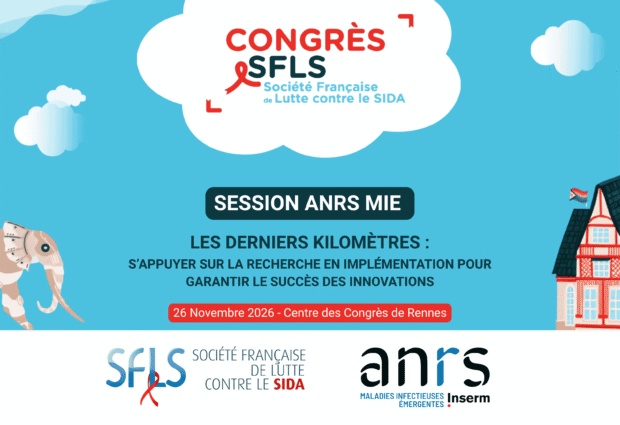
ANRS MIE at the 27th SFLS conference in Rennes (France)

‘Going for… the final kilometre’: the 27th SFLS conference will take place from 25 to 27 November 2026 at the Rennes Conference Centre. ANRS MIE will lead a session on 26 November.

From 25 to 27 November 2026

Main points

ANRS MIE will be attending the next French Society for the Fight against AIDS (SFLS) conference

  • The SFLS is organising its next conference from 25 to 27 November at the Rennes Congress Centre.
  • The conference will bring together stakeholders involved in the prevention, screening and management of HIV and associated infections.
  • ANRS MIE will lead a session on Thursday 26 November from 9.15 am to 10.30 am.

The final kilometres: using implementation research to secure the success of innovations

A session organised by ANRS MIE

How can we bring prevention, care and, more broadly, sexual health to those who remain furthest removed from existing services? The ‘last few kilometres’ are not just geographical, but also social, cultural and administrative. The SFLS conference aims to share resources, experiences and innovations to roll out screening and prevention where people are: pharmacies, charities, workplaces, festivals, etc. It also seeks to innovate in therapeutic support through streamlined pathways, teleconsultations and easier access to treatment.

It is within this framework that ANRS MIE will present the session “The final kilometres: using implementation research to ensuring the success of innovations”.

Context and challenges

The prevention of HIV and STIs rests on three pillars: testing, prevention and treatment. Recent years have seen numerous innovations:

  • Testing: a wider range of tools (blood tests, rapid diagnostic tests, self-tests) and methods (with or without a prescription, in healthcare or community settings).
  • Prevention: the introduction of pre-exposure prophylaxis (PrEP) in various forms (continuous, on-demand, and soon extended-release).
  • Treatment: a wider range of delivery methods with the introduction of long-acting antiretroviral combinations.

However, these innovations, which, when combined, could bring the HIV epidemic to an end, have not benefited the most affected populations equally. The 2030 target of eliminating new HIV infections and HIV-related deaths remains to be achieved.

Aims of this session

This session aims to present the challenges involved in implementing health innovations across different populations and to showcase research on implementation in the fields of HIV, hepatitis and STIs.

Registration for the 27th SFLS conference

Programme – Thursday 26 November – 9.15 am / 10.30 am

9.15 am – Introduction

9.20 am – Part 1 – Presentations

Presentation 1: Detection and treatment

  • Karen Champenois (IAME Inserm UMR1137, PreVIST team) – Key issues in screening research and presentation of the NotiVIH study

Presentation 2: PrEP

  • Geoffroy Liegeon (AP-HP, Université Paris Cité) – Research on PrEP: from clinical trials to implementation studies

Presentation 3: Taking action at the grassroots level amongst the most affected populations and regions

  • Niklas Luhmann (WHO Health and Human Services) – From research to public health: the Zero HIV initiative in Île-de-France

10.05 – Part 2 – Round-table discussion

  • Gabriel Girard, health sociologist (Inserm, SESSTIM)
  • Thierry Tran, administrator (AIDES, TRT-5 CHV)
  • Karen Champenois, epidemiologist (IAME Inserm UMR1137, PreVIST team)
  • Geoffroy Liegeon, infectious diseases specialist (AP-HP, Université Paris Cité)
  • Niklas Luhmann, public health doctor (ARS Ile-de-France)
Discover the full conference programme