


Last updated on 24 July 2026
PRISME Guinea is mainly structured around the Research and Training Centre in Infectious Diseases of Guinea of Gamal Abdel Nasser University of Conakry (CERFIG/UGANC).
Creation date
2022
Leads
Prof. Abdoulaye Touré (PRISME Lead), Prof. Eric Delaporte (France contact)
Physical hosting of the partnership
CERFIG/UGANC, Conakry, Guinea
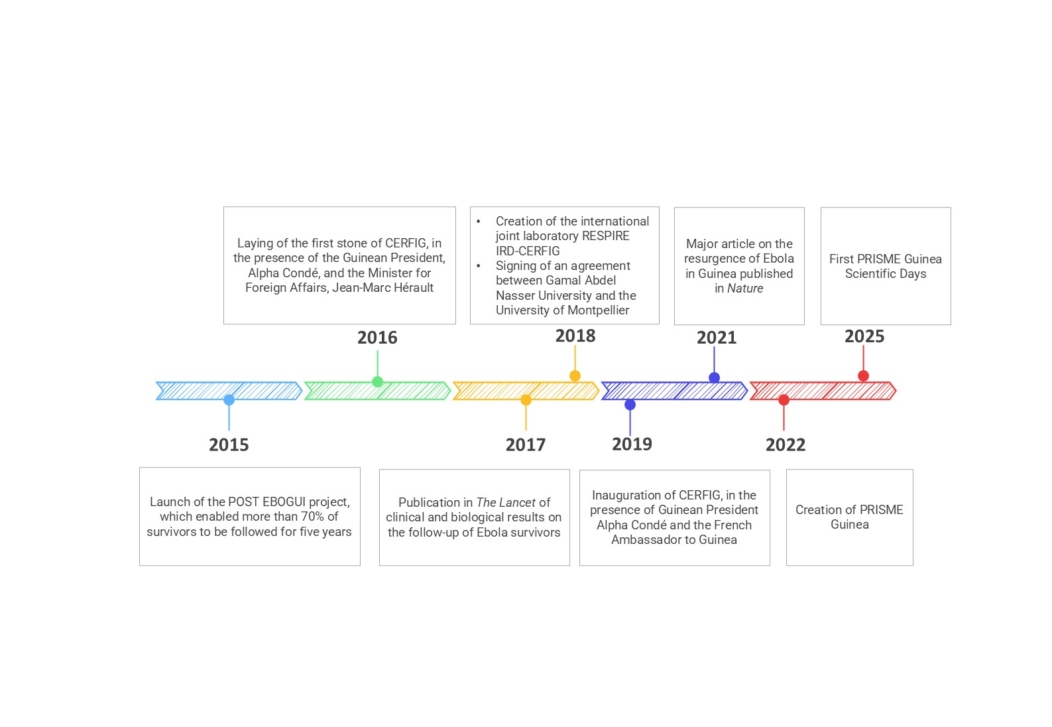
The Franco-Guinean scientific partnership was structured at the time of the Ebola epidemic from 2013 to 2016, and as part of the strengthening of research and training infrastructure in Guinea. It led to the creation of the Research and Training Centre in Infectious Diseases of Guinea (CERFIG), which brings together French and Guinean national authorities, Inserm, IRD, the University of Montpellier and Gamal Abdel Nasser University of Conakry, with the aim of improving prevention of and response to emergences. This partnership initially led to the creation of an international joint laboratory between Gamal Abdel Nasser University and CERFIG, on the one hand, and IRD and the TransVIHMI research unit in Montpellier, on the other.
In the continuity of this important collaboration and of CERFIG’s scientific and academic dynamism, the institutions involved wished, under the impetus of ANRS MIE, to structure this partnership around a new partnership model: the International Research Platforms in Global Health (PRISMEs). This platform with regional scope, focused on joint scientific facilitation, capacity building, the implementation of research projects and training actions, was made official in Guinea through the signing of a framework agreement in 2022.
The Research and Training Centre in Infectious Diseases of Guinea (CERFIG) is Guinea’s research and training centre in infectious diseases, placed under the administrative responsibility of Gamal Abdel Nasser University of Conakry (UGANC), of which it is one of the departments. Its aim is to contribute to the understanding, diagnosis, prevention and management of infectious diseases. As such, its main objectives are to design and implement clinical or interventional research projects in the field of infectious diseases.
CERFIG is also a centre committed to training. It provides certificate- and diploma-awarding training at national level, as well as an inter-university diploma in global health involving the University of Conakry and the University of Montpellier.

PRISME Guinea Lead: Prof. Abdoulaye TOURE
CERFIG, Conakry, Guinea

France contact: Prof. Eric DELAPORTE
IRD, University of Montpellier, France

Chair of the PRISME Guinea steering committee: Prof. Alpha KEITA
UGANC, Guinea
Many partners such as universities, NGOs, ministries, research institutions, healthcare facilities and community stakeholders are connected with CERFIG through PRISME Guinea. In Guinea, these include Donka University Hospital Centre (Infectious and Tropical Diseases Department) in Conakry, and the Institut Bouisson Bertrand in Montpellier, France. There are also other institutional, financial or project-based partnerships.
Research projects ongoing or initiated since 2023 by PRISME Guinea stakeholders and their collaborators focus mainly on arboviruses and viral haemorrhagic fevers (yellow fever, dengue, chikungunya, Zika, West Nile virus, Rift Valley fever, Ebola, Marburg, Lassa, Crimean-Congo fever, O’nyong nyong, Usutu). New research will be developed, or will also continue, on subjects such as respiratory diseases, healthcare-associated infections, antimicrobial resistance, causes of fever not related to malaria, H5N1 seroprevalence among livestock farmers, modelling of malaria data and ART monitoring.
The first projects funded by ANRS MIE in Guinea focused on HIV infection, in particular the dynamics of the virological and genetic variability of viruses, sustainable, rapid and affordable access to viral load tests to optimise the care of people living with HIV (PLHIV), and the assessment of diagnostic and therapeutic interventions for the prevention of mother-to-child HIV transmission. More recently, studies have been conducted on determining an adequate antituberculosis regimen in adults and adolescents hospitalised for severe immunosuppression associated with HIV (DATURA). The AIR-POP 2 study, currently being set up, aims to assess drone transport to improve the care cascade for newborns and children exposed to HIV in Guinea.
Major projects have been carried out on Ebola virus infection, mainly by CERFIG, in partnership with the TransVIHMI unit, and with support from Reacting in particular:
The IMOVA and EBO-PEP trials, currently being set up (2025), aim to assess, respectively, the impact of the time between administration of Inmazeb and vaccination with Ervebo on response and the efficacy of post exposure prophylaxis (PEP) against filoviruses.
Following the emergence of the COVID-19 (coronavirus disease 2019) epidemic, ANRS MIE also supported or promoted research on the dynamics of the epidemic in Guinea (COVEPIGUI), the prevalence and genetic diversity of coronaviruses in bats (BAT-COV), the assessment of early treatment in vulnerable people with non-severe infection (COVERAGE) and the assessment of vaccination strategies in adults (COVICOMPARE). The AFROSCREEN project is currently supported to create a genomic surveillance and research network in Africa.
As part of the response to the mpox epidemic, the multicentre Panafpox study examined the potential reservoir of mpox in Guinea. With the emergence of the first cases, the EPAMAC cohort study, which aims to study the clinical manifestations and sequelae of infection according to viral clades, began in Guinea in 2025.
CERFIG is a key partner in the PREZODE initiative in Guinea, in complementarity with ANRS MIE projects.
The Franco-Guinean partnership structured at the time of the Ebola epidemic in 2013 gave rise to CERFIG, whose position is now consolidated by PRISME Guinea at national level and among French health and research structures operating in Guinea. Today, it contributes to capacity building, the implementation of research projects and the carrying out of training actions.
Since its creation, the platform has helped cover part of CERFIG’s staff costs in order to ensure stability in human resources. It has also contributed to strengthening laboratory capacity, in particular by helping to build the laboratory annex over an area of 200 m².
PRISME Guinea, in collaboration with the Institut Pasteur de Guinée, took part in the conceptualisation of a project funded by the Solidarity Fund for Innovative Projects (FSPI) awarded by the French Embassy in Guinea in 2023. The CRESU-MIE project includes CERFIG research and training activities open to all health research structures in Guinea. These activities concern the surveillance of infectious diseases, particularly yellow fever, measles/rubella and viral haemorrhagic fevers.
PRISME Guinea has also led to the revision of the public health training curriculum and to the mobility of teachers in biology and public health for UGANC Master’s and DIU programmes. The link between CERFIG and future generations of researchers (junior assistants, public health Master’s students, microbiology-immunology Master’s students and doctoral students at the life and health sciences doctoral school) has been strengthened through research projects and the platform’s technical and financial support.
The partnership has consolidated CERFIG’s position at national level and among French health and research structures operating in Guinea.
On 18 September 2025, in connection with Gamal Abdel Nasser University of Conakry (UGANC) and the Research and Training Centre in Infectious Diseases of Guinea (CERFIG), the PRISME Guinea Lead, Professor Abdoulaye TOURÉ, and the chair of the PRISME Guinea steering committee, Professor Alpha Kabinet KEITA, published an essay entitled “Lessons from Epidemics. Engaged Reflections for a Future without Epidemics”.
In this work, the authors – both laureates of the Christophe Mérieux 2025 prize – look back on field accounts, strategic reflections and a vision of epidemic crisis management rooted in Africa. This book is available from L’Harmattan Guinée.