


Last updated on 05 January 2026
The HBV Cure working group aims to contribute actively to the identification of new therapeutic targets and antiviral molecules for a functional cure of the HBV virus.
One of the priorities is also to support basic research with translational and clinical research.

Fabien Zoulim
Inserm U1052, CHU Lyon – Lyon Cancer Research Centre
Chloé Duquesnay (Coordinatrice des instances scientifiques)
Tounès Saïdi (Cheffe de projet)
An estimated 254 million people are infected with hepatitis B virus (HBV) worldwide, with 1.2 million new cases of chronic hepatitis B (CHB) and 1.1 million deaths each year. Currently, hepatitis B requires life-long treatment, which is rarely curative.
Constant drug procurement can be a problem in resource limited settings, and patient adherence may be challenging. Finite therapeutic strategies aim to restore efficient immune responses in chronically infected patients for functional cures.
In a study funded by ANRS MIE, the Institut Pasteur, Inserm and the European Union, the authors of the article ‘Functional immune responses induced by a capsid assembly modulator in chronic Hepatitis B virus infected humanized mice’ report that an immunocompetent humanised mouse model of chronic HBV, a capsid assembly modulator* (the antiviral GLP-26) reduces viraemia and viral antigens while slowing hepatitis.
After treatment was discontinued, immune control of HBV emerged with a combination of neutralising antibodies and antigen-specific T-cell responses, leading to seroconversion and HBV functional cure.
* These molecules target and distort the HBV capsid, rendering it unable to spread. The virus assembly is disrupted, which halts HBV proliferation in infected cells.
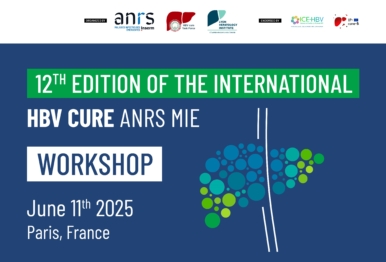
The HBV Cure International Workshop, dedicated to current translational research into curing hepatitis B virus infection, will take place on June 11, 2025 at the Institut Pasteur in Paris, France.
05 December 2024

The HBV Cure International Workshop, dedicated to current translational research into curing hepatitis B virus infection, will take place on July 3, 2024 in Lyon, France.
26 February 2024