

Last updated on 15 April 2026
In January 2025, the ANRS Emerging Infectious Diseases Unit (ANRS MIE) sought to bring together partners from its International Network, researchers involved in several of its coordinated initiatives, and representatives from civil society within a working group (WG).
Objective: to centralise discussions on the challenges of ageing among people living with HIV/AIDS (PLHIV), particularly in low- and middle-income countries (LMICs), with a view to developing a research project incorporating a multidisciplinary approach.
It should be noted that ANRS MIE has, for several years now, been supporting projects within this new thematic area, which has become a priority, such as FRAGERICARE and SEPTAVIH.
With the introduction of antiretroviral treatments and their gradual simplification, life expectancy for people living with HIV is now close to that of the general population. Nevertheless, this chronic infection is associated with premature and accelerated ageing, resulting in an increased frequency and severity of comorbidities. Whilst this phenomenon has been well studied in high–income countries, it is less well described and assessed in PRFI countries, where public health considerations play a fundamental role in the formulation of health policies.
The ‘HIV and Ageing’ Working Group aims to develop a multidisciplinary research project focused on PLHIV and tailored to the context of LDCs, which include some of the populations most affected by the disease.
The aim of the project would be to describe the clinical profile, needs and socio-health determinants of older PLHIV in PRFI, and then to evaluate the most appropriate interventions, based on evidence and compatible with the capacities of local health systems.
To this end, its members meet quarterly to:
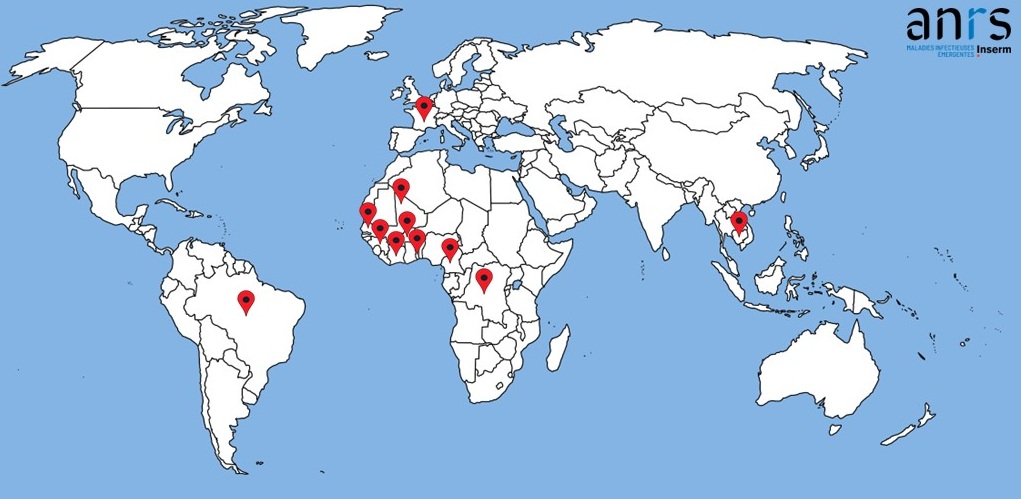
The WG stands out for the diversity of its members:
The WG also brings together members from several coordinated actions: the CA ‘Clinical research on HIV’ (CA44), the CA ‘Host-virus interactions: basic and translational research on HIV’ (CA41) and the CA ‘Public health, HIV, sexual health and hepatitis’ (CA46).
Dr Laura Ciaffi
TransVIHMI IRD / INSERM / Université de Montpellier

Pr Louise Fortes
Hôpital Dalal Jamm / Université Cheikh Anta Diop, Sénégal

Pr Mamadou Coume
Université Cheikh Anta Diop / CHNU de Fann, Dakar, Sénégal