

EU-SyndAct, which stands for “European Syndromic Adaptive Clinical Trial,” is an adaptive clinical trial platform that aims to strengthen Europe's capacity to respond effectively to future health emergencies.
Last updated on 19 December 2025
The declaration of COVID-19 (30 January 2020) and then mpox virus disease (23 July 2022) as public health emergencies of international concern by the WHO served as a reminder that emerging infectious diseases remain a major threat to public health. In the face of climate change and international trade, new health threats are likely.
These crises have also led to the emergence of new forms of clinical research, conducted “in real time” and “in the real world“, to accelerate the evaluation of treatments for emerging infectious diseases.
Hence the need for proactive approaches that ensure the rapid availability of medical countermeasures. PROACT EU-Response therefore aims to strengthen Europe’s capacity to respond effectively to future health emergencies by establishing a network of experts and civil society focused on setting up adaptive clinical trials. One part of the project will be the management of the EU-SyndAct adaptive clinical trial platform and the development of tools for preparing large-scale multi-country trials.
The objectives of the EU-SyndAct trials are:
The methodology of an adaptive umbrella-type platform trial provides a flexible, effective and harmonised framework for simultaneously evaluating several experimental treatments for hospitalisation-level respiratory tract viral infections within a single global protocol. The study design allows several interventions to be evaluated simultaneously in a clinical trial.
The platform study design is based on:
Thanks to its flexible and adaptive nature, this type of protocol makes it easy to add or remove treatment arms as knowledge advances and the scientific and epidemic context evolves.
The target population will be hospitalised adults (≥18 years of age) with severe respiratory viral infections (coronavirus, RSV, influenza, or other emerging pathogens).
The primary objective will be to evaluate the efficacy of treatments (new or repurposed molecules, alone or in combination) on the recovery of hospitalised patients, compared to standard care. Secondary objectives will also include the evaluation of safety and the risk of resistance.
Discover PROACT EU-Response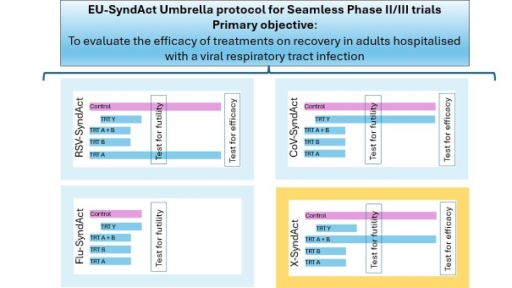
The project is currently in the development phase. The next steps will consist of finalising, in collaboration with experts in the field, the drafting of the protocols for the various sub-studies, as well as the selection of the molecules to be evaluated.
At the same time, coordination with the partners involved in the project and the selection of participating clinical centres will continue.
Once these elements have been defined, the necessary regulatory procedures can be initiated, and the project can be rolled out operationally with a view to including the first participants.
Preparing Europe to respond to future pandemics by creating a network of adaptive clinical trials
19 December 2025