Start programme : laureates of Master’s, PhD and postdoctoral grants 2026

Every year, the ANRS MIE’s Start programme enables young scientists to gain training and launch their careers.

Last updated on 17 July 2026

In brief

As part of its Start programme, its policy to support earlycareer researchers, the ANRS Emerging infectious diseases (ANRS MIE) funds Master’s scholarships and doctoral or postdoctoral grants to enable young scientists to train and embark on a career in research.

In 2026, the agency awarded its first ten research grants for PhD or postdoctoral projects on emerging infectious diseases.

In 2026, three calls for applications were launched to fund Master’s, PhD and postdoctoral research projects:

Master’s grants

The ‘Master’s grants – International Network’ call for applications, to support students or healthcare professionals from LMICs (Low- and Middle-Income Countries) in their master’s programmes.

PhD & postdoctoral grants

The ‘Research grants – Emerging Infectious Diseases’ call for applications, to enable individuals to undertake or to finish a doctoral thesis or a postdoctoral project on the topic of emerging infectious diseases (EIDs).

The generic call for proposals on HIV/AIDS, STIs, viral hepatitis and tuberculosis (editions 2026-1 and 2026-2), to enable individuals to undertake or to finish a doctoral thesis or a postdoctoral project on the topics of HIV/AIDS, STIs, viral hepatitis and tuberculosis.

Laureates of the 2026 call for applications for ‘Research grants – Emerging Infectious Diseases’

Under this call for applications, which was open to PhD thesis projects and, for the first time in 2026, to fourth-year of PhD and postdoctoral projects, 10 grants were awarded.

The emerging or reemerging nature of the disease(s) or pathogen(s) under study had to be justified, with priority given to arboviral diseases, viral haemorrhagic fevers and respiratory viral infections. All disciplines and research approaches were eligible under this call.

Finally, innovative approaches, including the modelling of epidemic dynamics, the use of artificial intelligence applied to research into emerging and re-emerging infectious diseases, and One Health research approaches, were encouraged.

PhD grants

DACAUD Jody

  • PhD thesis project: Skin mechanisms of protection by the YelLow fever VAcciNe at the site of infected-mosquIto bite in mAcaques (SYLVANIA)
  • Supervisors: BEIGNON Anne-Sophie ; POMPON Julien
  • Host organisation: Laboratoire « Immunité et Transmission » (LIT), département « Immunological diseases, microbiology and innovative therapies and Transmission » (IDMIT), Institut de biologie François Jacob, CEA, Université Paris Saclay, Inserm

DE CRUZ HIERNAUX Alejandro   

  • PhD thesis project: Understanding the contribution of complement to the neutralization of coronaviruses
  • Supervisor: BRUEL Timothée
  • Host organisation: Laboratoire « Virus et immunité », Institut Pasteur, Université Paris Cité

NDIAYE Serigne

  • PhD thesis project: Structure and Function of the Transcription Complex of Mononegavirus: Nipah Virus and Vesicular Stomatitis Virus
  • Supervisor: BLOYET Louis-Marie
  • Host organisation: Centre International de Recherche en Infectiologie (CIRI), Université Claude Bernard Lyon 1, INSERM, CNRS, ENS LYON

ROLIN Axelle

  • PhD thesis project: Unmasking NSs: decoding phenuivirus virulence mechanisms
  • Supervisors: MAISSE Carine ; LOZACH Pierre-Yves
  • Host organisation: Unité « Infections Virales et Pathologie Comparée » (IVPC), INRAE, Université Claude Bernard Lyon 1, EPHE


Fourth year of PhD grants

FILHOL Typhaine

  • PhD thesis project: Identification and characterization of cellular factors required for enterovirus D replication
  • Supervisor: BESSAUD Maël
  • Host organisation: Laboratoire « Signalisation antivirale », Institut Pasteur, CNRS

RIBEIRO Alexandre

  • PhD thesis project: Impact of vaccine-induced immunity on the evolution of H9N2 avian influenza virus
  • Supervisors: DUCATEZ Mariette ; FUSADE-BOYER Maxime
  • Host organisation: Unité « Interactions Hôtes Agents Pathogènes » (IHAP), ENVT, INRAE

URESIN Deniz

  • PhD thesis project: Innate Sensing from RNA virus infection to mRNA vaccine
  • Supervisor: KOMAROVA Anastassia
  • Host organisation: Laboratoire commun Institut Pasteur-Oncovita

Postdoctoral grants

FERY-SIMONIAN Luc

  • Postdoctoral project: Host genetics and immunity shaping host-vector interactions in TBEV infection
  • Supervisor: MANET Caroline
  • Host organisation: Laboratoire « Génétique de la Souris, Immunité et Infections », Institut Pasteur

GOMES Ighor

  • Postdoctoral project: Deep-learning Phylodynamic Models for Arboviral Transmission Dynamics
  • Supervisors: ZHUKOVA Anna ; DUCHENE GARZON Sebastian
  • Host organisation: Laboratoire « Modélisation des agents pathogènes : Évolution, adaptation et propagation », Institut Pasteur, ENS, Inserm

KINGANDA-LUSAMAKI Eddy

  • Postdoctoral project: One health Network for Ebola & HF virus Surveillance using Epidemiology, Next Generation Sequencing and Serology Exploration
  • Supervisors: PEETERS Martine ; MBALA-KINGEBENI Placide
  • Host organisation: Unité « Recherches Translationnelles sur le VIH et les Maladies Infectieuses endémiques et émergentes » (TransVIHMI), IRD, Inserm, Université de Montpellier

Know more about the Start programme

The Start programme aims to support and mentor the next generation of researchers (particularly Master’s students, PhD students and postdoctoral researchers) working on the research themes of the ANRS MIE (HIV/AIDS, viral hepatitis, tuberculosis, STIs and emerging infectious diseases).

Launched in 2024, it brings together all the funding, training and support schemes offered or coordinated by ANRS MIE, including:

  • ‘Françoise Barré-Sinoussi, Nobel Prize in Medicine’ excellence grants;
  • Master’s grants – ANRS MIE’s International Network;
  • doctoral, postdoctoral and fourth-year PhD grants – Emerging Infectious Diseases;
  • PEPR MIE junior chairs;
  • coordination of the AMYB network (for the ANRS MIE Young Basic Research Community Network) and the RJCSS HIV/AIDS network (for the Network of Young Social Science Researchers on HIV/AIDS);
  • as well as a range of thematic workshops and training courses.

Contact: start@anrs.fr

More on Start programme
Recent news from the Start programme

News

“From basic to translational research”: a young researcher supported by ANRS MIE is helping to unravel the mysteries of CCHFV

Dr Solène Denolly, whose work is supported by ANRS MIE, discusses a study combining clinical and basic research.

22 April 2026

News

Deltavirus: a young researcher supported by ANRS MIE is helping to ‘expand the horizons of what is possible’

Dr Joe McKellar, whose postdoctoral research was funded by ANRS MIE as part of the Start Programme, discusses his contribution to advancing our understanding of deltaviruses.

17 April 2026
News

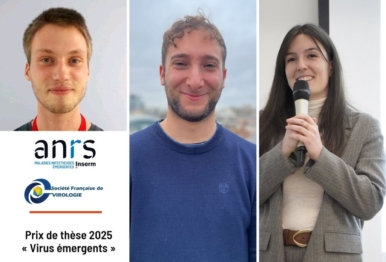
ANRS MIE / SFV “Emerging Viruses” 2025 Thesis Awards

In April 2026, the ANRS MIE and the SFV awarded three thesis prizes to Morena Gasparine, Riccardo Vernuccio and Konrad M. Wesselmann.

18 May 2026