

Every year, the ANRS MIE’s Start programme enables young scientists to gain training and launch their careers.
Last updated on 24 September 2026
As part of its Start programme, its policy to support early–career researchers, the ANRS Emerging infectious diseases (ANRS MIE) funds Master’s scholarships and doctoral or postdoctoral grants to enable young scientists to train and embark on a career in research.
In 2026, the agency awarded 38 research grants for PhD or postdoctoral projects.
In 2026, three calls for applications were launched to fund Master’s, PhD and postdoctoral research projects:
The ‘Master’s grants – International Network’ call for applications, to support students or healthcare professionals from LMICs (Low- and Middle-Income Countries) in their master’s programmes.
The ‘Research grants – Emerging Infectious Diseases’ call for applications, to enable individuals to undertake or to finish a doctoral thesis or a postdoctoral project on the topic of emerging infectious diseases (EIDs).
The generic call for proposals on HIV/AIDS, STIs, viral hepatitis and tuberculosis (editions 2026-1 and 2026-2), to enable individuals to undertake or to finish a doctoral thesis or a postdoctoral project on the topics of HIV/AIDS, STIs, viral hepatitis and tuberculosis.
Ten grants have been awarded under the 2026 call for applications ‘Research grants – Emerging Infectious Diseases’.
This scheme, which was initially open only to PhD projects, is also supporting, for the first time in 2026, projects undertaken by fourth–year PhD students and postdoctoral researchers.
The emerging or re-emerging nature of the disease(s) or pathogen(s) under study had to be justified, with priority given to arboviral diseases, viral haemorrhagic fevers and respiratory viral infections. All disciplines and research approaches were eligible under this call.
Finally, innovative approaches—including the modelling of epidemic dynamics, the use of artificial intelligence applied to research into emerging and re-emerging infectious diseases, and One Health research approaches—were encouraged.
DACAUD Jody
DE CRUZ HIERNAUX Alejandro
NDIAYE Serigne
ROLIN Axelle
FILHOL Typhaine
RIBEIRO Alexandre
URESIN Deniz
FERY-SIMONIAN Luc
GOMES Ighor
KINGANDA-LUSAMAKI Eddy
In total, 28 named research grants were awarded under the 2026-1 and 2026-2 rounds of the general call for proposals ‘HIV/AIDS, STIs, viral hepatitis, tuberculosis”: 13 PhD grants, 6 fourth-year PhD grants and 9 postdoctoral grants.
This call enables early–career researchers to undertake a PhD, a fourth year of their PhD or a postdoctoral project on the topics of HIV/AIDS, STIs, viral hepatitis and tuberculosis, including research into co-infections. This call also funds regular research projects and introductory contracts.
In particular, ANRS MIE has encouraged research that aligns with the targeted research priorities in the following areas:
Ana BOCQUET
Tibor BONHOMME
Thomas GOMES DAUBERNAY
Lisa KOKULE
Aranya MITRA
Jordi SEVILLA-FORTUNY
Simon SPILL
Clément TISSERON
Faustine BERNARDIN
Alice GALLOT
Oluwatomiloba GISANRIN
Chiza KASUNGU
Albane KNOCHE
Victor BOSCHETTI
Juliette DESFORGES
Léa MÉZIÈRE
Théo MONTAGNÉ
Ariane SESSEGO
Raymond VAN HUIZEN
Thomas BENOIST
Hanane CHAMMA
Saurabh CHUGH
Juthathip KHONGPETCH
Maria Jose LISTA BROTOS
Clark PIGNEDOLI
José Manuel SANCHEZ LOPEZ
Yousra KHERABI
Camilla TIEZZI
The Start programme aims to support and mentor the next generation of researchers (particularly Master’s students, PhD students and postdoctoral researchers) working on the research themes of the ANRS MIE (HIV/AIDS, viral hepatitis, tuberculosis, STIs and emerging infectious diseases).
Launched in 2024, it brings together all the funding, training and support schemes offered or coordinated by ANRS MIE, including:
Contact: start@anrs.fr
More on Start programme
Dr Solène Denolly, whose work is supported by ANRS MIE, discusses a study combining clinical and basic research.
22 April 2026

Dr Joe McKellar, whose postdoctoral research was funded by ANRS MIE as part of the Start Programme, discusses his contribution to advancing our understanding of deltaviruses.
17 April 2026
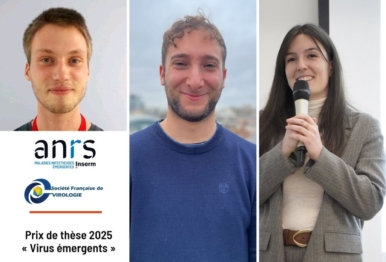
In April 2026, the ANRS MIE and the SFV awarded three thesis prizes to Morena Gasparine, Riccardo Vernuccio and Konrad M. Wesselmann.
18 May 2026