

Last updated on 16 September 2026
The “Diagnostic, therapeutic and vaccine viral targets” coordinated action of ANRS MIE aims to structure interdisciplinary and cross-disciplinary research to develop tools against emerging viruses. It focuses on the identification of viral targets to promote advances in the development of diagnostic tools, treatments and vaccines. This research will involve collaborations with players in preclinical development, clinical research and technology and product development.
In a context of epidemic preparedness and response, the translation of basic research data into the development of diagnostic, therapeutic and vaccine tools must be carried out within a timeframe compatible with the urgency of a health crisis.

Bruno CANARD
Aix Marseille University / CNRS

Delphine PLANAS
Inserm
Karine ALVAREZ
(Aix Marseille University)
Suzanne PEYROTTES
(Montpellier University)
François FERRON
(Aix Marseille University)
Allison BALLANDRAS-COLAS
(CNRS IBS Grenoble)
Sandrine BELOUZARD
(Institut Pasteur Lille / CIIL)
Olivier TERRIER
(Lyon CIRI)
Olivier SPERANDIO
(Institut Pasteur)
Gilles LABESSE
(CBS Montpellier)
Jeanne Bérard
(ANRS MIE)
Dounia Cherkaoui
(ANRS MIE)
Guia Carrara
(ANRS MIE)
Sandra Raine
(ANRS MIE)
The CA is made up of 4 scientific axes, whose members will work in a joint and complementary manner. Each scientific axis, led by a pair of co-leaders, will include a group of experts invited to take part in CA activities.
These themes are:
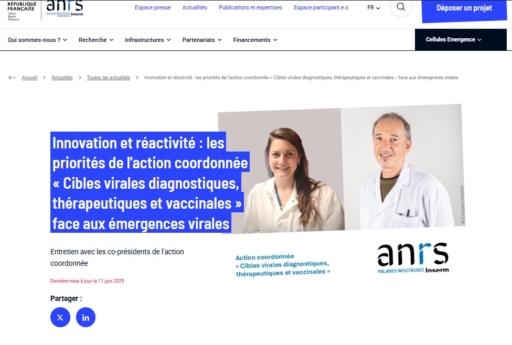
Innovation and responsiveness: discover priorities for coordinated action ‘Diagnostic, therapeutic and vaccine viral targets’ in response to viral emergencies
The ANRS MIE’s Coordinated Action on ‘Viral Targets for Diagnostics, Therapeutics and Vaccines’ is organising a workshop dedicated to preparedness for viral outbreaks, using the Nipah virus as a case study.
The aim will be to collectively reflect on how research conducted in the run-up to crises can help anticipate threats and accelerate the development of diagnostic, therapeutic and vaccine strategies.
Using the Nipah case as a starting point, discussions will focus on challenges widely shared across research into emerging viruses: characterisation of viral targets, experimental models, access to biological resources and clinical samples, specialised infrastructure, and the development of medical countermeasures and diagnostic tests. The workshop is therefore aimed more broadly at the entire scientific community working on viral outbreaks, extending beyond specialists in the Nipah virus alone.
The workshop will adopt a deliberately interactive format, differing from that of a traditional conference: short presentations will set out the key points and the current state of knowledge, and ample time will be devoted to discussions amongst experts and with the participating scientific community. The aim of these discussions will be to pool experiences, highlight the main obstacles and research needs, and collectively identify priorities and avenues for collaboration to better prepare for future viral outbreaks.
Programme:
Introduction and background (45 mins)
Current state of research in France (1h 20m)
Cross-cutting discussion: Identifying research priorities (40 mins)
Conclusion (15 mins)
Moderators: Delphine Planas (INSERM) and Bruno Canard (Aix-Marseille University/CNRS)
RegisterOn 7 July 2026, the Coordinated Action ‘Viral Targets for Diagnostics, Therapies and Vaccines’ co-organised a webinar with the Guangzhou National Laboratory (GZNL) in China. The theme was: ‘Structure, function and intervention in viral replication’.
This international webinar brought together leading experts from France and China to discuss recent advances in the structural biology of emerging viruses.
As part of this bilateral collaboration, the speakers presented their research on the structure, dynamics and molecular mechanisms involved in viral replication, as well as in host–pathogen interactions.
This event aimed to foster scientific and personal exchanges by providing a forum for dialogue and mutual discovery. It also sought to raise the profile of ongoing research in France and China, identify synergies and complementary areas of expertise, and pave the way for future collaborations.
On 15 April 2026, the Coordinated Action “Diagnostic, Therapeutic and Vaccine Viral Targets” of ANRS MIE held a webinar on AI for molecular discovery. This webinar explored how AI and computational modelling are advancing drug design and protein research. Speakers presented approaches for molecular design, prediction of protein variant effects and dynamics, and structural modelling of protein–protein interactions. The session took a critical perspective, addressing current limitations in cheminformatics and practical considerations for researchers.
Programme:
The replay is available below and on our YouTube channel.

The Coordinated Action on Diagnostic, Therapeutic and Vaccinal Targs for Viruses is organising its third thematic webinar on mosquito-borne viruses on Thursday 30 October 2025 from 12.30 pm to 2.00 pm.
The increasing circulation of mosquito-borne viruses, including those causing dengue, chikungunya, Zika and West Nile fever (among others), highlights the need for reliable, rapid diagnostic tools adapted to the varied epidemiological context we face.
The specific challenges of diagnosing arboviral diseases, notably antigenic variability and the co-circulation of multiple viruses in endemic areas, as well as the need for standardisation and access to biological samples, are of paramount importance. The detection and surveillance of these emerging infections will also be discussed during this webinar.
Programme:
To see the replay, click on the picture below.
The Coordinated Action on Viral Diagnostic, Therapeutic and Vaccine Targets is organising its second thematic webinar on the development of diagnostics for emerging viral diseases on Tuesday 21 October 2025 from 12.30 pm to 2.00 pm.
Against a backdrop of increasing viral epidemics worldwide – from dengue to Ebola, including COVID-19 and, more recently, the chikungunya virus – the rapid, reliable and accessible detection of pathogens has become a priority public health issue. However, the development of diagnostic tests for these emerging diseases remains fraught with obstacles.
This webinar offers an in-depth look at the scientific, logistical and technological challenges posed by the development of diagnostics during health emergencies and in periods of calm. We will address, in particular, the difficulties in accessing clinical samples as soon as the first cases appear and the need to develop specific antibodies.
In response to these challenges, advances in research and technological innovation have led to the development of innovative diagnostic solutions, such as non-invasive tests based on the analysis of exhaled air. These approaches facilitate both the screening and surveillance of emerging respiratory viruses, whose epidemic potential justifies rapid detection and enhanced monitoring.
Programme:
To see the replay, click on the picture below.
Influenza viruses pose a major challenge to global public health due to recurring seasonal outbreaks and the constant risk of new strains emerging. In early 2025, the flu outbreak reached an unprecedented intensity, leading to a particularly high level of hospital activity. Furthermore, the spread of the H5N1 virus among birds and its transmission to other species, including humans, is causing concern and requires increased vigilance. Despite decades of research, the genetic evolution of the influenza virus continues to pose a challenge for scientists and healthcare professionals, highlighting the importance of ongoing research.
Against this backdrop, this webinar brought together experts to discuss the many challenges associated with influenza viruses.
Programme:
To see the replay, click on the picture below.
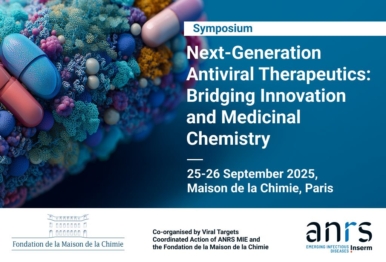
Next-Generation Antiviral Therapeutics: Bridging Innovation and Medicinal Chemistry
28 May 2025