Last updated on 05 August 2026
The Cameroon Partner Site is primarily structured around the Coordination and Research Centre located within Yaoundé Central Hospital, Cameroon.
Creation date
2005
Leads
Prof. Anne-Cécile Zoung Kanyi Bissek (Cameroon Coordinator) and Prof. Eric Delaporte (France Coordinator)
Physical hosting of the partnership
Coordination and Research Centre within Yaoundé Central Hospital and CREMER, Yaoundé, Cameroon
International technical expert
Dr Marie Varloteaux
The Cameroon Partner Site was historically established around a major collaboration in the fight against HIV/AIDS, under the impetus of Professor Eric Delaporte (TransVIHMI unit at IRD/Inserm/University of Montpellier) and Dr Eitel Mpoudi Ngole (laboratory of the Institute of Medical Research and Medicinal Plants Studies (CREMER/IMPM)). It was developed through research projects supported by ANRS, the first of which, PRESICA, received funding in 1994.
Collaborations between Cameroonian and French teams took concrete form in 1999 with the creation of the Cameroonian Coordination and Research Centre, established and equipped with support from ANRS within the grounds of Yaoundé Central Hospital.
The partnership was formalised in 2005 through a tripartite agreement with the Cameroonian Ministry of Health and Ministry of Research and Innovation. This memorandum of understanding was renewed in December 2021, with the French Embassy in Cameroon joining the agreement, in order to reaffirm the importance of international collaborations in the fight against infectious diseases, include emerging and re-emerging infectious diseases within the partner site’s research areas, and continue to steer scientific policy in line with Cameroon’s public health priorities.
The Coordination and Research Centre based within Yaoundé Central Hospital is a Cameroonian research centre whose objective is to address the country’s public health challenges. Its areas of expertise expanded following health crises and include HIV/AIDS infection, hepatitis, tuberculosis, sexually transmitted infections (STIs) and, since the SARS-CoV-2 pandemic, emerging infectious diseases. All these topics are addressed using the One Health approach.
Its missions are to support Cameroonian national programmes through the implementation of research projects and the training of students and young researchers, mainly in global health, research ethics and the application of good clinical practice. The centre hosts and facilitates exchanges between students, researchers, teaching staff, healthcare professionals and associations of people living with HIV (PLHIV).
The Coordination and Research Centre works closely with the Centre for Research on Emerging and Re-emerging Diseases (CREMER), which focuses its research on emerging and re-emerging diseases, particularly viral infections. CREMER conducts studies on the origin and emergence of new viruses, analyses viral genetic diversity and its implications for diagnosis, assesses the effectiveness of antiviral treatments and associated resistance, and quantifies viral loads. It is organised into three laboratories dedicated to emerging and re-emerging viral diseases, environmental and animal health, and emerging and re-emerging non-viral diseases.
Cameroon Coordinator: Prof. Anne-Cécile ZOUNG KANYI BISSEK
Coordination and Research Centre/Yaoundé Central Hospital, Cameroon

France Coordinator: Prof. Eric DELAPORTE
IRD, Montpellier, France
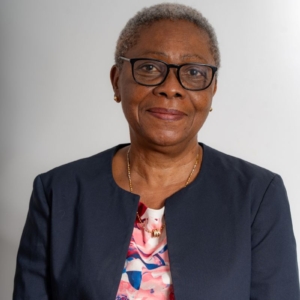
Honorary Coordinator: Prof. Sinata KOULLA SHIRO
Centre Pasteur du Cameroun, Cameroon

Scientific Coordinator: Dr Mireille MPOUDI ETAME
Ministry of Defence, Yaoundé, Cameroon

International technical expert: Dr Marie VARLOTEAUX
Coordination and Research Centre/Yaoundé Central Hospital, Cameroon
The partner site was previously coordinated by Professor Sinata KOULLA SHIRO (Cameroon Coordinator) and Dr Eithel MPOUDI NGOLE (Deputy Cameroon Coordinator). An international technical expert is assigned to the coordination of the Cameroon partner site and is currently based at the Coordination and Research Centre within Yaoundé Central Hospital, Cameroon.
Many partners, including universities, NGOs, ministries, research institutions, healthcare facilities and community stakeholders, are connected with the Coordination and Research Centre based at Yaoundé Central Hospital and CREMER through the partner site. There are also other institutional, financial and project-based partnerships.
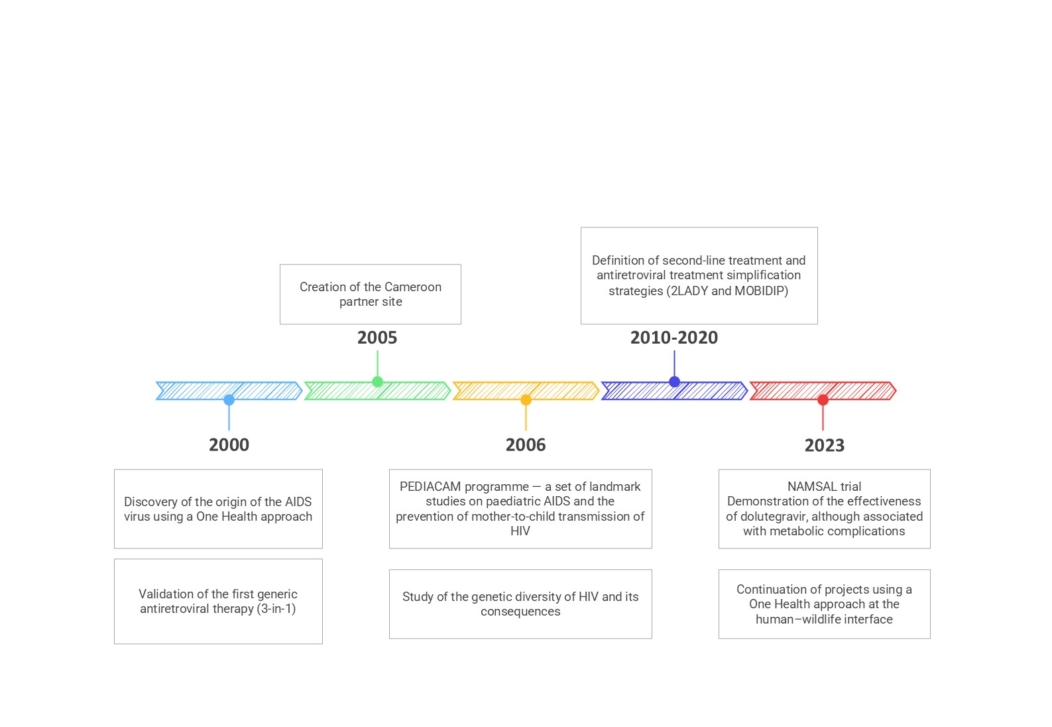
Since the launch in 1994 of the PRESICA project, supported by ANRS MIE and aimed at deepening knowledge of HIV-1 in Africa, Franco-Cameroonian research teams have carried out numerous major studies on infectious diseases, particularly HIV. Among these, the PEDIACAM cohort demonstrated the impact of early combination antiretroviral therapy (ART) in infants with HIV and continues to provide crucial clinical and social data for improving paediatric protocols. The NAMSAL project demonstrated that dolutegravir was an effective and well-tolerated alternative for first-line treatment in resource-limited countries.
Other clinical trials have assessed new therapeutic strategies for adults, including new combinations and treatment simplification, particularly through the 2LADY and MOBIDIP trials. Opportunistic infections were also studied as part of the ACTA trial, which validated new treatment regimens for cryptococcal meningitis. The DREAMM project enabled the development of an optimised protocol for managing central nervous system infections in patients with HIV.
In addition, extensive research has been conducted on HIV, contributing to a better understanding of its origin and genetic diversity — transmission from primates to humans and evolution through resistance mechanisms.
Considerable efforts have been under way for several years in the field of tuberculosis. The DATURA trial assesses the impact of intensified tuberculosis treatment on mortality among immunocompromised patients living with HIV. The TB SPEED project aims to decentralise and improve the diagnosis of paediatric tuberculosis, while INTEGRES-TB focuses on integrating tuberculosis screening into malaria prevention campaigns.
Research projects on hepatitis virus infection have focused on identifying the prevalence and assessing the treatment of hepatitis C. ANRS MIE currently supports three clinical programmes: ACCESS+, which seeks to compare a simplified screening and treatment strategy with the standard strategy used in Cameroon; TOPCHIB, which is studying in Tokombéré the effectiveness of tenofovir disoproxil in preventing mother-to-child transmission of the hepatitis B virus (HBV) among pregnant women infected with HBV and with a high viral load, in combination with the birth-dose vaccine; and the HIPOCAMP project, which compares two strategies for preventing mother-to-child transmission of hepatitis B.
Franco-Cameroonian research teams have also been strongly involved in the surveillance of and response to emerging diseases in recent years. The AFROSCREEN platform strengthens sequencing and surveillance capacity for SARS-CoV-2 variants and other emerging infections in Africa. Through PANAFPOX, the teams are studying mpox transmission at the human–wildlife interface. The ZOOSURSY/PREZODE project strengthens zoonosis surveillance and prevention using a One Health approach.
Research conducted to date illustrates Cameroon’s continued commitment, in collaboration with international partners and with support from the ANRS MIE Partner Site, to strengthening local clinical research capacity and improving the surveillance, prevention and treatment of infectious diseases.
Working closely with the authorities and with support from the partner site, the research teams at the Coordination and Research Centre within Yaoundé Central Hospital frequently respond to requests from national authorities in order to contribute to the activities of national programmes.
In recent years, the Coordination Centre has intensified its training efforts by offering numerous sessions covering a range of topics: research ethics, good clinical practice, the One Health approach and scientific writing for various audiences, including students, civil society and research teams. It has also established partnerships with the Faculties of Medicine and Biomedical Sciences in Garoua and Sangmélima to strengthen teaching staff’s expertise in human health research.
With support from the French Embassy in Cameroon, the partner site has supported young researchers through study grants, developed specific training courses — MOOCs — and created a digital and physical platform for scientific publications.
Partner-site stakeholders are also called upon to contribute to the implementation of major scientific events, such as the international AFRAVIH conference hosted in Yaoundé in 2024 and the Scientific Excellence Days of the Cameroonian Ministry of Research and Innovation in 2023.
Under the impetus of the partner site, the Coordination and Research Centre has worked with civil society organisations for many years. In 2023, several workshops providing assistance with writing scientific abstracts were held to support participation in the AFRAVIH conference organised in 2024.
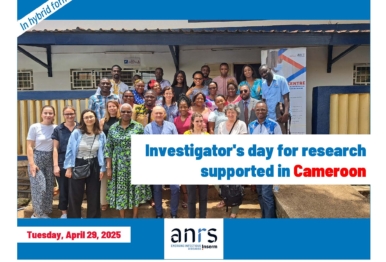
The investigators’ day for research supported in Cameroon by ANRS MIE took place on Tuesday, April 29, 2025, in a hybrid format
28 April 2025
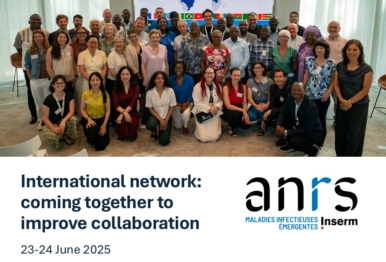
On 23 and 24 June 2025, the main representatives of the ANRS Emerging infectious diseases International Network met in Paris for two days of meetings, sharing and work.
03 July 2025