

Last updated on 24 July 2026
PRISME Côte d’Ivoire is mainly structured around the international Methodology and Management Centre MEREVA, which brings together the PAC-CI research centre in Abidjan, Côte d’Ivoire, and the GHIGS team from the U1219 Bordeaux Population Health Centre in France.
MSHP: Ivorian Ministry of Health, Public Hygiene and Universal Health Coverage; MESRS: Ivorian Ministry of Higher Education and Scientific Research; MFB: Ivorian Ministry of Finance and Budget
Find out more about the International NetworkCreation date
1996
Leads
Dr Raoul Moh (PRISME CI Lead), Dr Renaud Becquet (France contact)
Physical hosting of the partnership
PAC-CI, Abidjan, Côte d’Ivoire, and the GHIGS team from the U1219 Bordeaux Population Health Centre, France
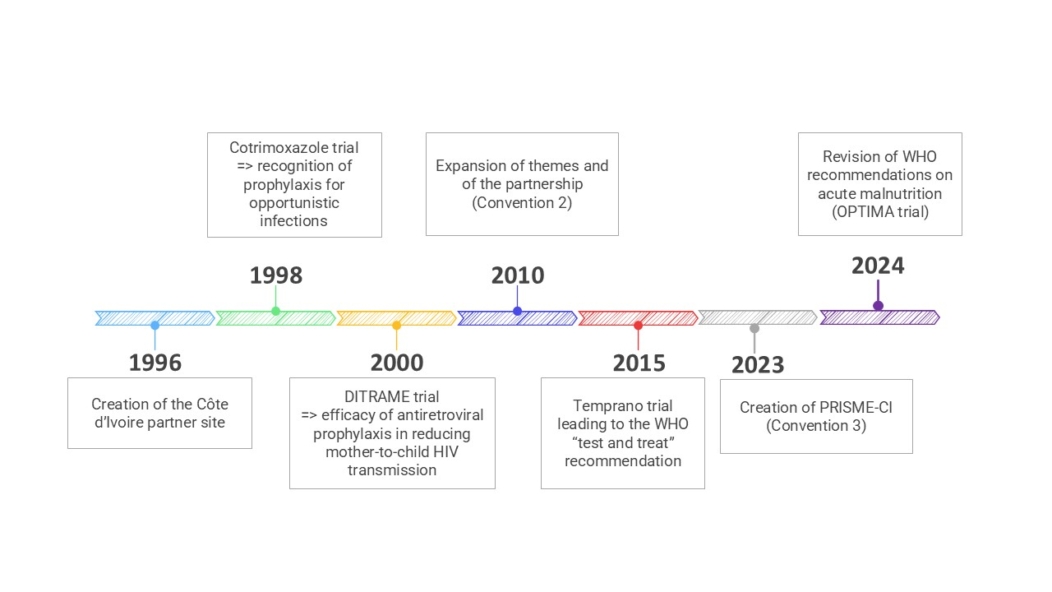
In 1996, the Government of the Republic of Côte d’Ivoire (represented by the MSHP and the MEF), the French Embassy in Côte d’Ivoire and the ANRS agreed, through the signing of a framework agreement, on a collaboration in scientific research in the field of HIV/AIDS. This marked the creation of the ANRS partner site in Côte d’Ivoire. This agreement defined the framework for a scientific programme named “Programme PAC-CI”, hosted by the PAC-CI association from 2009.
In 2010, the framework agreement was renewed to broaden the scope of research to all infectious diseases and to involve three additional partners: the Ivorian Ministry of Higher Education and Research (MESRS), the University of Bordeaux and Inserm. The same year saw the creation of the MEREVA Methodology and Management Centre, a Franco-Ivorian project management platform now coordinated by the PAC-CI association and the GHiGS team at the Population Health Research Centre (under the supervision of Inserm/IRD/University of Bordeaux).
In 2023, ANRS MIE, Inserm, the University of Bordeaux, IRD, the MSHP, the MESRS, the MEF, the PAC-CI association and the French Embassy in Côte d’Ivoire wished to strengthen their partnership by signing an agreement aimed at setting up an International Research Platform in Global Health (PRISME). This new partnership modality is embedded at the heart of global health issues in order to pursue the efforts already undertaken around major pandemics and develop preparedness and response strategies adapted to the emergence and re-emergence of epidemics.
The PAC-CI association, based at Treichville University Hospital Centre in Abidjan, is a research centre with NGO status. Its missions are to conduct research activities on HIV/AIDS and infectious diseases whose results would be useful to affected populations, and to promote the training of researchers from low- and middle-income countries (LMICs) in medical research. PAC-CI is part of a multidisciplinary approach, mobilising clinical sciences, epidemiology, public health, biology, demography, sociology, anthropology, applied economics and statistical modelling.
The GHiGS team (Global Health in the Global South) is a research unit under the supervision of Inserm, IRD and the University of Bordeaux, based at the Bordeaux Population Health Research Centre. The objectives of the GHiGS team are to produce data on diseases affecting the Global South, their epidemiology, risk factors and consequences, with the aim of using these results to design and assess innovative, effective, equitable and sustainable interventions for individuals and populations, and to contribute to progress in global health.
The PAC-CI association and the GHiGS team jointly coordinate the MEREVA Methodology and Management Centre (MMC), a Franco-Ivorian project management platform. This platform is able to host and train researchers in infectious diseases and to develop the set-up, coordination and follow-up of international research projects, supported by a specific Franco-Ivorian engineering system. MEREVA plays a central role in the implementation of the very large majority of studies carried out by Franco-Ivorian research teams in LMICs.

PRISME Côte d’Ivoire Lead: Dr Raoul MOH
PAC-CI, Abidjan, Côte d’Ivoire

France contact: Dr Renaud BECQUET
GHIGS team – U1219 Bordeaux Population Health Centre, Bordeaux, France

Chair of the strategic steering committee: Prof. Thérèse N’DRI-YOMAN
PAC-CI, Abidjan, Côte d’Ivoire
Before the creation of PRISME Côte d’Ivoire, the Côte d’Ivoire partner site was previously coordinated by: Dr Xavier ANGLARET (France coordinator), Prof. Thérèse N’DRI YOMAN (Côte d’Ivoire coordinator).
Many partners such as universities, NGOs, ministries, research institutions, healthcare facilities and community stakeholders are connected with the PAC-CI association and the GHiGS team through PRISME Côte d’Ivoire. There are also other institutional, financial or project-based partnerships.
The first research conducted as part of the Franco-Ivorian collaboration initially focused on HIV infection, then was gradually extended to viral hepatitis, tuberculosis, infectious diseases with threatening epidemic potential and maternal and child health, in an increasingly “global health”-oriented approach. The field of research was initially clinical, epidemiological and biological, before also opening up to health economics, socio-anthropology and statistical modelling.
Among the flagship research conducted around HIV, one may cite the pioneering Cotrimo-CI trial conducted in 1999, which demonstrated the efficacy of cotrimoxazole prophylaxis in preventing early opportunistic infections in people living with HIV. In the 2010s, the TEMPRANO trial demonstrated that early administration of antiretroviral therapy (ART) improves health outcomes. This trial influenced global recommendations for HIV management.
Numerous studies have examined strategies for preventing mother-to-child transmission of HIV, including the Ditrame trial, which demonstrated the efficacy of antiretroviral prophylaxis in reducing mother-to-child transmission of HIV during pregnancy and breastfeeding. Today, research on HIV is moving towards at-risk populations, new treatment strategies, malignancies such as cervical cancer and support for prevention programmes.
Research conducted on tuberculosis and viral hepatitis has made it possible to better understand HIV/tuberculosis co-infection and to identify strategies for the management of viral hepatitis B and C in West Africa. Research on tuberculosis is now being extended to the whole population, with particular interest in tuberculous meningitis and improving diagnosis in children. As for research on viral hepatitis, it is continuing around the improvement of treatments, diagnosis and prevention in vulnerable populations.
To contribute to efforts to combat the Ebola epidemic in 2014-2015, research teams mobilised through the JIKI clinical trial, conducted in Guinea, which made it possible to test potential treatments. In order to improve responses to viral epidemics in the region, research is continuing, beyond Ebola, on the transmission and management of other haemorrhagic fevers.
Research projects on maternal and child health have focused mainly on improving the care of pregnant women and young children, particularly in epidemic contexts. These projects include studies on vaccines, nutrition and infection prevention.
In 2023, the results of the OptiMA-RDC trial (one on management, the other on dosage optimisation) thus enabled the revision of WHO international recommendations on the management of acute malnutrition.
The main priority research areas identified (non-exhaustive and subject to change) are as follows:
Thanks to the support of the stakeholders of the Côte d’Ivoire partner site since 1996, and then of PRISME Côte d’Ivoire since 2023, the PAC-CI association, in close collaboration with the GHiGS team, has become a major player in the field of health research, with research projects on the HIV/AIDS epidemic, viral hepatitis, maternal and child health, tuberculosis and, more recently, infectious diseases with endemic potential, in LMICs.
Through the MEREVA MMC, supported by PRISME Côte d’Ivoire, the PAC-CI association and the GHIGS team offer a scientific engineering system that makes it possible to ensure the autonomous management of large-scale studies. In addition, for many years this system has contributed to training researchers from LMICs, particularly in research methodology, thereby improving local skills to respond to countries’ public health challenges.
The research conducted by Franco-Ivorian teams, benefiting in particular from the technical, human and financial support of PRISME Côte d’Ivoire, has played a central role in the management of infectious diseases in Côte d’Ivoire and in the region, contributing to the development of public health policies and international recommendations. For nearly 30 years, the stakeholders of PRISME Côte d’Ivoire have contributed to WHO recommendations for patient management, thereby improving their quality of life.
For almost 20 years, PAC-CI and GHiGS, together with the stakeholders of PRISME, have developed a vast network of partners, enabling the implementation each year of more than 30 studies conducted in more than 30 countries in Africa, Asia, Latin America and Europe.
With the support of PRISME, PAC-CI and GHiGS continue to adapt to new health challenges in West Africa and beyond, particularly in the face of the emergence of new epidemics and in the fight against chronic diseases.