


Congress of the ESCMID 2026 took place from April 17 to 21, 2026, in Munich, Germany.
From 17 to 21 April 2026
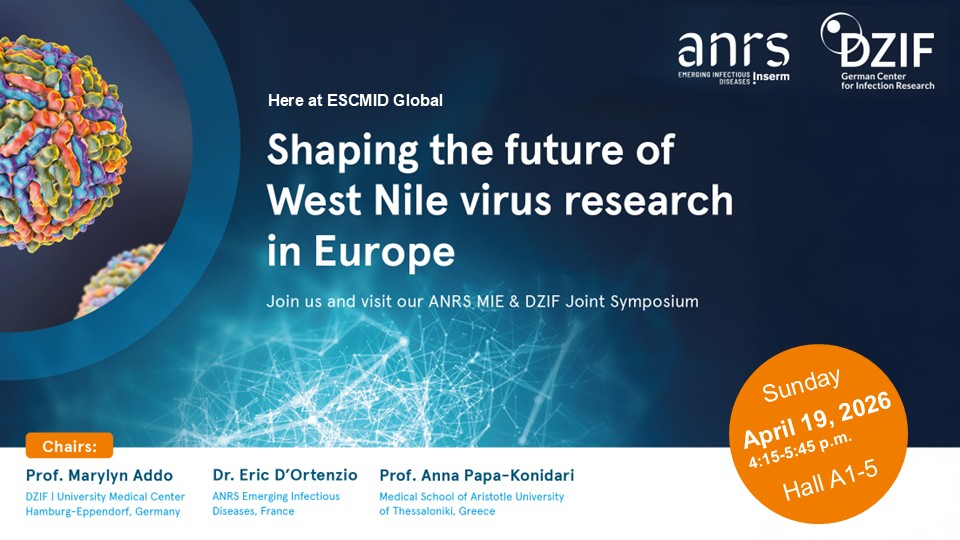
An ANRS MIE session, co-organised with the German Center for Infection Research (DZIF), will be held on the theme “Shaping the future of West Nile virus research in Europe.”
This session will focus on defining the future research priorities for West Nile Virus (WNV) in Europe, emphasising the need for stronger European scientific collaboration. By convening experts from virology, entomology, ecology and climate research, clinical research, and public health, the session will explore how coordinated and complementary research efforts can accelerate our understanding of WNV dynamics and improve epidemic preparedness specifically in the European context.


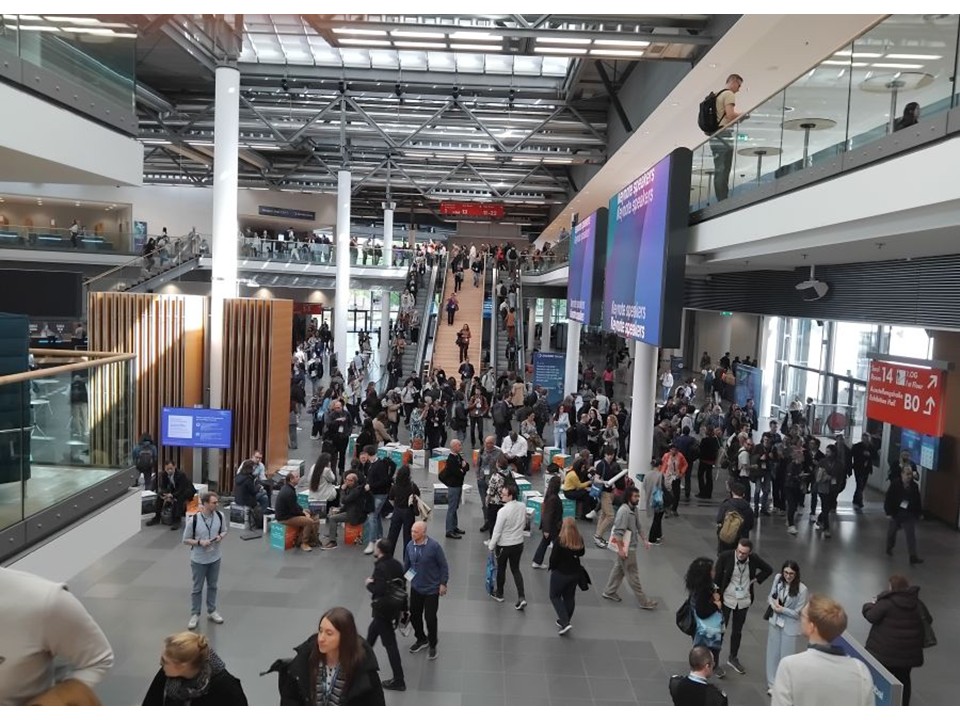
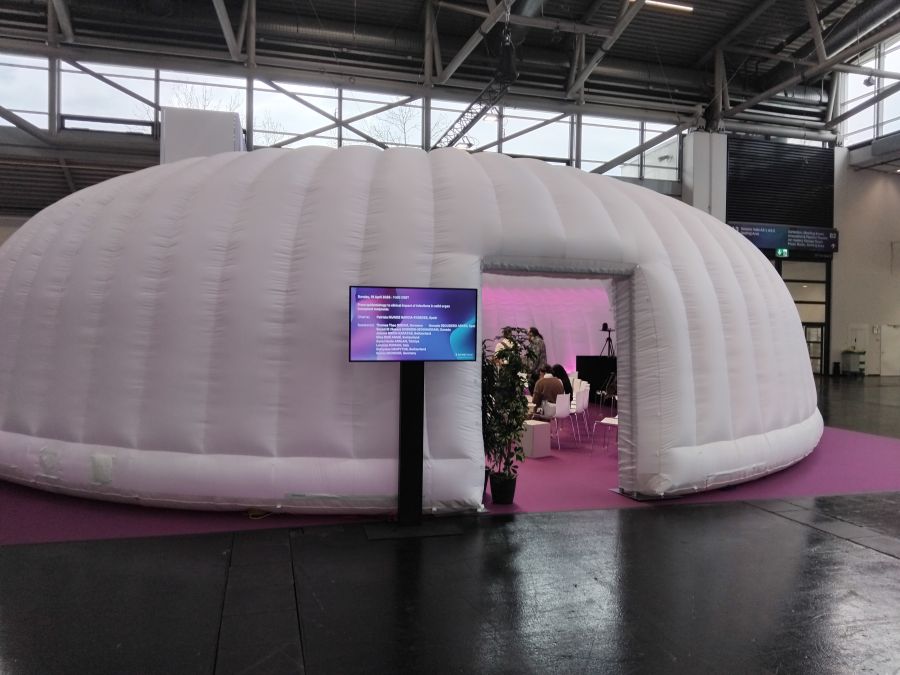
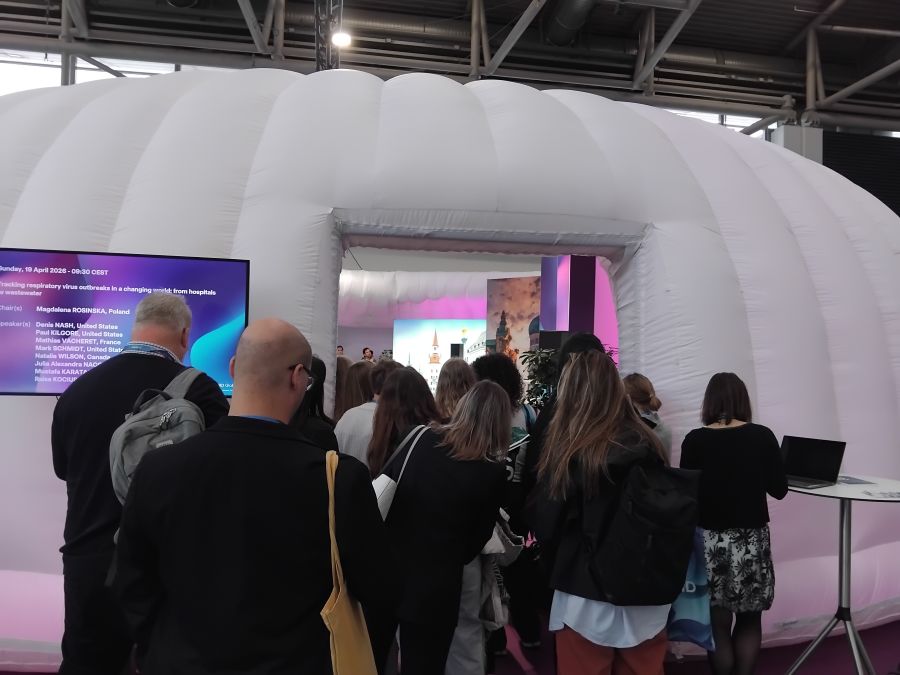
Leading experts in infectious diseases and clinical microbiology are gathering at ESCMID Global to exchange ideas and explore the latest innovations. It is also an opportunity to learn more about the research work funded by ANRS MIE.
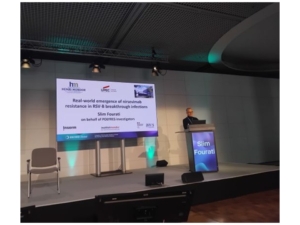 Professor Slim Fourati (CHU Henri Mondor, Créteil, France) presented the results of the POLYRES study conducted in France among infants under one year of age during the 2024–2025 season. In contrast to the 2023–2024 season, the 2024-2025 season was dominated by the circulation of RSV-B. He emphasises that this was a unique opportunity to study breakthrough infections and resistance to nirsévimab at a large scale.
This observational study showed that RSV-B resistance to nirsevimab can emerge in real-world settings, affecting around 12% of breakthrough infections and showing greater diversity than previously recognised.
The prevalence of VRS-B during the 2024–2025 season provided a unique opportunity to study, on a large scale, the emergence of resistance mutations to nirsevimab in newborns and infants.
Among 1,023 RSV-infected infants, 858 (83.9%) had full-length RSV genome sequences: 419 (48.8%) from nirsevimab-treated breakthrough infections (212 [50.6%] RSV-A, 207 [49.4%] RSV-B) and 439 (51.2%) from non-immunised infants (192 [43.7%] RSV-A, 247 [56.3%] RSV-B).
Resistance-associated substitutions were identified in 2 of 195 RSV-A breakthrough infections (1.0%) and in 23 of 184 RSV-B breakthrough infections (12.5%). In RSV-A, the only RAS was F:K209E, conferring intermediate resistance. In RSV-B, resistance was more frequent and diverse: 12 of 23 (52%) resistant viruses carried a substitution at residue 208 (F:N208D, F:N208I, F:N208K, F:N208S, or F:N208Y). Additional novel substitutions, including F:I64V/F:K65E, F:K68I, F:L204S, and F:P205S, also mediated resistance. No resistant RSV was detected in non-immunised infants.
Notably, Slim Fourati also pointed out taht a resistant RSV-B variant (F:N208S) was detected almost one year after prophylaxis, which highlights the need for extended genomic surveillance.
The POLYRES Study has been supported by ANRS MIE.
|
Amandine Caillault |
Emergence and persistence of RSV-B resistant variants under monoclonal antibody Pressure: Evidence in a 3D human airway model |
|
Slim Fourati |
Real-world emergence of nirsevimab resistance in RSV-B breakthrough infections |
|
Cloé Grosbois |
How nasal host-based markers can improve the Diagnosis of Respiratory Viral Infections even in immunosenescent subjects? |
|
Eddy Kinganda Lusamaki |
Sustained mpox clade I human-to-human spread in DRC calls for continuous variant monitoring |
|
Raphaël Mérilleau Dusart |
Optimisation and multimodal characterisation of an in vitro Mycobacterium tuberculosis granuloma model |
|
William Mouton |
Critical COVID-19 unveils the link between viral particle blood dissemination and prolonged Type I Interferon |
|
Tom Perisse |
History of vaccination and infection shapes the humoral response to SARS-CoV-2 through IgG4 class switching |
|
Laurent Softic |
Commercial serological assays as reliable surrogates for neutralisation in monitoring RSV vaccine responses in immunocompromised patients |
5-Year Immunogenicity of 3 Ebola Vaccine Strategies in West Africa par Abdoul Beavogui, et al. And the PREVAC study team.
Pathogens and people: modelling epidemics for preparedness
This presentation will focus on non-traditional data in modelling for pandemic preparedness and response.