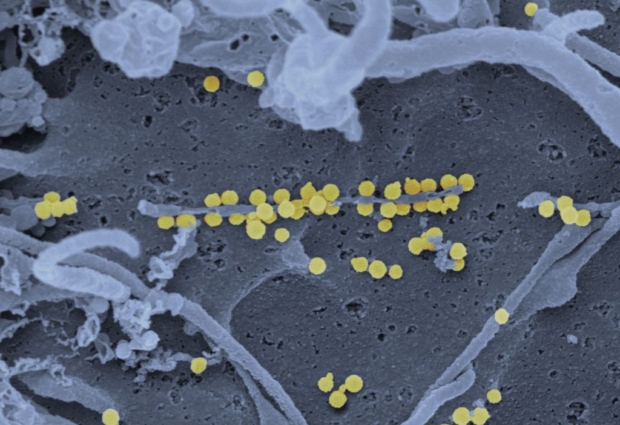
Dr Solène Denolly, whose work is supported by ANRS MIE, discusses a study combining clinical and basic research.
Last updated on 15 April 2026
 In a study published in the journal Emerging Microbes & Infections on 30 March 2026, researchers supported by ANRS MIE investigated the mechanisms by which the virus responsible for Crimean-Congo haemorrhagic fever (CCHFV) spreads. In 2024, in a previous study published in Nature Communications, Solène Denolly, François-Loïc Cosset, and their colleagues succeeded in identifying a lipoprotein receptor, linked to lipid transport and hijacked by CCHFV to transmit its own viral particles.
Here, as part of her Junior Chair “VISTA – Exploiting host factors associated with virus-induced structures to design antiviral strategies against Orthonairoviruses”, funded by ANRS MIE under the Priority Research Programme and Equipment for Emerging Infectious Diseases (PEPR MIE), Solène Denolly, an Inserm research fellow at the Lyon Cancer Research Centre (Inserm / CNRS / University of Lyon 1 / Léon Berard Centre), wanted to explore this discovery further. “We were able to demonstrate that CCHFV particles are associated with lipoprotein components. Building on this discovery, I wanted to validate how inhibitors of the formation of these lipoproteins, known to reduce the risk of obesity or cardiovascular disease, might halt the spread of CCHFV,” explains the young researcher.
In collaboration with, in particular, Dr François-Loïc Cosset, director of the Laboratory of Hepatotropic and Emerging Agents (CIRI, Lyon), whose work is also funded by ANRS MIE through the “Émergences PRFI” call for projects, and the Jean Mérieux Inserm P4 laboratory, Solène Denolly and her colleagues examined the antiviral effect of a dozen of these molecules already developed in clinical research. “We wanted to streamline the screening process in order to gain insights that could directly inform downstream research: moving directly from basic research to translational research. ” Result: a handful of molecules demonstrated a powerful antiviral effect. However, some of these molecules form the basis of drugs used to treat lipid disorders such as hypercholesterolaemia. This provides avenues for research into a first specific treatment against CCHFV.
The VISTA Chair led by Dr Solène Denolly is one of the five recent winners of the call for applications for the PEPR MIE ‘Junior Chair’. This funding scheme, launched for the first time in 2025, forms part of the support for young researchers under the ANRS MIE’s Start Programme. “My PhD on viral hepatitis was funded by an ANRS MIE grant, so you could say I’m a true product of the ANRS MIE!” jokes the young researcher. “More seriously, having a named grant is far more rewarding than standard funding: it validates the recognition of our profile by peers and gives us personal visibility. What’s more, when this support comes from a leading agency recognised at European and global level. ”
Solène Denolly’s case illustrates the benefit to the scientific community of specifically funding the early careers of young researchers without necessarily making them dependent on more experienced colleagues. Furthermore, thanks to the funding for her first chair, Solène Denolly intends to build a team: “recruit two or three other people to give the project more substance and, subsequently, obtain team accreditation.”
The Start Programme aims to support and mentor the next generation of researchers (particularly Master’s students, PhD students and postdoctoral researchers) working on the ANRS MIE’s research themes (HIV/AIDS, viral hepatitis, tuberculosis, STIs, emerging infectious diseases).
Launched in 2024, it brings together all the following funding, training and support schemes offered or coordinated by ANRS MIE:
Contact : start@anrs.fr
Know more about the Start Programme