

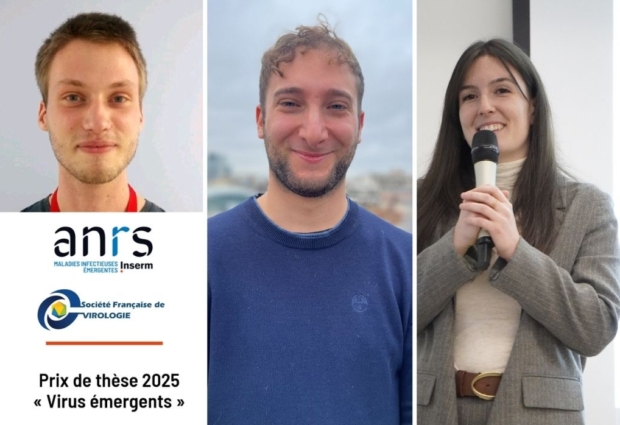
In April 2026, the ANRS MIE and the SFV awarded three thesis prizes to Morena Gasparine, Riccardo Vernuccio and Konrad M. Wesselmann.
Last updated on 18 May 2026
In April 2026, as they do every year, the ANRS Emerging Infectious Diseases (ANRS MIE) and the French Society of Virology (SFV) awarded prizes to PhD theses on ‘Emerging Viruses’ completed in 2025.
The 2025 winners are Morena Gasparine (on the Crimean-Congo haemorrhagic fever virus), Riccardo Vernuccio (on Poxviridae) and Konrad M. Wesselmann (on neglected arboviruses).
Every year, the ANRS MIE and the SFV join forces to award thesis prizes to young scientists whose research has made a significant contribution to the field through its high quality, originality and innovative nature. This partnership is included in the agency’s Start Programme, which supports the development of early–career researchers.
In April 2026, during the Francophone Virology Days in Toulouse, the ANRS MIE and the SFV awarded the ‘Emerging Viruses’ prize to three young researchers who had completed a thesis in 2025:
They each received a prize of 1,000 euros.
Moréna Gasparine: I completed a Bachelor’s degree in Agronomy at the University of Bordeaux, Périgueux campus (2016–2018), before going on to a Bachelor’s degree in Ecology and Biology of Organisms at the University of Poitiers (2018–2019). I then enrolled on the Master’s in Biology, Ecology and Evolution (BEE), specialising in the Emergence of Parasitic and Infectious Diseases (EPI), at the University of Montpellier (2019–2021).
I discovered the world of research during my second-year Master’s placement at the IHU in Marseille, supervised by Sébastien Briolant and Albin Fontaine. This work focused on the effect of co-infection by an insect-specific flavivirus (AEFV) and the Zika virus (ZIKV) in the tiger mosquito (Aedes albopictus). This experience was pivotal and inspired me to pursue a career in research.
Riccardo Vernuccio: I began with a bachelor’s degree in pharmaceutical biotechnology at the University of Milan. Then, drawn to biochemistry, I went on to do a Master’s in Biochemistry and Structural Biology at Ghent University, where I discovered structural biology. This led me to undertake a PhD in structural biology at the Pasteur Institute, in Dr Pablo Guardado-Calvo’s laboratory.
I’ve always been interested in the scientific side of things: so it was quite natural for me to head towards a scientific course of study. As I learnt more and discovered the world of research, I became convinced that I should continue with a PhD, followed by a postdoc.
MG: My PhD research focuses on identifying the ecological, epidemiological and evolutionary mechanisms that determine the persistence, circulation and spatio-temporal dynamics of the Crimean-Congo haemorrhagic fever (CCHFV) virus in Corsica. This Mediterranean island is considered a sentinel area for the emergence of vector-borne diseases. I have taken a particular interest in the role of the main vector, the tick Hyalomma (H.) marginatum, in the context of the virus’s pre-emergence.
RV: My PhD thesis in structural biology applied to research on poxviruses (such as Mpox), entitled “Structural studies of poxvirus envelope proteins”, centres on two main themes. The first concerns the stage that allows the virus to exit infected cells, and thus the spread of the virus within the body with the subsequent development of the disease. The second aimed to study the mechanisms of viral fusion, which allow the virus to infect new cells within the same organism and new hosts.
In particular, regarding viral release, I studied a viral phospholipase called F13, responsible for viral “wrapping”, which enables the virus to spread. This protein is important because it is the target of the main antiviral currently available on the market, tecovirimat. Discovered in 2002, its molecular mechanism remained unknown. The aim of my thesis was to discover how tecovirimat works and why resistant strains of the virus are resistant to its activity, thereby enabling the development of better therapies and overcoming resistance.
Regarding the second topic, I studied a protein complex called A16/G9, which is the largest and most conserved subcomplex of a larger and more complex molecular machinery known as the Entry Fusion Complex (EFC), which poxviruses use for viral entry and fusion, and thus to infect host cells.
This complex is known to be the target of another protein complex produced by the virus, called A56/K2, also known as viral suppressors. By interacting with A16/G9, A56/K2 prevents superinfection and regulates the timing and localisation of fusion. The aim of the thesis was to determine how A56/K2 interacts with A16/G9 and suppresses viral fusion. Another objective was to obtain neutralising single-domain VHH antibodies against A16/G9.
All this to help us better understand the viral fusion process and to study the immunogenicity of A16/G9. Finally, the aim was to assess whether it could be used in next-generation vaccines and to discover new regions of A16/G9 relevant to the development of new fusion inhibitors.
MG: In my view, the most significant result of this PhD work is the increase in CCHFV circulation across the entire island. Indeed, the proportion of animals carrying at least one positive tick pool rose from 1.6% in 2022–2023 to 2.8% in 2024–2025. Furthermore, this research has highlighted the possibility of a broader and more complex vector network than initially envisaged. This network may not be limited to H. marginatum, thereby calling into question certain established knowledge regarding the dynamics of viral circulation (seasonality, hosts and risk areas).
RV: The most significant finding of my thesis is the discovery that tecovirimat inhibits viral ‘wrapping’ by targeting the dimeric interface of F13, acting as a ‘molecular glue’ that stabilises F13 protein dimers. We also showed that resistant mutants carry mutations at the dimeric interface that alter it and reduce the efficacy of tecovirimat-induced dimerisation. These results will enable the development of more effective drugs that may be capable of working against resistant strains.
Furthermore, we have demonstrated that A16/G9 induces a neutralising immune response and, using structural biology techniques, we have identified key regions of the complex to be considered in future for the development of new therapies.
MG: To continue this work, several avenues seem essential to me. Firstly, the collections showed a low prevalence of H. marginatum in the environment, and all the environmental ticks analysed tested negative for CCHFV. It would therefore be useful to estimate the prevalence of the virus in both unfed and engorged ticks, particularly those collected from horses, where the viremia period is too short to allow for reinfection of the ticks, in order to more accurately estimate the actual prevalence of the virus.
Furthermore, collections were limited to large domestic ungulates, leading mainly to the sampling of adult stages. However, seroprevalence data obtained between 2024 and 2025 show high viral circulation in Haute-Corse, which does not correspond to the areas where positive ticks were detected (mainly in the south-west). This discrepancy could be partly explained by sampling bias, but also by a lack of knowledge regarding the immature stages of the vector.
Thus, a major challenge lies in understanding the role of the immature stages in the epidemiological cycle of CCHFV: their location, the ecological conditions favourable to them, and their hosts. Better characterising these elements would enable a better understanding of the virus’s enzootic and sylvatic cycles, and thus allow for more effective anticipation of high-risk areas and periods, in order to implement targeted prevention measures.
With this in mind, developing collaborations with stakeholders in the field, particularly hunters and bird ringers, will enable us to target potential hosts such as lagomorphs (hares, rabbits) and birds, often described as the preferred hosts of immature stages. In addition, the deployment of CO₂ traps in the environment will enable the collection of unfed ticks and the generation of more robust and representative prevalence estimates.
RV: I would suggest using the data and methods developed during the PhD to design new drugs or vaccines. Particularly in light of recent clinical studies which have shown that tecovirimat is not effective in patients with Mpox (the disease caused by the Monkeypox virus). Furthermore, current vaccines are effective but difficult to produce on a large scale in the event of a rapidly spreading epidemic. Given the pandemic potential of the Monkeypox virus and the risk that the smallpox virus (Variola virus) could be used as a biological weapon, I believe these advances are necessary to ensure a rapid and effective response in the event of widespread outbreaks.
MG: After my PhD, I wish to pursue a career in research into the eco-epidemiology of arboviruses, a field I am particularly passionate about. My aim is to continue developing my skills in this discipline, particularly through applied research projects. I also wish to get involved in work carried out in the Global South, particularly in Cameroon, where I have already had the opportunity to work as part of the TroHika project. This project aimed to assess the emergence of CCHFV in the Central Region, in the Akonolinga district, using a One Health approach.
RV: I am currently undertaking postdoctoral research in the same research unit on a drug discovery project. Afterwards, I would like to continue my research in the field of drug discovery and design.
The Start Programme aims to support and mentor the next generation of researchers (particularly Master’s students, PhD students and postdoctoral researchers) working on the ANRS MIE’s research themes (HIV/AIDS, viral hepatitis, tuberculosis, STIs, and emerging infectious diseases).
Launched in 2024, it brings together all the following funding, training and support schemes offered or coordinated by ANRS MIE:
Contact : start@anrs.fr
Know more on the Start Programme