

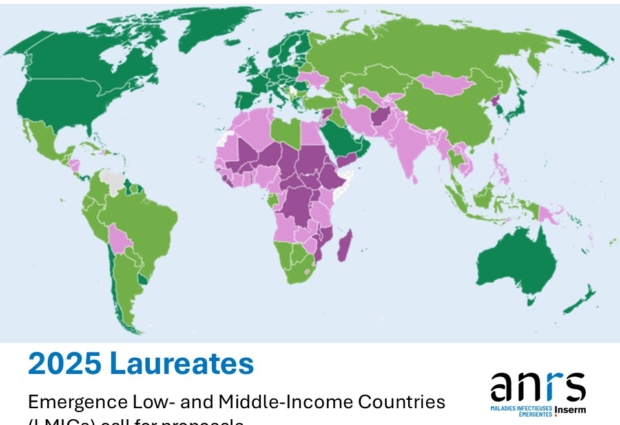
The ANRS MIE has published the list of the six projects selected under the 2025 ‘Émergences PRFI’ call for proposals.
Last updated on 17 July 2026
This call aims to support collaborative research projects between a French team and a team from a low- or middle-income country (LMIC), focusing on global challenges related to infectious diseases. It promotes an integrated approach, drawing on fundamental, translational, clinical, public health, and social and human sciences research.
Thematic priorities include, in particular, research into:
The ‘Émergences PRFI’ call is fully in line with the ANRS MIE’s goal, supporting research of excellence, based on partnership and with a significant impact on populations, through a comprehensive approach.
The 2025 edition of the ‘Émergences PRFI’ call confirms strong momentum, with a stable number of projects submitted, illustrating the scientific community’s sustained commitment to tackling infectious threats. This level of participation demonstrates the strategic value of a funding scheme dedicated to research into infectious diseases in partnership with the PRFIs, addressing the need for collaborative knowledge-building, local capacity-building and scientific action in the regions most at risk of epidemics.
The six successful projects were selected following a rigorous evaluation carried out by an international scientific committee, based on their scientific excellence, their alignment with the call’s priorities and the quality of the partnership established with teams at the PRFIs.
They stand out for:
By supporting these projects, the ‘Émergences PRFI’ call fully contributes to the agency’s strategic objectives: to anticipate, detect, understand and respond rapidly to health crises, whilst strengthening scientific communities working on these issues.
The six research projects selected this year, supported by the ANRS MIE with a total cumulative funding of nearly 5 million euros, cover six PRFIs across two continents: in Africa, in Madagascar and Côte d’Ivoire; and in Asia, in Vietnam, Thailand and Turkey.
Their work focuses on a wide variety of emerging and re–emerging viruses, including yellow fever, hantaviruses, the hepatitis E virus, New World arenaviruses (such as Lassa fever), respiratory syncytial virus (RSV) and various respiratory viral infections.
Yellow fever is a disease caused by an arbovirus transmitted by mosquitoes of the genus Aedes. It is endemic to sub–Saharan Africa and South America. Despite the presence of mosquito vectors capable of transmitting the virus, the disease has never been reported in Asia, although imported cases were detected in China in 2016. We hypothesise that, in order to trigger an urban outbreak, ‘spillovers’ must occur from a sylvatic cycle, as has been described in sub-Saharan Africa and South America.
The project comprises four objectives aimed at determining whether a sylvatic cycle is likely to become established by infecting three mosquito species predominant in three ecosystems respectively (urban, rural, forest) in three regions of Vietnam (north, centre, south), and to assess the crucial role of the Asian mosquito Aedes albopictus in blocking the replication of the yellow fever virus and thus preventing the initiation of a sylvatic cycle from an urban cycle. Vietnam will serve as a control region to test our hypothesis regarding the absence of yellow fever in Asia, examined from a vector perspective.
The RASTA–TANA project aims to gain a better understanding of the presence, circulation and transmission to humans of four infectious agents – orthohantaviruses, pathogenic leptospires, rotavirus and rat hepatitis E virus (ratHEV) – in a large urban market in Antananarivo.
It simultaneously combines the study of rats, the analysis of water, dust and air, the monitoring of exposure and disease among market traders, market customers and patients attending the city’s health centres, as well as an investigation into people’s habits and practices that could influence the risk of infection. To carry out all these aspects, the team includes experts in virology, bacteriology, urban ecology, anthropology and public health from the Pasteur Institutes in Paris and Madagascar, as well as from the CBGP (IRD and INRAE).
We hypothesise that certain very severe viral respiratory infections may be caused either by as yet unknown genetic defects affecting type I or III interferons, or by autoantibodies that block their action. To test this hypothesis, we will recruit patients with severe respiratory infections, particularly those caused by emerging or re–emerging viruses such as SARS–CoV–2, for example; search for new genetic defects, particularly partial abnormalities that only lead to severe symptoms in a minority of people; and finally, continue the search for autoantibodies that neutralise IFN-I in these new infections.
Our initial results are encouraging, with the identification of two new genetic disorders that we will characterise in greater detail, and the detection of anti-IFN-I autoantibodies in new pulmonary infections. The teams involved in this project have been working together for ten years and have published more than 30 major scientific articles. Since 2020, we have identified several complete or partial IFNAR1 deficiencies responsible for severe forms of COVID-19, and discovered new cases of anti-IFN autoantibodies. This work demonstrates the strength and complementary nature of our collaboration. Our aim is to better understand why some people develop severe viral infections. These findings will have major clinical implications for the diagnosis, management and follow-up of people carrying these genetic defects or these autoantibodies.
The aim is to use a One Health approach to analyse various socio–biological, entomological, zoological, environmental, institutional and public health factors that may influence the occurrence of dengue epidemics, as well as, by extension, other emerging epidemics in Côte d’Ivoire.
Over the past fifteen years, the country has seen an increase in both the frequency and intensity of dengue epidemics, mainly in affluent neighbourhoods of Abidjan. This trend, combined with the confirmed presence of seven emerging viruses, provides an ideal setting for understanding the contexts in which such outbreaks emerge in urban areas.
This project aims to better understand and control the spread of dangerous viruses known as New World arenaviruses (NWAs) in Bolivia, a country particularly vulnerable to zoonotic diseases. These viruses, which cause severe haemorrhagic fevers, are mainly transmitted through contact with the secretions of infected rodents (and sometimes bats) and cause symptoms in humans similar to those of dengue fever, making them difficult to diagnose.
Why this project? Bolivia is a region of high biodiversity, where rapid changes to the landscape (deforestation, agricultural expansion) encourage contact between humans and virus-carrying animals. This situation increases the risk of transmission of these viruses and of potentially fatal epidemics. It is therefore becoming urgent to study these little-known and highly dangerous viruses with a view to preventing epidemics.
We are proposing a study involving 800 pregnant women who have volunteered to take part, across eight Thai public hospitals. Half will receive a vaccine against respiratory syncytial virus (RSV) during pregnancy, whilst the other half will have their babies given antibodies at birth. We will then monitor all infants during their first year of life to compare the number of RSV-related respiratory infections in each group. We will also assess the safety of both approaches for mothers and babies, their acceptability to families, and their cost-effectiveness for the healthcare system. This study forms part of an international mother-and-child research programme called PIPELINE, conducted in collaboration with European teams.
This study will provide the first data directly comparing these two prevention methods in a middle-income country. The results will help Thailand decide whether to include either of these interventions in its national infant immunisation programme. This information will also be valuable for other countries in South-East Asia facing the same issues. More broadly, this project will strengthen clinical research capacity in the region and contribute to better protection of infants against this virus worldwide.