Hantaviruses are a family of viruses that are usually transmitted by rodents. This zoonotic disease can lead to two syndromes of varying severity, some of which can be fatal.
Last updated on 24 August 2026
The first clinical description of a hantavirus disease dates back to the Korean War (1950–1953), during which more than 3,000 soldiers developed haemorrhagic fever with hepatorenal syndrome. The virus responsible was identified in 1976 by Korean researchers. It is named after the Hantaan River, which lies on the border between the two Koreas.
Hantavirus infections are relatively rare worldwide. However, their case fatality rate varies between the regions affected (and the viral species involved) and can reach up to 50% of cases. Globally, it is estimated that between 10,000 and 100,000 cases occur each year, mainly affecting Asia and Europe. 1
In 2025, eight countries in the Americas reported confirmed cases of hantavirus pulmonary syndrome, totalling 229 cases and 59 deaths. The countries concerned are Argentina, Brazil, Bolivia, Chile, Panama, Paraguay, the United States of America and Uruguay.2
Between January and March 2026, the National Reference Centre (CNR) for Hantaviruses, part of the Pasteur Institute in Paris, recorded 19 confirmed cases of recent hantavirus infection. The number of cases detected is in line with the French monthly average. In French Guiana, since 2008, only 11 cases of Maripa hantavirus pulmonary syndrome have been detected, six of which were fatal.3
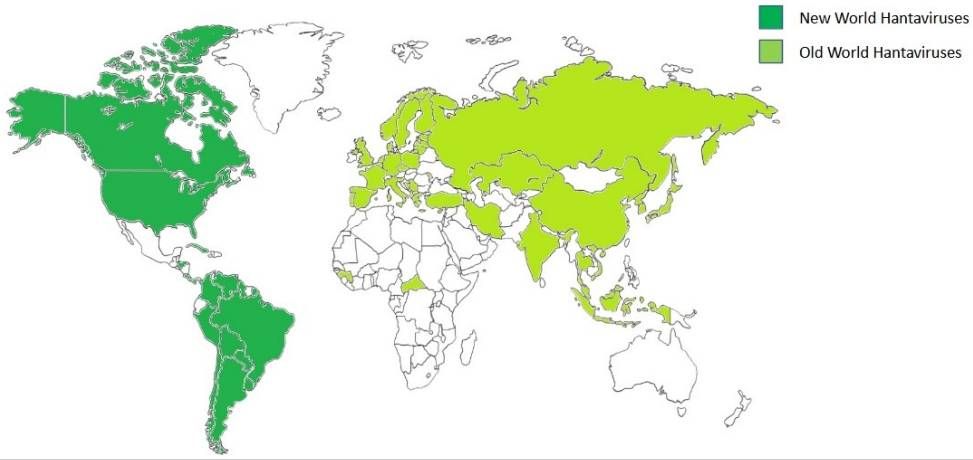
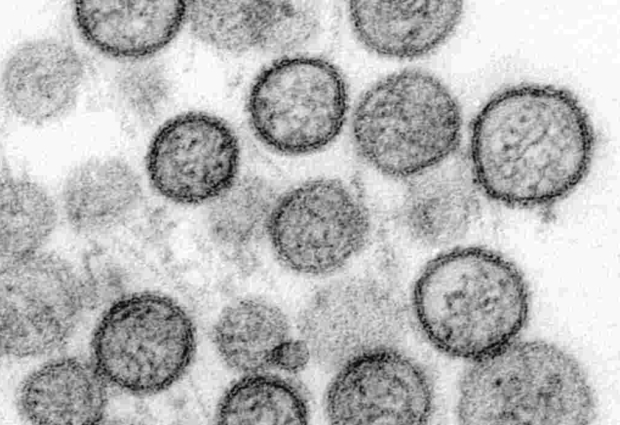
Hantaviruses are found on every continent. They belong to the family Hantaviridae, within the order Bunyavirales, which includes viruses with a tri-segmented negative-sense RNA genome. They encode only five viral proteins and replicate and transcribe their genome in the cytoplasm of infected cells. However, many details of the viral amplification cycle are still unknown.4
More than 20 viral species have been identified, all of which are zoonotic – that is, transmitted by animals. Each viral taxon is generally associated with a single natural host species, mainly including wild rodents (rats, voles, field mice) and, more rarely, insectivorous rodents (moles, shrews), bats, as well as fish and reptiles.
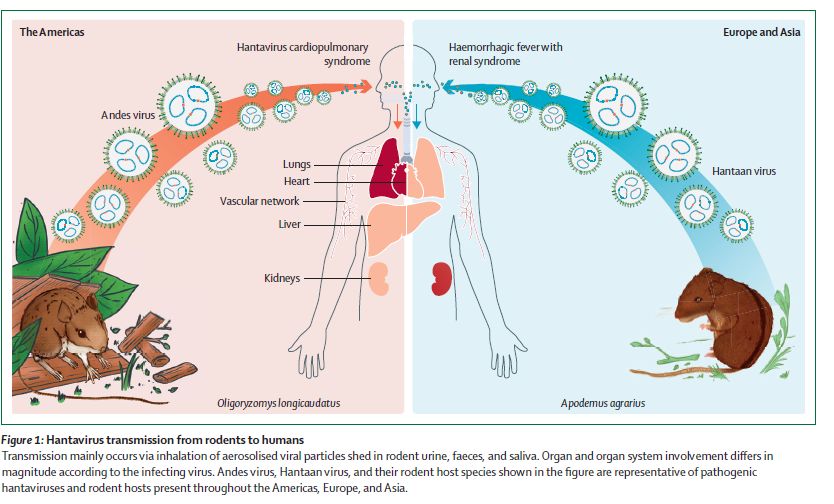
The virus is transmitted to humans mainly through indirect contact via the inhalation of aerosols contaminated by the excreta (urine, faeces) of asymptomatic infected rodents (referred to as ‘reservoir’ animals) and, more rarely, through direct contact or bites. Cases generally occur in rural areas, where forests, fields and farms provide a suitable habitat for rodents.
Human-to-human transmission of a hantavirus is rare. It was first confirmed during a nosocomial outbreak of hantavirus pulmonary syndrome in 1996 in southern Argentina and appears to involve only the Andes hantavirus, which is endemic in that country.
When they affect humans, hantaviruses can cause infections of varying severity, some of which are life-threatening.
The incubation period lasts an average of two weeks. The initial clinical symptoms are generally those of influenza: fever, headache, and muscle pain. Two types of syndrome may then be observed:
Both syndromes can be caused by the same viral species. However, renal and hepatic syndrome is more often associated with European and Asian hantaviruses (commonly referred to as ‘Old World hantaviruses’), while pulmonary syndrome is more commonly linked to American hantaviruses (or ‘New World hantaviruses’).
No specific treatment or vaccine is approved, fully effective or widely available internationally against hantavirus infection. Vaccines against Hantaan and Seoul hantaviruses are produced and used only in China and South Korea, but with moderate efficacy.5
Prevention of infection essentially involves limiting contact with rodents and their excretions. This requires avoiding, in high–risk areas: handling wood, cleaning premises that have been unoccupied for a long time, and any activity that stirs up dust or soil, such as renovating old, dusty premises, backfilling, etc.
ANRS Emerging Infectious Diseases (ANRS MIE) supports, facilitates and coordinates research into emerging infectious diseases. Hantaviruses are among these.
Given the epidemic potential of the hantavirus outbreak, the ANRS MIE decided to activate a Level 1 Outbreak Response unit on 7 May 2026, in order to define research priorities and establish enhanced scientific surveillance.
The ANRS MIE has supported a research project on hantaviruses as part of the 2025 edition of its call for proposals, ‘Émergence PRFI 2025’. This ongoing project, entitled “TRANSVI”, aims to characterise the transmission chains of hantaviruses between wildlife and humans on the Yucatan Peninsula (Mexico).
Also in 2025, one of the three “Emerging Viruses” thesis prizes awarded, as every year, by ANRS MIE and the French Society of Virology (SFV), was awarded to Dr Quentin Durieux Trouilleton (University of Grenoble / IBS) for his thesis “Structural and functional analysis of Bunyavirus replication and transcription”, focusing in particular on two hantaviruses. His work led him to observe, for the first time, a hantavirus polymerase – a molecule essential for the replication and therefore the spread of this virus.
A key player in numerous international partnerships and consortia, ANRS MIE is also part of the WHO’s Collaborative Open Research Consortium (CORC) network. In this context, links have been established with the UK Health Security Agency (UKHSA), which leads the Bunyavirales CORC, whose mission is to coordinate research as part of preparedness for hantavirus epidemics.
Finally, hantaviruses are discussed within several of its scientific working groups known as coordinated actions (ACs): the AC “Viral Haemorrhagic Fevers”, the AC “Host-Virus Interactions” and the AC “Human-to-Human Transmission of Respiratory Viruses”.