

Last updated on 05 August 2026
The Vietnam Partner Site is primarily structured around the Vietnam Administration for Disease Prevention (VADP) of the Ministry of Health in Hanoi, Hai Phong University of Medicine and Pharmacy (HPMU), in Hai Phong, and Hanoi Medical University (HMU).
Creation date
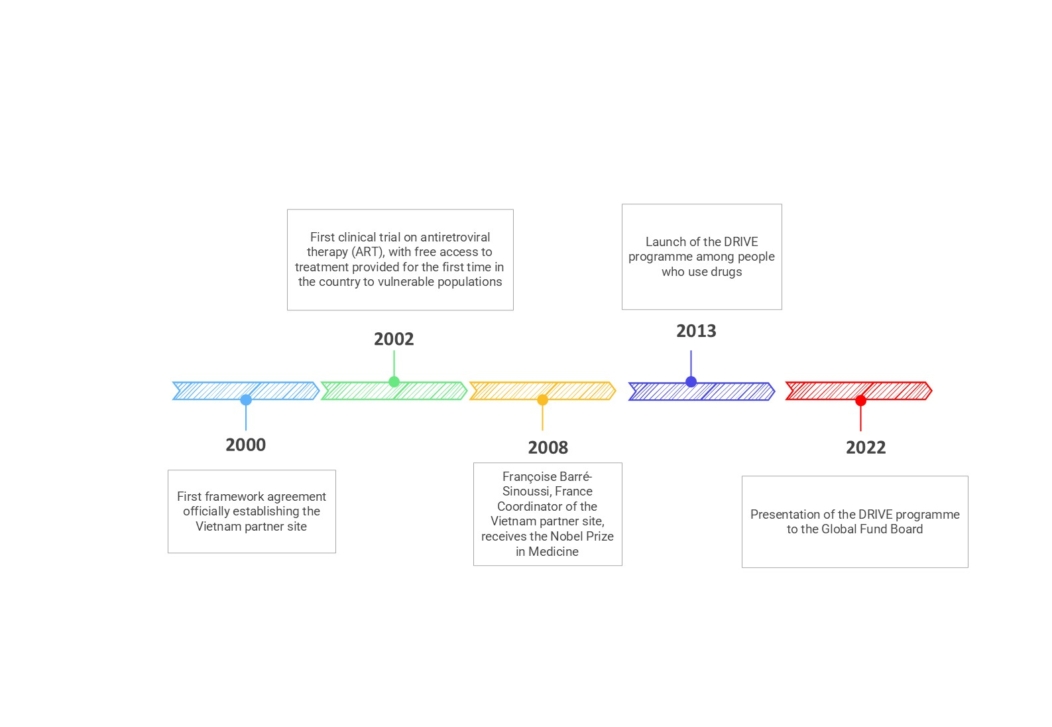
2000
Leads
Professor Thi Thui Huong Phan (Vietnam Coordinator), Dr Didier Laureillard (France Coordinator)
Physical hosting of the partnership
VADP/Ministry of Health, HMU, Hanoi, and HPMU, Hai Phong, Vietnam
International technical expert
Dr Ann-Claire Gourinat
In 1988, Truong Thi Xuan Lien, a researcher at the institut Pasteur in Ho Chi Minh City, attended the first course on HIV in Vietnam, taught by Professor Françoise Barré-Sinoussi. As a French speaker, she was appointed by the Ministry of Health to develop her technical skills at the Institut Pasteur in Paris, where she completed her doctoral thesis in science. Upon returning to Vietnam, she participated in the creation of the first HIV/AIDS laboratory at the institut Pasteur in Ho Chi Minh City and diagnosed the country’s first case of HIV in 1990. This marked the beginning of Franco-Vietnamese cooperation in HIV research.
ANRS signed an initial collaboration agreement with the Vietnamese Ministry of Health in 1995. The ANRS Vietnam Partner Site was officially established on 6 January 2000. The cooperation agreement between the Vietnamese Ministry of Health and ANRS was renewed and updated on 18 January 2018, confirming their shared commitment to continuing the collaboration.
The first studies focused primarily on virological aspects, particularly in collaboration with the institut Pasteur in Ho Chi Minh City. In 2010, a clinical trial coordination unit was opened at Pham Ngoc Thach Hospital (PNTH), the referral hospital for tuberculosis, to facilitate the coordination of studies on HIV/tuberculosis co-infection. In 2015, a second research coordination unit was opened at Hai Phong University of Medicine and Pharmacy (HPMU), where the DRIVE programme was implemented.
In 2017, an office dedicated to the overall coordination of the partnership was established within the VAAC (Vietnam Administration of HIV/AIDS Control, Ministry of Health) to strengthen collaborations.
Today, the partner site’s coordination activities continue within the VADP (Vietnam Administration for Disease Prevention, formerly the VAAC) and at HMU for general coordination, and at HPMU for the coordination of research. IRD’s Vietnam office is responsible for the administrative and financial management of the partnership’s activities.
The Vietnam Administration for Disease Prevention (VADP), which operates under the Ministry of Health, was established as part of a reorganisation that notably incorporated the responsibilities of the former VAAC. It coordinates the prevention and control of communicable diseases at national level and provides technical support to the provincial Centres for Disease Control and Prevention (CDCs).
A second coordination office was opened in 2025 at Hanoi Medical University (HMU), which works with the VADP and other partners to coordinate and implement research activities. Founded in 1902 by Alexandre Yersin, this university is the oldest and leading medical school in the capital. It plays a central role in medical training and biomedical research in Vietnam, with a firmly established national and international reputation.
Research activities are particularly well developed with Hai Phong University of Medicine and Pharmacy (HPMU), notably within its Faculty of Public Health, which comprises four specialised departments: epidemiology, nutrition and food safety, environmental health and occupational health.

Vietnam Coordinator: Prof. Thi Thu HUONG PHAN
HMU, Hanoi, Vietnam

France Coordinator: Dr Didier LAUREILLARD
PCCEI UMR 1058 Montpellier and Nîmes University Hospital, France

Vietnam Deputy Coordinator: Dr Thi Thuy LINH DOAN
VADP/Ministry of Health, Hanoi, Vietnam

France Deputy Coordinator and international technical expert: Dr Ann-Claire GOURINAT
HMU, Hanoi, Vietnam
The partner site was previously coordinated by Professor Françoise BARRE-SINOUSSI (France Coordinator), Professor TRUONG THI XUAN Lien (Vietnam Coordinator) and Ms CAO THI HUE Chi (Vietnam Deputy Coordinator). An international technical expert is assigned to support the coordination of the Vietnam Partner Site.
Read Ann-Claire Gourinat’s account of her work as an ITE in Vietnam.
Many partners, including universities, NGOs, ministries, research institutions, healthcare facilities and community stakeholders, are connected with the VADP, HMU and HPMU through the partner site. There are also other institutional, financial and project-based partnerships.
The first studies focused primarily on virological aspects, with the exception of two clinical studies: VIETAR ANRS 1210, the first pilot study aiming to assess the feasibility, efficacy and tolerability of antiretroviral therapy (ART) in Vietnam, and PNEUMOVIET ANRS 1260, which assessed the aetiologies of pneumonia in patients with HIV.
Today, research focuses on improving prevention and care strategies, particularly among the most exposed populations. The DRIVE-MIND II study assesses the impact of mental health interventions on risk behaviours and engagement with care. At the same time, studies such as MOVIDA 2 examine the use of new virological monitoring tools in decentralised settings, while the POSTCOVIET study documents post-Covid-19 sequelae and their consequences among several at-risk groups, including people living with HIV (PLHIV).
Viral hepatitis research occupies a central position in Vietnam, where the prevalence of hepatitis B virus (HBV) remains high and hepatitis C is particularly concentrated among key populations. From 2014 onwards, the first hepatitis C studies were incorporated into the DRIVE programme, demonstrating the feasibility of an effective community-based screening and treatment model.
The DRIVE-C project marked a major milestone by developing a comprehensive model for the screening, care and follow-up of people who inject drugs, which has now been extended to analyse the long-term effects of antiviral treatment. At the same time, the MOVIDA-Hep2 study explores access to treatment in remote areas, using dried blood spots (DBS; blood spot analysis on filter paper) for virological monitoring.
The HIPOCAMP project, which is currently being rolled out, opens up a new avenue for preventing mother-to-child transmission of HBV by comparing two prophylaxis strategies.
Research prospects include strengthening HBV diagnosis during pregnancy, incorporating research on hepatitis D, assessing decentralised approaches to HCV care and studying premature ageing or long-term toxicity following treatment with direct-acting antivirals.
Tuberculosis (TB) remains a major issue in Vietnam, a high-incidence country that is transitioning towards a model in which health insurance plays a central role in funding. The ANRS MIE Vietnam partner site became involved at an early stage in research on HIV/TB co-infection, particularly at Pham Ngoc Thach Hospital in Ho Chi Minh City, where clinical studies have helped improve diagnosis and care.
Current activities are structured around the DRIVE-TB project, which applies the proven community-based approaches of the DRIVE programme to tuberculosis screening. This model combines chain-referral screening through RDS, diagnostic algorithms involving chest X-rays, CRP and Xpert, and enhanced peer support to encourage treatment initiation and completion. A specific component focuses on the prevention of latent tuberculosis using the 3HP regimen.
The next stages will focus on optimising diagnostic algorithms in non-medical settings, exploring latent tuberculosis among key populations and analysing DRIVE-TB data to support the development of national policies.
With the creation of ANRS MIE, emerging infectious diseases were gradually incorporated into the projects conducted by the Vietnam partner site. COVID-19 (coronavirus disease 2019) was the first area investigated, with the development of an innovative modelling tool (COMOKIT) used to assess different intervention scenarios at city level, as well as the POSTCOVIET study devoted to post-infection sequelae.
mpox (“monkeypox”) led to research on knowledge, attitudes and practices among at-risk populations, particularly MSM (men who have sex with men), in the context of a recent outbreak that remains poorly documented.
Dengue is now a priority area for development. The DENGAGE project, based in Dak Lak Province, will combine serological surveys to measure exposure to dengue, a study of knowledge and behaviours relating to the disease, and interviews with local health stakeholders. The expected results will provide a better understanding of the impact of dengue in the province, identify the areas and groups most at risk and thereby enable more targeted prevention measures to be proposed. These data will also help prioritise the use of dengue vaccines and strengthen preparedness for future outbreaks, combining a seroprevalence study, a KAP survey and community-based interventions.
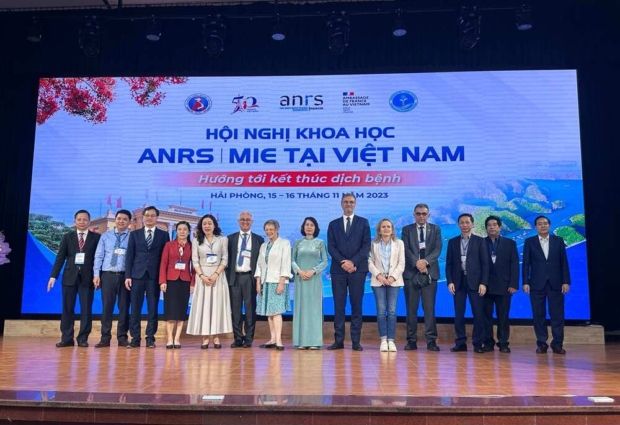
Since its creation, the Vietnam partner site has facilitated numerous exploratory missions throughout the country and organised scientific events to bring together Vietnamese, French and international research stakeholders. These initiatives have helped identify research priorities, develop collaborations and support the implementation and promotion of projects at national and international level.
The partner site supported the development and implementation of the DRIVE community-based research programme (drug use and viral infections in Vietnam), co-funded by ANRS, the Global Fund and the US National Institute on Drug Abuse (NIDA). This programme led to the creation of a multidisciplinary research platform, strengthening an already solid partnership with the local authorities and civil society. Today, this platform forms the basis for other studies on access to the diagnosis and treatment of conditions such as hepatitis C, tuberculosis and mental health disorders among people who use drugs. Having demonstrated its effectiveness in the city of Hai Phong, the DRIVE model is now being replicated at national level, thanks to funding awarded by the Global Fund, targeting not only people who inject drugs but also MSM.
The distinctive feature of the Vietnam partner site lies in the systematic involvement of community-based organisations, particularly SCDI and the CBOs in Hai Phong, in the design, implementation and evaluation of projects. Their contribution was decisive in the DRIVE, DRIVE-C, DRIVE-TB, DRIVE-MIND and DENGAGE studies, enabling broad inclusion of key populations, better adherence to programmes and a unique capacity to move from a research model to national implementation.
Collaborations with health authorities, universities and research institutes have enabled the partner site to occupy a strategic position, particularly in national discussions on prevention, mental health, hepatitis C, tuberculosis and emerging diseases.
Since 2022, a new circular governing the use of foreign funds has changed certain procedures for implementing research projects and obtaining the necessary authorisations. The partner site actively supports research teams to facilitate the rollout of their projects in this new context.
The next Scientific Days of the ANRS MIE’s Vietnam Partner Site will be held on March 10 and 11, 2026 in Hanoi, and online.
18 December 2025
As it does every year to mark World Hepatitis Day on 28 July, ANRS MIE reaffirms its commitment to research into viral hepatitis.
28 July 2026