Last updated on 24 September 2026
The ANRS Emerging Infectious Diseases (ANRS MIE) funds posts for clinical trial coordinators (MEC), laboratory coordinators (MEB) and social science coordinators (MESS).
These staff provide cross-functional support to laboratories and hospital departments actively participating in clinical trials organised by the agency.
They thus contribute directly to the implementation of research activities in France and also form a network that can be mobilised when new research is launched in response to emerging health threats.
The ANRS MIE funds clinical research staff posts in hospital clinical departments and hospital virology laboratories involved in studies sponsored by the agency in France.
Unlike staff at the methodology and management centres (CMG) who coordinate clinical trials, clinical trial coordinators (MEC) and biological study coordinators (MEB) are in direct contact with patients taking part in these trials.
They act as a link between principal investigators and hospital or laboratory technicians. They are also responsible for coordinating, analysing and evaluating various aspects of clinical trials.
CMGs may also employ social science study coordinators (MESS). As project managers and epidemiologists funded by the ANRS MIE, they evaluate the work of investigators and carry out statistical analyses on the data produced.
Each year, ANRS MIE awards individual grants to these clinical research staff for a renewable period of one year, in connection with research projects promoted by the agency in France. In 2025, 126 people (82 full-time equivalents) in mainland France and its overseas territories benefited from this support, totalling nearly 5 million euros of ANRS MIE’s budget.
This support makes it possible, in particular, to build a network, pool resources across several studies and thereby reduce associated hospital costs. It primarily helps to sustain the long-term involvement of the departments concerned and to strengthen their research activities.
This financial support reflects the agency’s strong commitment to clinical research, not only in the fields of HIV, viral hepatitis and co-infection, but also, since 1st January 2021, in the field of emerging infectious diseases. Maintaining this dynamic network, which can be rapidly mobilised in the event of an outbreak, is essential in the event of a crisis, as was the case in 2020 during the Covid–19 pandemic.
The clinical trial coordinator is primarily involved in monitoring patients enrolled in a clinical trial.
They help with patient selection, the preparation and analysis of questionnaires, and logistical arrangements, acting as the link between the doctor, the technician, the laboratory and, on occasion, the social worker.
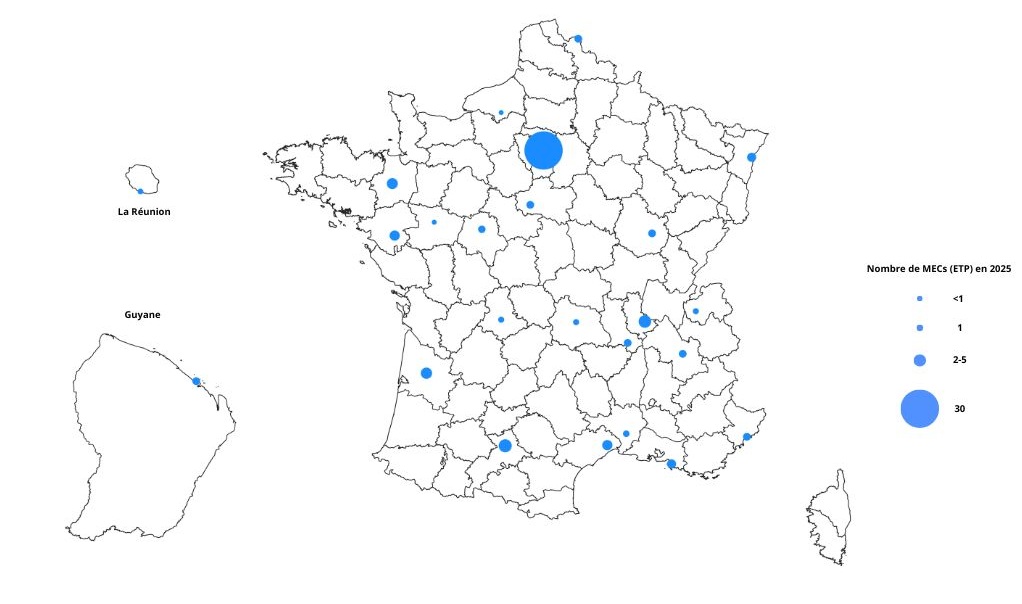
Proportional representation of the number of MEC posts funded in 2025 by the ANRS MIE in infectious diseases and hepatogastroenterology departments in mainland France, Réunion and French Guiana.

The support of an organisation such as ANRS MIE is essential to the role of clinical trial coordinator. Without it, the conduct of many trials – whether or not funded by ANRS MIE – would not be sufficiently smooth and efficient to enable the necessary scientific and medical knowledge to be acquired.
Clinical trial coordinators (MEC) may be assigned to various roles:
The clinical trial doctor assists the principal investigator in carrying out the clinical procedures required by the research. They play an active role in assessing potential candidates and subsequently recruiting participants. They may also issue prescriptions.
The clinical trial coordinator is responsible for monitoring and coordinating the research within the relevant clinical department, working with the pharmacy and participating laboratories. They act as a link between researchers, sponsors, doctors, clinical research coordinators and technicians, as well as the methodology and management centre(s) (CMG) involved.
The clinical trial technician, for their part, assists the principal investigator throughout the trial. They help to recruit participants, collect data and manage logistics.
Unlike the MEC, the MEB carries out their work exclusively in virology or immunology laboratories.
They do not interact with patients but with their biological samples, the collection and analysis of which they coordinate.
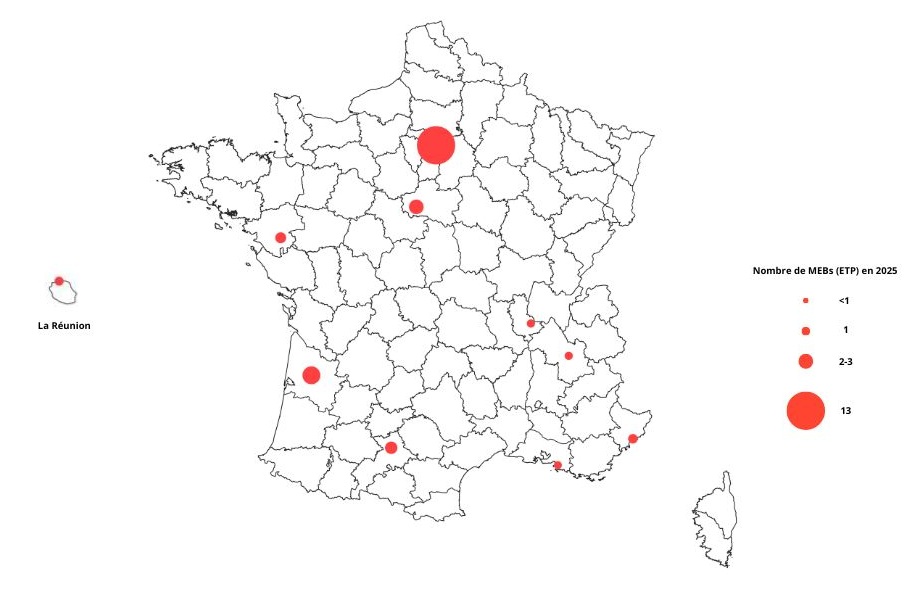
Proportional representation of the number of MEB positions funded by the ANRS MIE in 2025 in virology laboratories in mainland France and Réunion.
The biological study coordinator acts as the link between the clinical team and the laboratory. They coordinate the management of samples, from receipt of specimens through to the performance of analyses and the interpretation of data.
Two types of staff are funded by the ANRS MIE in biological studies:
The biological study monitor, strictly speaking, is responsible for managing clinical or therapeutic research in a virology or immunology laboratory. They develop laboratory techniques and ensure their implementation on an exploratory basis, particularly within the framework of clinical sub–studies (or sub–protocols).
The biological study technician, for their part, assists the principal virologist or immunologist throughout the research. They also help with the management of the research, particularly in terms of logistics.