

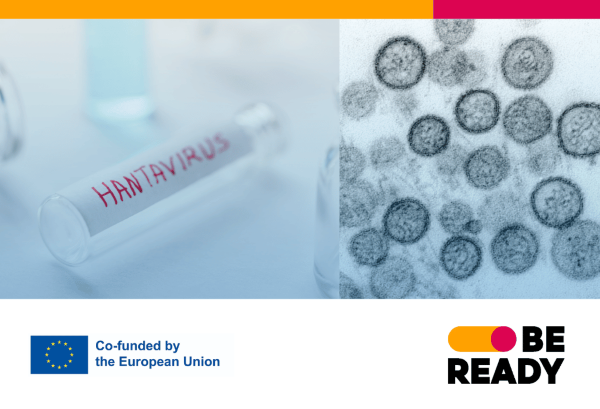
In the wake of the Andes hantavirus (ANDV) outbreak in May 2026, BE READY has been working closely with its European stakeholders to initiate cross-country alignment of research priorities.
Last updated on 14 June 2026
BE READY, the European Partnership for Pandemic Preparedness, has been working closely with its European stakeholders since 10 May 2026, when passengers of the MV Hondius disembarked in Tenerife, Canary Islands, Spain.
On Friday 22 May, one hundred BE READY partners met online to initiate discussions on cross-country alignment of research priorities in response to the ANDV outbreak. A survey, closely linked to the prioritisation work currently being carried out by the WHO Collaborative Open Research Consortium (CORC) on Bunyavirales, is open to collect input from partners. Its goal is to:
Because preparedness depends on linking evidence across the full ‘One Health’ continuum, ‘animal reservoirs’, ‘transmission’, ‘clinical evidence’, ‘diagnosis & care’, ‘tools’, and ‘societal response’ are the six research priorities that were identified.
Three working groups (Work Package 10, WP11, and WP12) contribute to BE READY’s response to the hantavirus situation:
The NAVIS platform, based on the WHO/ISARIC (International Severe Acute Respiratory and Emerging Infection Consortium) protocol, is a prospective observational study of individuals exposed to Andes virus through direct human-to-human, environmental, or healthcare-related exposures.
The study aims primarily to define the natural history timeline of Andes virus infection, from exposure to key clinical and biological endpoints. It will also document virological and immunological responses, mechanisms of disease severity, clinical outcomes, and transmission-related endpoints. NAVIS is structured around three stages — exposure, pre-symptomatic infection, and symptomatic disease — with epidemiological, clinical, haematological, biochemical, virological, and immunological assessments adapted to each stage and timepoint.
The NAVIS study is an important opportunity to strengthen international preparedness for Andes hantavirus infection, notably by supporting the development of a pre-approved protocol for post-exposure prophylaxis and/or early clinical research, enabling studies to be launched rapidly in the event of a future outbreak.