

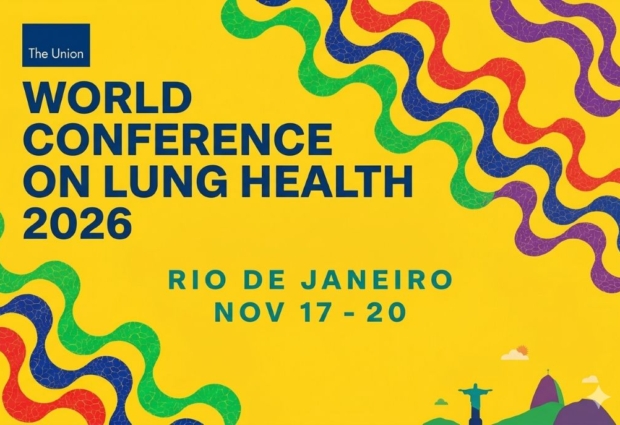
On 18 November 2027 in Rio de Janeiro, Brazil.
18 November 2026
The next World Conference on Lung Health, organised by the International Union Against Tuberculosis and Lung Disease (Union), will take place from 17 to 20 November 2026 in Brazil. The ANRS MIE’s coordinated action on ‘Tuberculosis’ is organising a satellite symposium at the conference focusing on this disease.
The International Union Against Tuberculosis and Lung Disease (Union), an organisation founded in 1920, organises the World Conference on Lung Health every year. Scheduled to take place in Rio de Janeiro, Brazil, from 17 to 20 November 2027, this event will host a symposium organised by the coordinated action on ‘Tuberculosis’ (AC TB) of the ANRS Emerging Infectious Diseases (ANRS MIE).
This session will take place on Wednesday 18 November 2026, from 5.45 pm to 7.15 pm (Rio de Janeiro time). Its theme will be: “Tuberculosis: from silent to severe disease, insights from clinical trials and new strategies”.
This session will explore the full spectrum of tuberculosis (TB), from asymptomatic infection to severe disease, highlighting how recent clinical trials are reshaping our understanding and management of TB. Participants will gain insights into the hidden burden of asymptomatic TB and its implications for transmission and case detection, as well as current evidence on strategies to reduce mortality in severe forms. The session will also address persistent challenges in childhood TB and review advances in novel drugs and shorter treatment regimens. Overall, attendees will learn how clinical trial evidence can inform more effective, patient-centered TB care and guide future research priorities.
To mark this occasion, the ANRS MIE invites interested researchers to submit their abstracts relating to work supported by the ANRS MIE.
The agency will be spotlighting the event to showcase the selected research. It guarantees the confidentiality of the documents submitted until the embargo imposed by the conference is lifted.
Submit an abstractChairs :
Speaker: Nicolas NAGOT (CHU/Université de Montpellier)
About half of individuals with active TB in a population lack symptoms, contributing to ongoing transmission and delaying diagnosis. These cases challenge traditional symptom-based screening strategies and question their role in TB dynamics. Whether targeting these asymptomatic cases in TB screening strategies can markedly improve TB control strategies is a key question. In addition, addressing the cascade of TB care for these people with TB but who don’t feel sick is crucial for an effective screening strategy. We will take the example of a community-based TB control strategy implemented in a high-risk group in Vietnam to document these questions.
Speaker: François-Xavier BLANC (CHU/ Université de Nantes)
Despite effective antimicrobial regimens, mortality remains high in severe TB, particularly in TB meningitis or disseminated TB in people living with HIV. Increasing attention has recently focused on adjunctive strategies, including optimized antimicrobial regimens (e.g., high-dose rifampicin or isoniazid, fluoroquinolones, linezolid) and host-directed therapies targeting inflammation and immune dysfunction. While corticosteroids remain the only intervention reducing mortality in TB meningitis in people without HIV, recent trials evaluating high doses steroids or aspirin failed to reduce mortality in severe forms of TB. Other ongoing clinical trials aim to refine these approaches and improve outcomes.
Speaker: Chishala CHABALA (University of Zambia, School of Medicine)
Childhood TB remains a major global health challenge. More than half of children with TB are never diagnosed, largely due to non-specific symptoms, difficulty in obtaining microbiological confirmation, and the paucibacillary nature of disease. Significant gaps persist across the care cascade, particularly in screening and diagnosis, access to treatment for children with TB and to preventive therapy for exposed children. For drug-resistant TB, paediatric-specific data on optimal treatment regimens remain limited. In addition, current vaccines provide incomplete protection. Addressing these challenges is essential to reduce preventable morbidity and mortality in children.
Speaker: Mihaja RABERAHONA (University Hospital Joseph Raseta Befelatanana, ERCMI Madagascar)
Dr. Mihaja Raberahona is an infectious disease physician-researcher at University Hospital Joseph Raseta Befelatanana and the Executive Director of ERCMI research team in Antananarivo, Madagascar. His work focuses on tuberculosis, HIV, and other poverty-related infectious diseases. He leads and contributes to clinical trials in tuberculous meningitis, including intensified regimens with high-dose rifampicin, linezolid, and aspirin, and novel alpibectir/ethionamide combinations. He also evaluates AI-based tools for pulmonary TB triage, using cough analysis and data collected from wearable devices. Through clinical care and research, he contributes to improving diagnosis, patient management, and public health strategies in Madagascar.
Speaker: Nathalie De Castro – AP-HP Hôpital Saint-Louis, ANRS MIE France–Brazil International Research Platform in Global Health (PRISME)
Over the past decades, ANRS MIE has substantially contributed to improve TB knowledge through a large international research network. With this short presentation, the audience will learn about the ANRS MIE network and research portfolio on TB from translational and basic science to clinical trials on HIV-TB co-infection, TB in children or therapeutic strategies.
Nicolas Nagot is a medical epidemiologist, professor of Public Health, leading a University of Montpellier/INSERM research Unit entitled ‘Pathogenesis & Control of Chronic and Emerging Infections’. He is also the head of the Clinical epidemiology and data science department at the University Hospital of Montpellier. His research has focused on the prevention of vertical transmission of HIV, but also on the elaboration and evaluation of interventions to control HIV, hepatitis C, STIs among high-risk populations. Now, he is exploring how pillars of successful interventions to control HIV and HCV in people who use drugs (PWUD), mainly through community mobilization and networking, could be adapted for TB control interventions among PWUD and other groups at high-risk of TB in Southeast Asia and Southern Africa.
Professor François-Xavier Blanc is a medical doctor, clinician trained in respiratory medicine and works at the Nantes University medical school and hospital. His current research activities focus on the management of TB/HIV patients, with a global objective of targeting the high mortality that still affects the most severely immunocompromised individuals. His main scientific interests focus on tuberculosis, especially in people living with HIV/AIDS. He coordinated large international trials including CAMELIA, STATIS and DATURA. Since 2023, he has been the co-chair of the ANRS MIE TB scientific coordination working group (AC TB) and its working group on TB and immunodeficiency.
Dr Chishala Chabala is a paediatrician and lecturer at the University of Zambia, School of Medicine and a part-time faculty member at the London School of Hygiene and Tropical Medicine. He is an investigator on multinational collaborative paediatric clinical trials on tuberculosis, HIV treatment and pneumonia. He is the vice chair of the Child and Adolescent TB working group of the Stop TB Partnership. He has also provided technical input in the development of the national TB strategic plan, treatment guidelines and training materials for adults and children in Zambia.
Dr. Mihaja Raberahona is an infectious disease physician-researcher at University Hospital Joseph Raseta Befelatanana and the Executive Director of ERCMI research team in Antananarivo, Madagascar. His work focuses on tuberculosis, HIV, and other poverty-related infectious diseases. He leads and contributes to clinical trials in tuberculous meningitis, including intensified regimens with high-dose rifampicin, linezolid, and aspirin, and novel alpibectir/ethionamide combinations. He also evaluates AI-based tools for pulmonary TB triage, using cough analysis and data collected from wearable devices. Through clinical care and research, he contributes to improving diagnosis, patient management, and public health strategies in Madagascar.
Nathalie De Castro is a professor of infectious diseases, involved in the care of people living with HIV and other immunosuppressed populations, including transplant recipients and cancer patients, as well as pulmonary infections and tuberculosis. She is a permanent researcher at IAME (Infection, Antimicrobials, Modelling, Evolution), Université Paris Cité. She has participated in numerous clinical research projects and coordinated several trials on HIV treatment and HIV–TB co-infection. She currently leads the ANRS MIE-supported FRENCH-TB prospective cohort in France. She is also the French coordinator of the ANRS MIE France-Brazil International research Platform in global health (PRISME).