


Last updated on 05 August 2026
The Cambodia Partner Site is primarily structured around the institut Pasteur du Cambodge (IPC) and the University of Health Sciences (UHS) in Phnom Penh.
Creation date
2000
Leads
Prof. Vonthanak Saphonn (Cambodia Coordinator), Dr Bruno Spire (France Coordinator)
Physical hosting of the partnership
IPC and UHS, Phnom Penh, Cambodia
International technical expert
Dr Victor Gellie
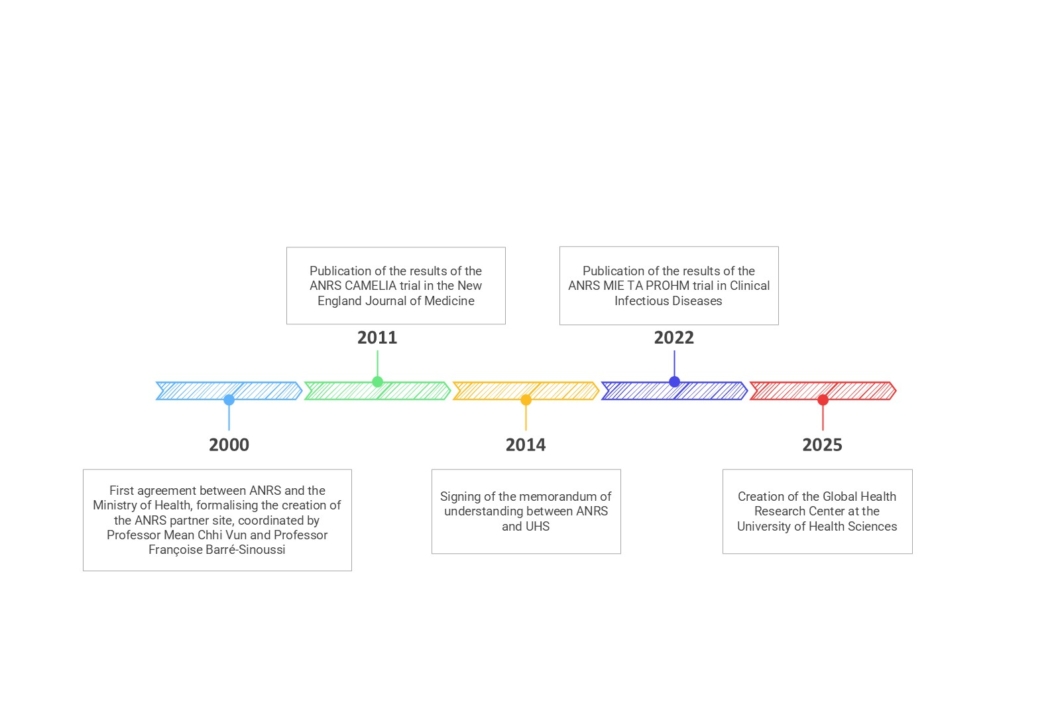
The first Franco-Cambodian collaborations began in 1995. The partnership was formalised in 2000 through the signing of a framework agreement between the Cambodian Ministry of Health, the French Embassy in Cambodia and ANRS MIE.
This partnership, born of a shared desire on the part of France and the Kingdom of Cambodia to collaborate in scientific research in the field of HIV/AIDS, is supported by several institutions, including the institut Pasteur du Cambodge (IPC) and the University of Health Sciences (UHS) in Phnom Penh. It forms part of the national NCHADS programmes for HIV, CENAT for tuberculosis, NMCHC for the mother-and-child component, and CDCD-MoH for viral hepatitis and emerging infectious diseases.
In recent years, the collaborations and areas of activity of the Cambodia Partner Site have expanded in order to better address public health and scientific issues in Cambodia and South-East Asia, with a broadening to infectious diseases and the One Health approach, within a global health context.
The institut Pasteur du Cambodge (IPC) is a Cambodian non-profit research institute whose main mission is to conduct life sciences and health research on infectious diseases and emerging pathogens. IPC also supports public health surveillance and response through high-quality laboratories and capabilities in epidemiology and clinical research.
The University of Health Sciences (UHS) is the country’s main public institution dedicated to training in health sciences. It comprises several faculties, including medicine, pharmacy and dentistry. In terms of research, UHS focuses primarily on public health research and infectious diseases.
The activities of the Cambodia Partner Site and the research projects supported by ANRS MIE are mainly developed and conducted within IPC’s Clinical Research Group. At UHS, these activities were mainly coordinated by the UHS Grant Management Office until 2025, before gradually being taken over by the recently established Global Health Research Center.
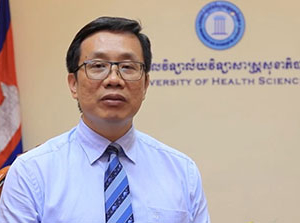
Cambodia Coordinator: Prof. Saphonn VONTHANAK
UHS, Phnom Penh, Cambodia

France Coordinator: Dr Bruno SPIRE
UMR 1252 SESSTIM, Marseille, France

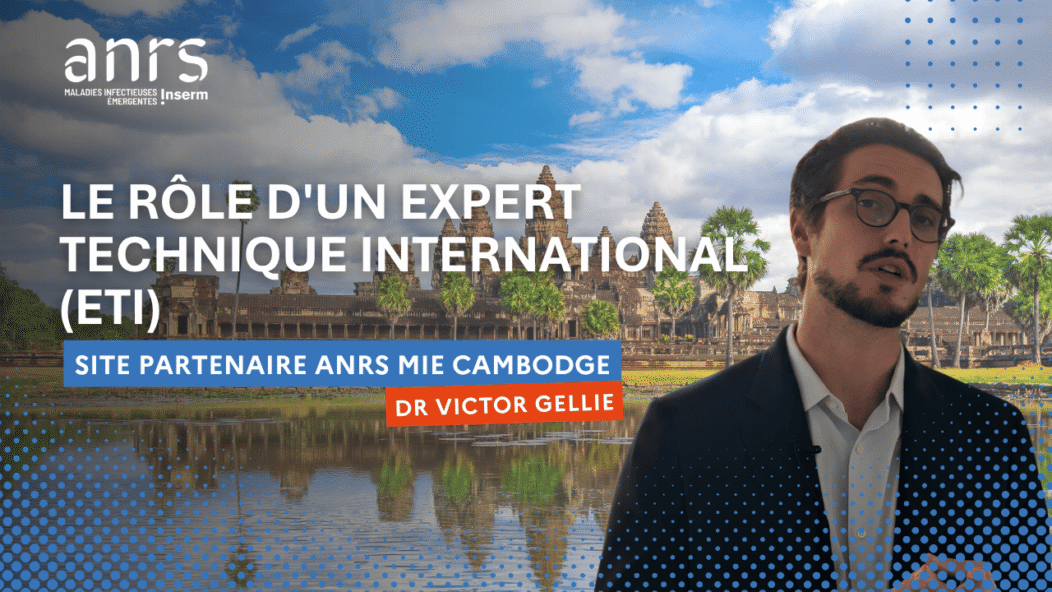
International technical expert: Dr Victor GELLIE
UHS, Phnom Penh, Cambodia
The partner site was previously coordinated by Dr Mean CHHIVUN (Cambodia Coordinator, then Deputy Cambodia Coordinator), Prof. Françoise BARRÉ-SINOUSSI (France Coordinator) and Dr Isabelle FOURNIER (France Coordinator). An international technical expert is assigned to support the coordination of the Cambodia partner site and is based at the University of Health Sciences.
Many partners, including universities, NGOs, ministries, research institutions, healthcare facilities and community stakeholders, are connected with UHS and IPC through the partner site. There are also other institutional, financial and project-based partnerships.
In recent years, research priorities have expanded to emerging infectious diseases, the One Health approach and global health. UHS has established itself nationally in these priority areas, as well as in antimicrobial resistance. IPC and UHS also remain major stakeholders in ANRS’s historical research areas: HIV, tuberculosis and hepatitis.
Since 2024, given the observed increase in incidence, emphasis has also been placed on sexually transmitted infections.
The first Franco-Cambodian research focused on preventing mother-to-child transmission of HIV. Research activity subsequently focused primarily on clinical research, with trials conducted in adults and children with HIV–tuberculosis co-infection. These trials concerned, in particular, diagnostic techniques in children and the assessment of therapeutic strategies for the prevention and/or treatment of HIV–tuberculosis co-infection in adults (CAMELIA, PAANTHER, etc.).
Basic research studies were conducted in virology, covering viral load and genotyping of resistance to antiretroviral therapy (ART), and in immunology, covering the role of NK and T cells.
Since 2015, research activity has included viral hepatitis as a subject of study. The TA PROHM project demonstrated the effectiveness of a strategy for preventing mother-to-child transmission of the hepatitis B virus (HBV).
Today, several research projects are being conducted at IPC and UHS in various fields: clinical research, epidemiology, public health, microbiology and social sciences. All of the projects seek to address Cambodia’s public health issues through operational research on screening and treatment (CAM-C, HEPEDIAC, etc.), the development of new diagnostic and monitoring tools for the country (HDV4Cambodia, FUNGiCAM, Papillomazimuth, etc.), and approaches providing access to new prevention and treatment strategies and assessing their impact (QualiPrEP, DATURA, PrestiCam).
IPC’s clinical research unit demonstrates its international appeal through the initiation of new projects not only at regional level (SEA-ROADS), but also at international level (DATURA). UHS has also established an ambitious project in cooperation with the Cambodian CDC: a cohort on meningoencephalitis caused by the Japanese encephalitis virus (DEMELE-JEV).
Over the years, the Cambodia Partner Site has established a privileged framework for collaboration, bringing together national and international experts to develop strategies to combat infectious diseases. Through research, training and capacity-building efforts, this partnership has played an essential role in addressing the region’s health challenges.
With support from the Cambodia Partner Site, two methodology centres were established at IPC and UHS: the Grant Management Office and the Clinical Research Group. Today, they coordinate research projects addressing Cambodia’s public health needs. The Global Health Research Center, recently established within UHS, is currently being structured and is expected to play a growing role in this framework.
Since 2000, nearly 40 studies have been conducted by stakeholders in the Cambodia Partner Site. These studies, carried out in collaboration with referral hospitals in Phnom Penh and the provinces, NGOs and as part of national programmes, have strengthened research capacity by providing new biological tools and new preventive and therapeutic strategies.
In line with the priority areas of national health programmes, this research has had a direct impact on public health. In particular, it has led to the development of an HIV quantification technique adapted to the strain circulating in Cambodia, the implementation of prevention strategies aimed at reducing mother-to-child transmission of HIV and HBV, and improvements in therapeutic approaches to HIV and tuberculosis. More recently, it has enabled the implementation of recommendations for the management of human papillomavirus (HPV) in women living with HIV.

An unprecedented study on key populations that are particularly vulnerable to HIV
24 May 2024
