Ebola virus disease is a rare but often fatal illness in humans. Three viruses (or strains) are primarily responsible for it: Ebola (Zaire), Sudan and Bundibugyo.
Last updated on 30 September 2026
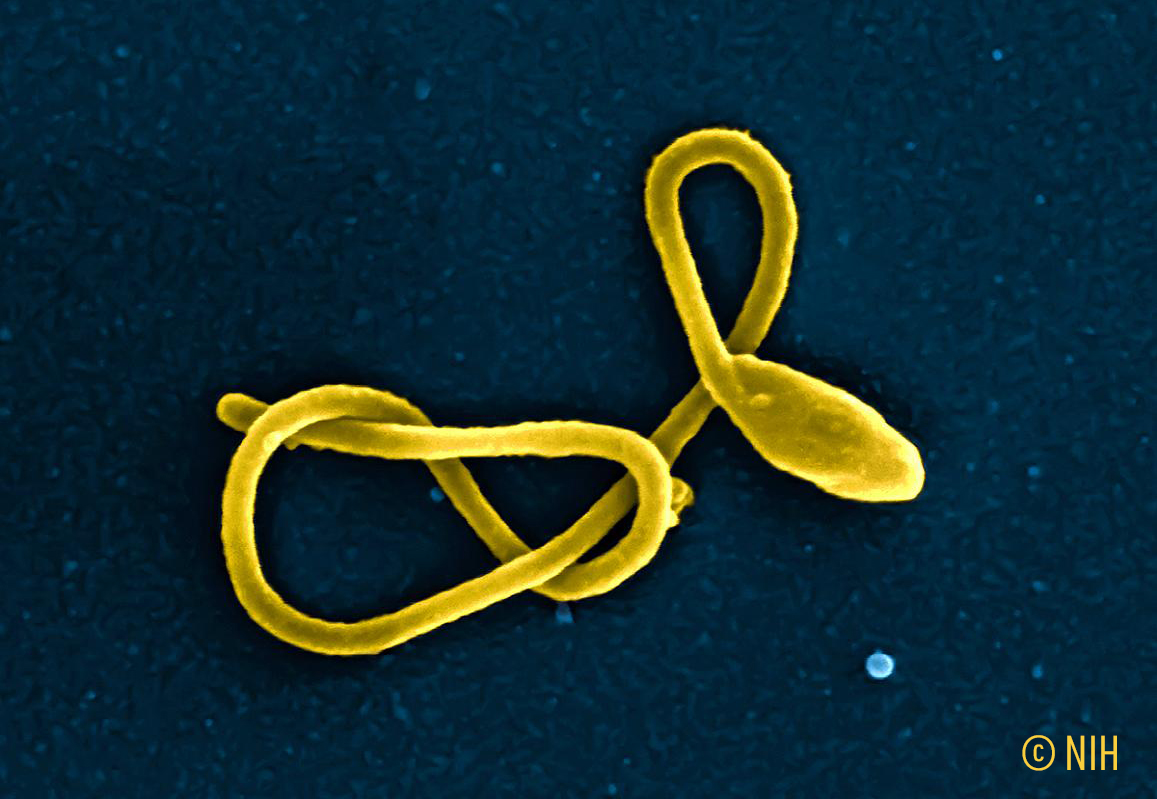
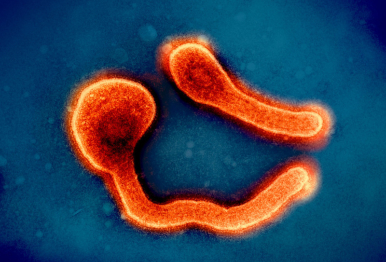
Ebola virus disease (EVD) is caused by single-stranded RNA viruses of the genus Orthoebolavirus belonging to the family Filoviridae, responsible for certain viral haemorrhagic fevers (Ebola and Marburg virus disease). These viruses are filoviruses, i.e. enveloped filamentous particles with a non-segmented, negative-strand RNA genome. In all Ebola viruses, unlike the Marburg virus, RNA splicing leads to the expression of the glycoprotein that forms the spicule.1
Six viral species have been described to date, three of which are highly pathogenic to humans:1
Of the three other known viral species, only the Taï Forest virus (named after Taï National Park in Ivory Coast, where it first appeared in 1994) is also pathogenic to humans. The Reston virus affects only non-human primates, and the Bombali virus only bats.
Ebola virus disease was first identified in 1976 during two simultaneous outbreaks in Central and East Africa: one was Sudan virus disease in the town of Nzara (in South Sudan); and the other was Ebola virus disease (Zaire strain) near the river of the same name in the village of Yambuku in the Democratic Republic of the Congo (DRC, formerly Zaire).2
The Bundibugyo virus, meanwhile, was first characterised during the 2007–2008 outbreak in the Bundibugyo district of Uganda.3
Around fifty Ebola virus disease outbreaks have been recorded since 1976.4
The majority and most severe of these were caused by the Ebola (Zaire) virus. The 2014–2016 outbreak in West Africa (Guinea, Liberia, Sierra Leone) affected 28,610 people, of whom 11,308 died. During this outbreak of unprecedented scale, fewer than 10 cases were recorded outside Africa (including two in France), mainly linked to the repatriation of patients, including healthcare workers who had been infected locally.
The most recent Ebola virus (Zaire) outbreak occurred between September and December 2025 in the DRC. More than 47,500 people were vaccinated, enabling the outbreak to be rapidly contained despite difficult logistical conditions, with a total of 64 cases, including 45 deaths.5
Sudan virus outbreaks have been concentrated in Uganda and along the border between the DRC and South Sudan. The most recent one took place between January and April 2025 in Uganda.
As for the Bundibugyo virus, it was responsible for three outbreaks: in Uganda in 2007–2008 (131 cases, 42 deaths); in the DRC in 2012 (38 confirmed cases, 12 deaths); and during an ongoing outbreak in both countries in May 2026.
As of 24 June 2026, only one confirmed case of Ebola virus disease had been imported into mainland France or its overseas territories. In June 2026, the Ministry of Health, Families, Autonomy and People with Disabilities confirmed the identification of the first positive case of Ebola virus disease (Bundibugyo) on national territory. The patient, who had returned from a humanitarian mission in one of the areas where the virus is circulating in the DRC, was immediately admitted to a specialist facility in accordance with strict biosafety protocols (negative-pressure room, specific equipment and protocols).
To date, no confirmed cases have been imported into mainland France or its overseas territories. The only two confirmed cases treated in mainland France were brought back via a secure medical repatriation following their diagnosis during the 2014–2016 Ebola virus (Zaire) outbreak. No secondary cases were recorded at that time.6
Ebola virus disease is of zoonotic origin. Its natural host is a fruit-eating bat of the family Pteropodidae. This bat transmits the virus to other mammals, particularly non-human primates, via contaminated fruit and its faeces. Transmission from animals to humans occurs through contact with live or dead infected animals.
Human-to-human transmission occurs through direct contact with the bodily fluids of an infected person, or indirectly via contaminated bed linen, clothing or syringes.7 Sexual transmission has been observed, but is extremely rare.8
Healthcare workers are particularly at risk whilst providing care. It is essential to wear the required personal protective equipment.9 Pregnant women who have previously had an acute form of the disease may still carry the virus in breast milk or in fluids and tissues associated with pregnancy.10 Therefore, it is recommended that breastfeeding be avoided.11
Clinically, Ebola virus disease appears, in its early stages, similar to other infectious diseases such as malaria, typhoid fever, shigellosis, meningitis and other viral haemorrhagic fevers.
Diagnosis therefore relies primarily on the detection of viral RNA by RT-PCR during the acute phase, carried out in laboratories with appropriate biosafety facilities. Rapid antigen tests may be used as a first-line approach in remote areas, but require confirmation by PCR.12
The incubation period ranges from 2 to 21 days.13
Infected individuals are only contagious after the onset of the first symptoms. Symptoms appear successively in two phases:
The management of Ebola virus disease patients is often intensive and relies on supportive care, including oral or intravenous rehydration, and symptomatic treatment.
The case fatality rate varies depending on the strain and the patient’s management. Management in an intensive care unit with trained staff will improve the patient’s prognosis.
Nevertheless, the case fatality rate remains high, at 25% for the Bundibugyo virus, 50% for the Sudan virus and 80–90% for the Ebola (Zaire) virus.14
Of the three viral species that are highly pathogenic to humans, only the Ebola virus (Zaire) (ZEBOV) has treatments and vaccines approved by health authorities.
There are currently two treatments approved in 2020 by the US Food and Drug Administration (FDA), each targeting the surface glycoprotein of ZEBOV:15
They have similar efficacy in treating the infection in adults and children, in infants born to people with confirmed Ebola, and in pregnant and breastfeeding women. They were used during the 2018–2020 outbreak in the Democratic Republic of the Congo.
To date, two vaccines have been approved by the FDA and the European Medicines Agency (EMA) for the prevention of ZEBOV disease.
Erbevo® (rVSV-ZEBOV)18, developed by the US laboratory Merck & Co, is a single-dose live attenuated vaccine containing the ZEBOV surface glycoprotein. Administered prior to exposure to the virus, it has demonstrated 97.5–100% efficacy and elicited a detectable antibody response after 12 months in 76% of adults and 87% of children.19–21 In August 2023, the FDA also approved Ervebo® for children aged one year and older.22
Zabdeno®/Mvabea® (Ad26.ZEBOV/MVA-BN)23, developed by the Belgian laboratory Johnson & Johnson Innovative Medicine (formerly Janssen Pharmaceuticals), is a two-dose recombinant vaccine: the first dose contains the ZEBOV surface glycoprotein; the second, administered eight weeks after the first, contains the glycoproteins of the ZEBOV, Sudan and Marburg viruses. The vaccine has been shown to be safe in Phase I, II and III clinical trials, with 41% of adults and 78% of children showing a detectable antibody response at 12 months.24,25 However, further studies are needed to clarify the vaccine’s protective efficacy.
The World Health Organisation’s Strategic Advisory Group of Experts (SAGE) recommends using the authorised vaccine Ervebo® during an outbreak and maintaining a global stockpile of 500,000 doses.26
Other treatments or vaccines targeting ZEBOV are also under investigation:
Finally, some approaches have not proved conclusive, such as convalescent plasma.34
To date, no specific antiviral treatment or vaccine has been approved for the Sudan (SUDV) or Bundibugyo (BDBV) viruses.
Several antivirals and monoclonal antibodies are currently being studied for their activity against SUDV, including obeldesivir, which has already been successfully tested in cynomolgus macaques.35
As for BDBV, the most advanced treatment candidate to date is MBP134 (and its optimised derivative, MBP431). This cocktail of two broad-spectrum monoclonal antibodies, capable of neutralising several viral species of Orthoebolavirus, has already been tested as a single dose administered intravenously or intramuscularly in non-human primates.36,37 Obeldesivir (oral) and remdesivir, two broad-spectrum antivirals, have shown activity against BDBV, but data remain limited.
Approved vaccines against ZEBOV do not appear to confer cross-protection against SUDV.38 In 2022, however, a pre-clinical study demonstrated a protective immune response induced by the multivalent Zabdeno®/Mvabea® vaccine against SUDV and Marburg virus in non-human primates.39
Although designed against ZEBOV, the Ervebo® vaccine offers partial heterologous protection against BDBV40, but its efficacy remains unproven in real-world conditions. And although the Zabdeno®/Mvabea® vaccine is a multivalent platform (targeting multiple viruses), no data demonstrate cross-protection against BDBV.
Several vaccine candidates specifically targeting BDBV or designed to be pan-filoviral are currently in the preclinical phase, with results in animals. The rVSV-BDBV GP vaccine, in particular, has shown protection in primates following exposure, but has never progressed to the clinical stage.
ANRS Emerging Infectious Diseases (ANRS MIE) supports, facilitates and coordinates research on emerging infectious diseases – including Orthoebolavirus.
On 21 January 2025, ANRS MIE was appointed to lead the Collaborative Open Research Consortium (CORC) on filoviruses of the World Health Organisation (WHO).
CORCs are international networks of research institutions whose mission is to define research priorities and strengthen global pandemic preparedness through collaborative research, knowledge sharing and the rapid development of countermeasures.
In March 2025, the ANRS MIE’s “Epidemic Surveillance and Response” unit activated a Level 1 Emergence Cell on filoviruses. This permanent cell involves scientific surveillance of Marburg and Ebola virus epidemics.
It follows on from an initial Level 1 Emergency Cell, which operated from September 2022 to January 2023 in response to the Ebola virus outbreak (Sudan) that occurred in Uganda.
In 2024, ANRS MIE established a Coordinated Action on Viral Haemorrhagic Fevers co-chaired by Sylvain Baize, Marie Jaspard and Abdoulaye Touré.
This group for exchange and strategic reflection is dedicated in particular to scientific research on filoviruses and aims, through its working groups (therapeutics, wildlife, vaccines), to develop research projects within the framework of international collaborations, primarily with our partners in Africa.
Finally, one of the main missions of ANRS MIE is to fund basic and clinical research. The EBO-PEP project is one of the projects funded in this way to improve understanding of Ebola virus disease.
Coordinated by Prof. Placide Mbala and Dr Marie Jaspard, its aim is to evaluate an innovative post-exposure prophylaxis (PEP) strategy for high-risk individuals (children, adolescents, adults) following contact with the Ebola virus (Zaire). The study compares an approach combining monoclonal antibodies and vaccination with vaccination alone. Conducted in real-world epidemic settings (DRC, Guinea, Liberia, Sierra Leone), this trial aims to prevent the development of the disease, reduce secondary transmission and better protect exposed populations, particularly healthcare workers.
Image credit:
Viral haemorrhagic fevers (VHFs) encompass various diseases (Ebola, Lassa fever, Marburg fever, Crimean–Congo fever, etc.).
12 March 2024