

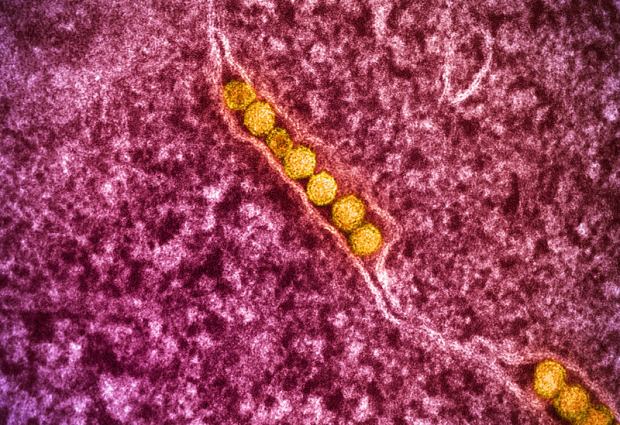
West Nile fever is an infectious disease caused by an arbovirus belonging to the Flaviviridae family. It is currently found in Africa, Europe, the Middle East, North America and Western Asia.
Last updated on 30 September 2026
West Nile virus (WNV) is the causative agent of the zoonotic disease known as West Nile fever.¹ It was first isolated in 1937 from a woman living in the Protectorate of Uganda (present-day Republic of Uganda), in the West Nile Province.² Sporadic human cases were subsequently identified in Egypt and Israel during the 1950s.¹
The virus is believed to have been introduced into Europe during the 1960s by migratory birds originating from sub-Saharan Africa and the Middle East. With 13 human cases recorded in the Camargue region between 1962 and 1964, France became the first European country to report human WNV infections.1,3
The first major human outbreak occurred in South Africa in 1974.⁴ However, it was not until the late 1990s that the virus attracted significant scientific attention, following the occurrence of unusually severe human cases during nine outbreaks affecting countries around the Mediterranean basin (Algeria, Morocco, Tunisia, France, Italy and Israel) as well as countries in Central and Western Europe (Romania and Russia).⁴
In 1999, a West Nile virus strain circulating in Tunisia and Israel was introduced into New York, revealing its epidemic potential. The large-scale outbreak that spread throughout the United States between 1999 and 2010 highlighted the global threat posed by this emerging virus, which is now endemic in North America.5,6 Between 1999 and 2006, West Nile virus infection caused 962 deaths in the United States. Nearly 24,000 infections were documented, including almost 9,900 neuroinvasive cases.⁶
The virus is currently present in Africa, Europe, the Middle East, North America and Western Asia.⁵
Following several sporadic outbreaks, the first major European epidemic occurred in Romania in 1996, with nearly 400 human cases and the first reports of severe neurological disease.⁷ Since then, particularly from 2010 onwards, outbreaks and epizootic events have multiplied, especially in Central Europe and the Eastern Mediterranean, where the virus is endemic and where major migratory bird flyways are located.5,8
The year 2018 was particularly noteworthy, with the largest outbreak ever recorded in Europe and a number of cases exceeding the combined total reported during the previous seven years. Human cases were reported for the first time in Germany in 2019 and 2020, and in the Netherlands in 2020.⁸
In 2024, 19 European countries reported 1,436 autochthonous human WNV infections, including 235 deaths, mainly in Italy (455 cases and 21 deaths) and Greece (217 cases and 34 deaths).⁹
From the beginning of 2025 to 13 August 2025, eight European countries reported human WNV infections: 1 case in Bulgaria, 1 in Hungary, 5 in Romania, 13 in France, 24 in Greece, 9 in Serbia, 1 in Spain and 267 in Italy.¹⁰
On 16 July 2026, Santé publique France reported a locally acquired case of WNV infection identified in the Pyrénées–Orientales (Occitanie). This is the first detection of the virus circulating in humans in France in 2026.

Since its first detection in France in 1962, West Nile virus has been regularly identified around the Mediterranean basin.1,3,8
Human WNV infections were identified in France in 2003, with increasing viral circulation observed since 2015.⁶
In 2024, 38 autochthonous infections were reported in the Provence-Alpes-Côte d’Azur, Occitanie and Nouvelle-Aquitaine regions: 24 cases in Var, 9 in Hérault, 3 in Gard, 1 in Gironde and 1 in Pyrénées-Atlantiques. The 2024 burden was among the highest ever recorded, close to that of 2023 (39 cases) and substantially higher than in 2022 (6 cases) and 2021 (no reported cases). Since 2021, West Nile fever has been included on the list of notifiable diseases in humans, strengthening surveillance efforts.¹¹
Between the beginning of 2025 and 19 August, 13 autochthonous infections were reported in mainland France. Three transmission clusters were identified in Provence-Alpes-Côte d’Azur (9 cases), one in Île-de-France (2 cases), one in Corsica (1 case) and one in Occitanie (1 case). The first detection of the virus in 2025 occurred in Var on 29 July.¹²
The Île-de-France cluster involved two patients with no medical history or recognised risk factors who developed neurological disease. The first patient, a 25-year-old woman with no recent travel history, presented with meningitis associated with nystagmus (an involuntary rhythmic oscillation of one or both eyes), a manifestation rarely reported in West Nile virus infection. The second patient, a 64-year-old man who had recently stayed in the Jura region, developed encephalitis associated with a cerebellar syndrome*. Neither patient received specific treatment. Both recovered fully without sequelae after several days of hospitalisation. A third case in Île-de-France remains under investigation.
* A disorder affecting the cerebellum and characterised by balance impairment, speech difficulties, gait disturbances and impaired fine motor coordination.
West Nile virus (WNV) is a positive-sense single-stranded RNA arbovirus belonging to the family Flaviviridae and the genus Orthoflavivirus, which also includes Zika virus and dengue virus.6,13 It can infect humans, horses and other mammals.5,14
Nine phylogenetic lineages have been described. In Europe, lineages 1 and 2 are responsible for human disease.13,15 Lineage 3 is also considered potentially pathogenic for humans.¹⁶
West Nile fever is an arboviral disease.2,6,14
Birds constitute the main reservoir of the virus, and transmission between viraemic and non-infected birds is primarily mediated by female mosquitoes of the genus Culex.¹⁷
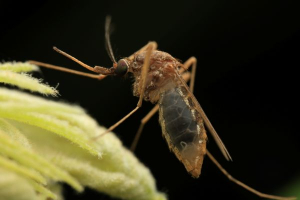 In mainland France, two species are primarily involved: Culex pipiens, which may be highly abundant in urban environments, and Culex modestus, which is more commonly found in rural settings.17 Culex pipiens pipiens feeds on a wide ran ge of hosts, including birds and mammals, and plays a major role in virus transmission. Culex pipiens molestus feeds primarily on mammals and is thought to play a more limited role in transmission.¹⁷
Culex modestus preferentially feeds on birds but also bites humans and other animals.¹⁷
Other mosquito species, such as Aedes albopictus, can replicate or transmit West Nile virus. However, their epidemiological importance in France has not been demonstrated.¹⁷
Viral circulation follows a seasonal pattern linked to the mosquito breeding season, which begins in spring and ends in autumn. Horses and humans are considered accidental hosts or epidemiological dead-end hosts, as viraemia levels are insufficient to infect mosquitoes during blood feeding and therefore do not sustain onward transmission.8,14
Culex modestus preferentially feeds on birds but also bites humans and other animals.¹⁷
Other mosquito species, such as Aedes albopictus, can replicate or transmit West Nile virus. However, their epidemiological importance in France has not been demonstrated.¹⁷
Viral circulation follows a seasonal pattern linked to the mosquito breeding season, which begins in spring and ends in autumn. Horses and humans are considered accidental hosts or epidemiological dead-end hosts, as viraemia levels are insufficient to infect mosquitoes during blood feeding and therefore do not sustain onward transmission.8,14
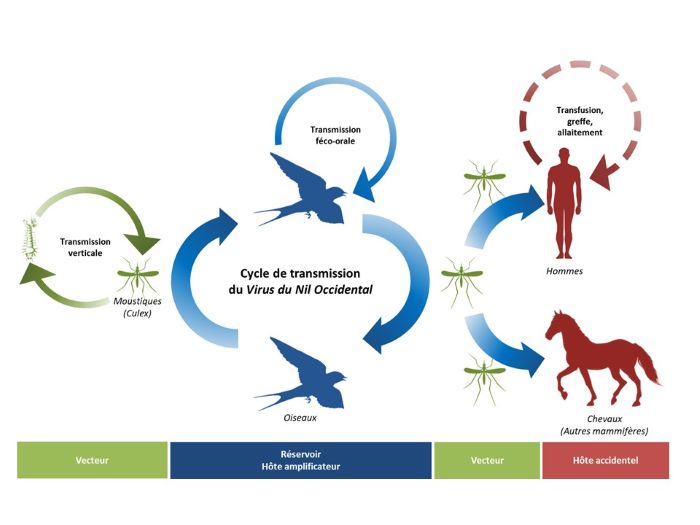
Human-to-human transmission may occur through substances of human origin, including blood transfusion and the transplantation of tissues, cells or organs from an infected viraemic donor.¹⁷
The incubation period generally ranges from two to six days but may extend to 21 days in immunocompromised individuals.⁶ Diagnosis of WNV infection relies on both indirect and direct detection methods. Indirect diagnosis is based on serological testing of serum and cerebrospinal fluid, although cross-reactivity may occur with other Orthoflavivirus infections. Direct diagnosis can be achieved using PCR performed on whole blood, plasma (from day 2 onwards), serum, cerebrospinal fluid in cases with neurological involvement, and urine samples.⁸
Human infections with West Nile virus are asymptomatic in approximately 80% of cases. However, around 20% of infected individuals may develop symptomatic disease characterised by fever, myalgia, malaise, nausea, vomiting or skin rash, which generally resolves within one week.5,6,18
Neurological complications, including meningitis, encephalitis and acute flaccid paralysis, occur in fewer than 1% of patients.6,18 Guillain–Barré syndrome has also been reported and may be fatal.¹⁸
Among severe cases, the case-fatality rate may reach 17%, particularly in high-risk populations such as immunocompromised individuals and older adults.5,19 Risk factors include advanced age, malignancies affecting blood–brain barrier integrity, hypertension, haematological disorders, diabetes mellitus, kidney disease, alcohol misuse and genetic predisposition.¹⁹
There is currently no curative treatment available for human West Nile virus infection, and no licensed therapeutic WNV-specific immunoglobulin products exist. Supportive care is provided to patients with neuroinvasive disease and may include hospitalisation, respiratory support and close monitoring of vital functions.¹³
Research on antiviral treatments, including both antiviral compounds and monoclonal antibodies, is ongoing but remains limited. Several candidates have been identified and evaluated primarily in animal models, with encouraging results. In parallel, monoclonal antibodies targeting the West Nile virus envelope (E) protein have demonstrated promising efficacy by improving survival and reducing viral load in these models. However, no specific treatment has yet been approved for human use, partly because of the challenges associated with rapidly establishing clinical trials during outbreaks.²⁰
Other research efforts are focused on identifying and optimising novel inhibitors, particularly those targeting the RNA-dependent RNA polymerase responsible for synthesising RNA from an RNA template.²¹
No vaccine is currently available for human use. However, veterinary products such as West Nile-Innovator® (Zoetis) and Recombitek® Equine West Nile Virus (Merial), which have demonstrated efficacy in horses, may serve as models for the development of human vaccines.
Among the approaches under investigation, inactivated vaccines have demonstrated strong immune responses in animal studies. For example, vaccination of zoo birds has been shown to induce a substantial increase in neutralising antibody titres.²²
Several clinical trials are currently evaluating the safety, immunogenicity and adverse effects of vaccine candidates in humans*:
Phase I
Phase II
*These candidates include chimeric vaccines (such as ChimeriVax-WN02) and multi-peptide vaccines.²¹
Individuals can reduce exposure to mosquitoes by wearing protective clothing and using repellents, mosquito coils, electric diffusers and mosquito nets. Collective measures include the control of mosquito breeding sites and, depending on the entomological situation, targeted interventions against adult mosquitoes.⁸
Specific measures are also implemented to ensure the safety of blood transfusion and organ and tissue donation. These measures are based on donor screening and the exclusion of at-risk donors, in accordance with recommendations issued by the French High Council for Public Health (HCSP) and its permanent working group on the safety of human-derived products (SECPROH).⁸
Effective prevention depends on the development of comprehensive and integrated mosquito surveillance programmes. For this reason, plans are underway to map ecosystems and monitor their evolution under the influence of climate change in order to track changes in West Nile virus risk.²¹
ANRS Emerging infectious diseases supports research on West Nile virus and its vectors through a portfolio of projects representing approximately five million euros in funding, covering areas including clinical research, vector control and surveillance.
To advance understanding of the disease, ANRS MIE supports projects through its LMIC Emerging Diseases Calls for Proposals. One example is the IFNArboVE project, led by a French team headed by Shenying Zhang (IHU Institut Imagine, Paris) and a Brazilian team led by Carolina Prando (Pelé Pequeno Príncipe Research Institute). The project explores the central role of deficiencies in type I interferon-mediated immunity in the development of severe neuroinvasive disease, particularly encephalitis, caused by arboviruses including West Nile virus, dengue virus, Zika virus, chikungunya virus and Oropouche virus.
The agency also encourages research on therapeutics. The NeuroFlaviNA project, led by Suzanne Peyrottes (CNRS) and funded through the PEPR MIE 2024 Call for Proposals, aims to develop new compounds, including nucleoside analogues capable of efficiently crossing the blood–brain barrier, for the treatment of neuroinvasive infections caused by emerging or re-emerging Orthoflaviviruses.
ANRS MIE is involved in several research projects funded through various agency calls for proposals:
The agency supports projects aimed at strengthening surveillance systems.
One example is the ArboFaso project (LMIC Emerging Diseases 2022 Call for Proposals, Burkina Faso), led by Yannick Simonin (University of Montpellier) and Bachirou Tinto (IRSS, Centre MURAZ). The project adopts an integrated One Health approach to assess and monitor arboviral risk in Burkina Faso. It investigates virus circulation among humans, domestic and wild animals, and their vectors in both urban and peri-urban environments.
During the exceptional circulation of Usutu virus and West Nile virus in the Nouvelle-Aquitaine region, a research programme led by Alexandre Duvignaud (University of Bordeaux) brought together regional and national stakeholders from the fields of human, animal and environmental health. Within this framework, a preliminary seroprevalence study in horses confirmed the circulation of West Nile virus in Nouvelle-Aquitaine. This initiative demonstrated the value of an integrated surveillance system. Extending this approach to the Île-de-France region could be considered.
As part of the ANRS MIE–Arbo-France call for applications, which awards three PhD fellowships in arbovirology to early-career researchers developing innovative projects in vector control, Djara Konate was awarded funding in 2024 for her doctoral project entitled: “Avian and Equine Surveillance for Two Flaviviruses in Burkina Faso.” The project aims to monitor Usutu virus and West Nile virus in domestic and wild birds, as well as in horses, in urban and peri-urban areas of Burkina Faso using molecular and serological methods. Its objectives are to identify bird species involved in the enzootic cycle, characterise circulating viral strains and evaluate the usefulness of horses as sentinel animals.
In collaboration with ANRS MIE, Arbo-France dedicated a scientific workshop to West Nile virus surveillance in November 2023. The event highlighted the need for an integrated surveillance system combining regulatory surveillance and applied research to respond to the expanding circulation of the virus and the associated risks to human health. The workshop also underscored the importance of a nationally coordinated strategy with strong regional implementation, supported by data collection and analysis tools, interagency coordination mechanisms and dedicated financial resources.
Supporting scientific research on emerging infectious diseases, including West Nile virus, is a core mission of ANRS Emerging infectious diseases.
To facilitate this support, several funding mechanisms have been established.
We encourage you to consult the full list of our calls for proposals to identify the funding scheme best suited to your objectives.
ANRS MIE activated a Level 1 outbreak response unit on 21 August 2025 in response to the evolving West Nile fever situation in France.