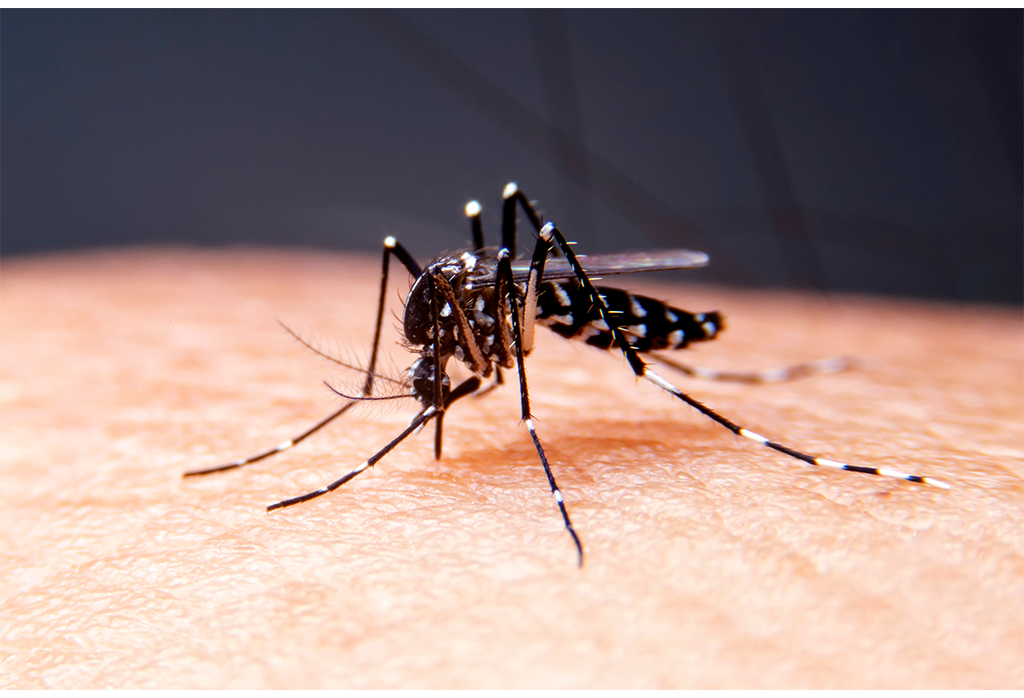
As a 2025 PEPR MIE grant recipient, the ArboSENSOR project aims to develop a portable and reliable arbovirus detection system. Project coordinator Dr Laura Picas explains.
Last updated on 17 June 2026
 The aim of the ArboSENSOR project is to harness research to drive innovation. A 2025 awardee of the Priority Research Programme and Equipment for Emerging Infectious Diseases (PEPR MIE), led and operated by ANRS MIE as part of the France 2030 plan, this project aims to develop a miniature system for detecting the chikungunya, Zika and dengue viruses, which is portable yet as reliable as an ELISA or PCR test.
“We want to continue making point-of-care diagnostic systems more widely available [in the immediate vicinity of the patient], much like the at-home Covid-19 antigen self-tests,” says Dr Laura Picas, research director at the CNRS and the University of Montpellier and coordinator of the ArboSENSOR consortium. “This will enable us to identify patients even in areas that are difficult to access or lack the infrastructure and specialist staff required for ELISA or PCR tests.”
The research project is based on an initial exploratory proof of concept: the adaptation and subsequent optimisation of a miniature quartz-based optical detection system capable of analysing specific oscillation frequency signatures in a sample.
In collaboration with a research team specialising in microelectronics, Dr Laura Picas’s team has succeeded in developing a surface onto which anti-chikungunya antibodies can be attached, thereby making the system “five times more sensitive than an ELISA test”, says Dr Laura Picas. “With the ArboSENSOR project, we aim to extend the compatibility of our system to other arboviruses, improve it to achieve a sensitivity close to that of a PCR test, and adapt it for electrical rather than optical detection in order to miniaturise it even further. ”
Dr Laura Picas’s team would not have been able to pursue this ambition without the support of ANRS MIE.
“As a biophysicist, albeit working at an institute of infectious diseases, I was unsure whether I would be eligible for funding from ANRS MIE,” says the research director at the Montpellier Institute for Infectious Diseases Research (IRIM). But when the PEPR MIE’s 2025 call for proposals opened, everything fell into place: the drive to innovate in ‘point-of-care’ testing, the means to assemble the widest possible consortium and thus draw on significant sampling capabilities, and, of course, the priority given to research into emerging infectious diseases. This has enabled us to develop the technology as we envisaged it and make a real difference.”
With the support of the ANRS MIE, the ArboSENSOR project will therefore begin in September 2026. As part of the PEPR MIE, this project is receiving funding of 1 million euros over 36 months.
With a budget of 70 million euros from the France 2030 plan and led by the ANRS MIE, the PEPR MIE is an essential funding mechanism for research and innovation to combat the emergence of infectious diseases. It is one of the key measures of the Government’s acceleration strategy ‘Emerging Infectious Diseases & Nuclear, Radiological, Biological and Chemical Threats’ (SA MIE MN).
Since 2023, the PEPR MIE has funded 34 research projects and junior chairs, focusing on acquiring new knowledge, developing new therapeutic strategies and improving public health policies. Discover four profiles of winning projects:
And find all the video interviews and conference replays on the PEPR MIE on our YouTube playlist.

Pandemic preparedness for respiratory virus X: integrative modelling from early cases to early health countermeasures.
24 February 2026
Analysis of volatile organic compounds in exhaled air for rapid diagnosis of emerging respiratory infections.
24 February 2026
Determinants of severe dengue fever in the French overseas territories
23 January 2025