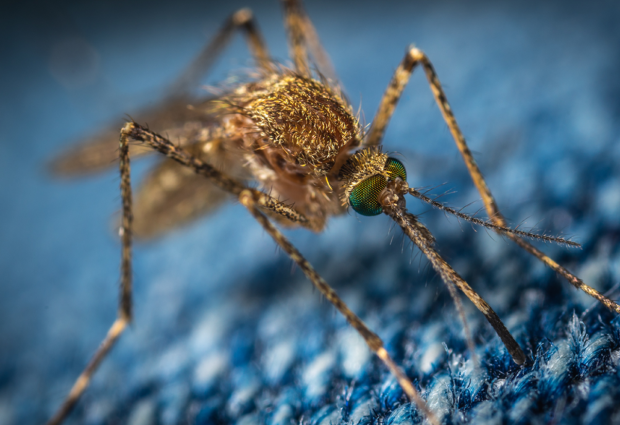
20 August marks the anniversary of Dr Ross’s 1897 discovery of the role played by female mosquitoes in transmitting malaria to humans. Above all, this day provides an opportunity to raise public awareness of the health risks associated with mosquitoes and the diseases they carry.
Last updated on 20 August 2026
There are 65 different species of mosquitoes in mainland France, 13 in Réunion, 50 in Mayotte, 22 in New Caledonia, 17 in French Polynesia, 22 in Martinique, 41 in Guadeloupe and 249 in French Guiana.1
Fewer than 400 species of mosquitoes, out of the 3,500 that exist, are responsible for transmitting viral and parasitic diseases to humans.2
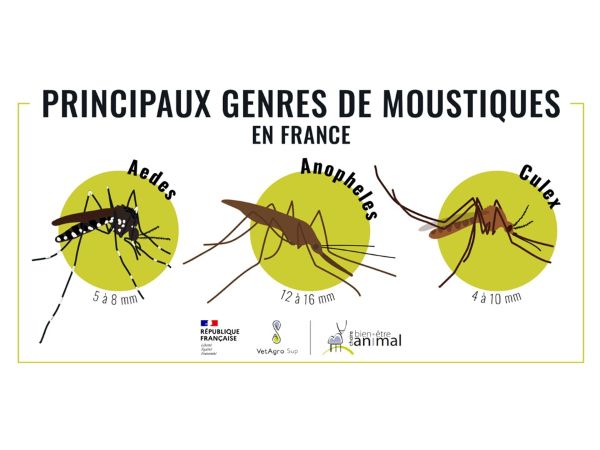
Three main genera of mosquitoes are found in France: Aedes, Anopheles and Culex.1
The Culex genus includes the species Culex pipiens, the most common species in mainland France. Anopheles mosquitoes are found in rural and peri-urban areas along the Atlantic coast, in Corsica and in certain wetlands in central France. They are found in Europe and the Middle East.1,4
The Aedes albopictus mosquito (tiger mosquito), native to Asia and classified as an invasive alien species, has spread rapidly across mainland France since 2004. As of 1 January 2026, it was established in 83 out of 96 departments.1,4 The genus Aedes is also present in Réunion, Mayotte, Guadeloupe, Martinique and French Guiana.1
Mosquitoes of the genus Aedes are vectors of the dengue virus, the chikungunya virus and the Zika virus.2,6
Those of the genus Anopheles are the primary vectors of the Plasmodium parasite, which causes malaria, while mosquitoes of the genus Culex transmit the West Nile virus. 2,6
Some of these diseases (dengue, chikungunya, Zika and West Nile fever) are arboviral infections.
2025 was marked by the early circulation of certain arboviruses in mainland France. The first signs of chikungunya were reported as early as 27 May.7
The year was also characterised by a rise in the number of locally acquired cases.7 In mainland France, over the period 2010–2024, the highest annual number of locally acquired arbovirus cases was 84 in 2024: 83 cases of dengue and 1 case of chikungunya. In 2025, 809 locally acquired cases of chikungunya and 30 locally acquired cases of dengue were reported.7
The early and massive increase in episodes of chikungunya transmission in 2025 can be explained by the epidemic that occurred in the Indian Ocean, particularly in Réunion, where frequent travel to mainland France played a key role in the introduction of the virus by viraemic travellers. Furthermore, this epidemic was caused by a viral strain particularly well-adapted to the Ae. albopictus mosquito.7
As of 3 August 2026, three episodes of local transmission of chikungunya (seven cases), two of local transmission of dengue (two cases) and four locally acquired cases of West Nile virus infection had been identified in mainland France.8
The year 2026 was marked by heatwaves (periods of temperatures significantly higher than normal for several days) and spells of extreme heat (periods of very high temperatures, both day and night, over an extended period of at least three days).9
There is currently no consensus on exactly how climate change will affect vector-borne diseases globally.10 However, climate change is recognised as a key factor influencing the geographical distribution of arboviral diseases.10-12
A warmer climate and changing rainfall patterns can create environments conducive to climate-sensitive vectors (such as mosquitoes and ticks) and pathogens.11
In recent years, the range of arboviral diseases has expanded beyond their natural boundaries – the tropical and subtropical regions – to reach the temperate regions of Europe, which had previously been spared.2
Mosquitoes are ectothermic: their body temperature depends on their external environment. Unable to regulate their internal temperature, they adapt to temperature changes by moving to areas where climatic conditions are compatible with their development.13 The climate therefore acts as a limiting factor on the establishment of these insects.13
High temperatures can reduce virus transmission by lowering the survival rate of mosquitoes and exceeding the thermal limits of arboviruses. They can also promote transmission by accelerating viral replication and shortening the extrinsic incubation period.12
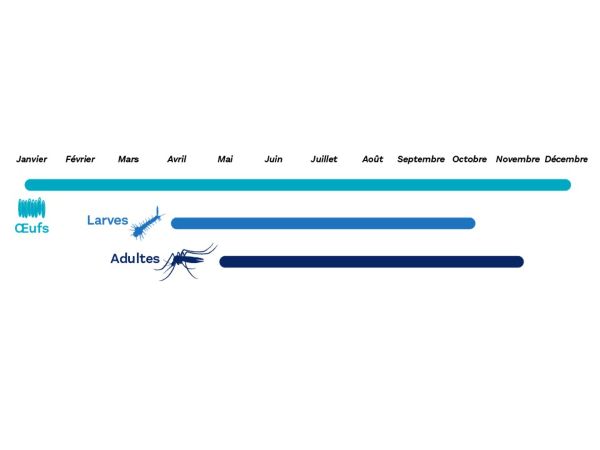
For example, the development cycle of Ae. albopictus is half as long at 30 °C as it is at 20 °C.13 The survival rate of adults also depends on temperature. Yet the infected adult mosquito must survive long enough to ensure transmission of the pathogen.13
Thus, the thermal plasticity of mosquito traits plays an important role.12
Current data indicate that Ae. aegypti exhibits greater tolerance to high-temperature thermal stress than Ae. Albopictus. The native species Cx. pipiens, which is better adapted to cold conditions, shows the lowest survival rate under heat stress, its upper thermal limit (UTL) being the lowest of the three species.12
Experiments on the life cycles of these species have shown that Cx. pipiens generally cannot tolerate temperatures above 33 °C, Ae. albopictus above 35 °C and Ae. aegypti above 40 °C.12
One study examined the upper thermal limit of the three species at each life stage and assessed their potential persistence in Europe under current and future heatwave scenarios.12
Models predicted that heatwaves would primarily affect the larvae and adults of all species (the survival threshold varies depending on the life stage). By 2100, the two Aedes species are expected to be able to persist thanks to their egg reserves, should Ae. aegypti become established in Europe.12
Vast regions of southern Europe will exceed the thermal limits of Cx. pipiens. Due to its lower heat tolerance, the species could see its viable habitat reduced under successive heatwaves. Ae. albopictus is expected to face moderate constraints. Ae. aegypti is not expected to be limited by extreme heat overall, but rather by low humidity, which supports the hypothesis that aridity limits its current distribution in Europe.12
Climate and weather variations – whether in temperature, rainfall or humidity – can therefore affect the reproduction, survival and geographical distribution of mosquitoes and, consequently, their ability to transmit pathogens.10
Arbo-France, under the aegis of ANRS MIE, is a French network dedicated to the study of arboviral diseases, whose aim is to facilitate preparedness and response to human and animal arbovirus epidemics in mainland France and overseas territories.
Arbo-France has identified three priority areas in arbovirology research:
Management of the epidemic, covering patient care, prevention and innovative strategies for combating and responding to these infections (therapeutic, vaccine-based and vector-control measures), while incorporating the socio-anthropological dimension and social and regional inequalities.
This consortium brings together French medical and scientific teams from Guadeloupe, Martinique, French Guiana, Réunion, French Polynesia, New Caledonia and mainland France. Its aim is to identify new prognostic biomarkers for severe forms of dengue using the CARBO cohort.
It is funded under the Priority Programme and Equipment for Research into Emerging Infectious Diseases (PEPR MIE).
LSDengue will establish the first inter-territorial network for sharing samples and data, linking most of France’s overseas territories.
This project, closely linked to LSDengue, is based on the collection of dengue virus (DENV) genomes circulating in French overseas territories and mainland France, and aims to identify the genetic determinants of the virus involved in the severity of the disease.
This project aims to study the impact of DENV genome mutations on the pathogenesis of the disease and on methods of combating it.
This project is funded by MSDavenir.
LSDengue and ARBOGEN are complementary projects that will lay solid foundations for preparedness and response to emerging viruses, particularly arboviruses, across the whole of France.
This call aims to support collaborative research projects between a French team and a team from a low- or middle-income country (LMIC) on global challenges related to emerging infectious diseases, including arboviral diseases. It promotes an integrated approach, bringing together basic, translational and clinical research, as well as research in public health, humanities and social sciences.
20 August marks World Mosquito Day, commemorating a critical discovery made by Dr Ross in 1897, who first made the link that female mosquitoes transmit malaria between humans. Above all, it is an opportunity to raise public awareness of the health risks associated with mosquitoes and the diseases…
20 August 2025