

Dernière mise à jour le 27 février 2023
ANRS/NIDA DRIVE-IN, a study supported by the ANRS and the US National Institute on Drug Abuse (NIDA), has shown in Haiphong, Vietnam, that a large-scale program for risk reduction and increased access to antiretroviral therapies greatly reduced HIV incidence in people who inject drugs. The HCV epidemic, on the other hand, continues unabated in this population, despite high coverage of harm reduction interventions. Only broad access to highly effective treatments will enable eradication of hepatitis C among people who inject drugs in Vietnam. The ANRS/NIDA DRIVE-IN results will be presented by Professor Pham Minh Khuê (Faculty of Public Health, Haiphong University of Medicine and Pharmacy) in an oral communication on July 25, during the 9th IAS Conference on HIV Science, organized by the International Aids Society and the ANRS in Paris from 23 to 26 July 2017.
Réalisée à Hai Phong, l’étude ANRS/NIDA DRIVE-IN, soutenue par l’ANRS et le National Institute on Drug Abuse (NIDA) des USA, met en évidence une réduction importante de l’incidence du VIH parmi les usagers de drogues, grâce à un vaste programme de réduction des risques et d’accès aux traitements antirétroviraux. En revanche, l’épidémie liée au virus de l’hépatite C reste très active dans cette population, malgré une large couverture des interventions de réduction des risques. Seule l’addition d’un accès large aux traitements hautement efficaces permettrait d’enrayer l’hépatite C parmi les usagers de drogues au Vietnam. Les résultats de l’étude ANRS/NIDA DRIVE-IN, sont présentés par le Pr Pham Minh Khuê (Faculté de Santé Publique, Université de médecine et de pharmacie d’Hai Phong) en communication orale le 25 juillet prochain lors de la 9ème Conférence scientifique sur le VIH (IAS 2017) organisée par l’International Aids Society et l’ANRS à Paris du 23 au 26 Juillet 2017.
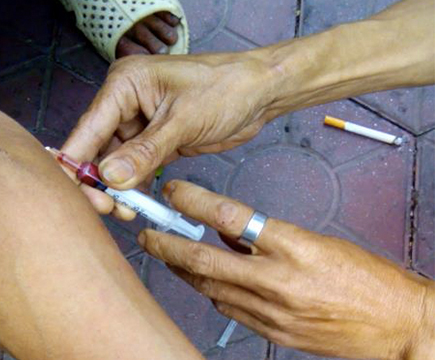
Image issue d’un film réalisé par Mr Hà Quang Hiêp membre du groupe d’UDI Friendship Arm.
In Vietnam, people who inject drugs (PWID) constitute the population most affected by HIV/AIDS and hepatitis C. ANRS and NIDA support various research programs in Vietnam, thus assisting the national authorities in their fight against these epidemics. One such program, ANRS/NIDA DRIVE-IN, has assessed the feasibility of an interventional program among PWID in the city of Haiphong. On July 25 at the 9th IAS Conference on HIV Science, organized by the International Aids Society and the ANRS in Paris, Professor Pham Minh Khuê will give an oral presentation on the results of this study of the dynamics of the HCV and HIV epidemics among PWID.
603 PWID recruited through respondent driven sampling method conducted with a self-support groups were offered screening tests, which showed that 25 % of them were seropositive for HIV and that 66 % were seropositive for HCV. These results reveal high prevalence of HIV and HCV infections among PWID, who are therefore a key population regarding these epidemics.
Among these 603 PWID, 204 were included in a cohort and were followed up for one year, with screening every six months for those who had been tested negative for HIV and/or HCV. During follow-up, the participants had access to a community-based risk reduction program (communication on harm reduction, safe injection and safe sex, distribution of syringes/needles and condoms) and received assistance in accessing to methadone services and antiretroviral treatment for HIV-infected participants. Among these 204 PWID, at baseline: 94 (46 %) were seronegative for both HIV and HCV, 105 (51 %) were seropositive for HCV alone, and 5 (2 %) seropositive for HIV alone. After one-year follow-up, no new HIV infections were observed. In contrast, there was a high incidence of HCV, with 18 new infections. Multivariate analysis indicated a strong correlation between the reported number of injections monthly and the risk of infection: those PWID who self-injected more than 75 times a month were infected most likely by HCV.
Dr Didier Laureillard, the coordinator of the ANRS site in Vietnam, considers that “These results show that the efforts made over the last ten years or so in Vietnam to reduce risk and to increase access to antiretrovirals among PWID have paid off. HIV incidence has decreased markedly in this population. This is a very encouraging result, showing that it is possible to act effectively among PWID.”
In contrast, the situation regarding hepatitis C is very worrying. Professor Pham Minh Khuê (Faculty of Public Health, Haiphong University), who is a co-investigator of ANRS/NIDA DRIVE-IN, speaks of the results: “In terms of HCV, it is today essential to implement an approach similar to that which we have been using to control HIV. Harm reduction programs designed for HIV appear insufficient to combat the HCV epidemic and need to be adapted. But the essential measure that could reduce the incidence of hepatitis C is broad access to new highly effective treatments as performed successfully for HIV infection. At present, very few patients with hepatitis C receive these treatments.”
“This objective is all the more crucial,” adds Dr. Laureillard, “because with these treatments it is possible to cure hepatitis C in nearly all patients in a few months. We could therefore rapidly eradicate the epidemic, not only among PWID, but also in the general population.”
Following the feasibility study ANRS/NIDA DRIVE-IN, the ANRS- and NIDA-supported DRIVE study was launched in September 2016. This study will, after 4 years of follow-up, evaluate the benefits of the community-based intervention drawn up during ANRS/NIDA DRIVE-IN, but this time scaled up to a population level, in the whole city of Haiphong in Vietnam. The new study will recruit 1500 PWID every year.
Professor François Dabis, Director of the ANRS, says that “Access to treatments of HCV infection is a challenge not only for Vietnam, but for all resource-limited countries affected by this epidemic. In terms of research, we must undertake new studies for large-scale assessment of HCV treatment as a new tool for prevention of this infection.”
Source :
Low HIV incidence but high HCV incidence among people who inject drugs in Haiphong, Vietnam: Results of the ANRS 12299/NIDA P30DA011041 DRIVE-IN study
M.K. Pham1, J.P. Moles2, H. Duong Thi1, T. Nguyen Thi3, G. Hoang Thi4, T.T. Nham Thi5, V. Vu Hai6, H.O. Khuat Thi5, R. Vallo2, M.Peries2, K. Arasteh7, C. Quillet2, J. Feelemyer7, L. Michel8, T. Hammett9, N. Nagot2, D. Des Jarlais7, D. Laureillard2,10, DRIVE study group
1 Faculty of Public Health, Haiphong University of Medicine and Pharmacy, Haiphong, Vietnam, 2University of Montpellier, Inserm U1058, Etablissement Français du Sang, Montpellier, France, 3Haiphong Provincial AIDS Center, Haiphong, Vietnam, 4Haiphong University of Medicine and Pharmacy, Haiphong, Vietnam, 5Supporting Community Development Initiatives, Hanoi, Vietnam, 6Dept of Infectious and tropical diseases, Viet Tiep Hospital, Haiphong, Vietnam, 7Icahn School of Medicine at Mount Sinai, New York, United States, 8CESP/Inserm U1018, Pierre Nicole Centre, French Red Cross, Paris, France, 9Abt Associates, Cambridge, MA, United States, 10Infectious Diseases Department, Caremeau University Hospital, Nimes, France.
Image issue d’un film réalisé par Mr Hà Quang Hiêp membre du groupe d’UDI Friendship Arm.
Parmi ces 603 UDI, 204 ont été intégrés dans une cohorte et ont fait l’objet d’un suivi pendant un an, avec un dépistage tous les six mois pour ceux qui avaient été testés négativement pour le VIH et/ou VHC. Lors de ce suivi, les participants avaient accès au programme de réduction des risques des structures communautaires (informations sur les méthodes de réduction des risques concernant les relations sexuelles et les injections, distribution de seringues/aiguilles et préservatifs) et bénéficiaient d’une aide à l’accès au traitement de substitution par la méthadone et au traitement antirétroviral pour les participants infectés par le VIH. Parmi ces 204 UDI, à l’inclusion, 94 (46 %) étaient séronégatifs à la fois pour le VIH et le VHC, 105 (51 %) étaient séropositifs seulement par le VHC et 5 (2 %) séropositifs seulement par le VIH. Au terme de l’année de suivi, aucune contamination par le VIH n’a été observée. A l’inverse, une incidence élevée du VHC a été constatée avec 18 nouvelles infections. Une analyse multivariée indique une forte corrélation entre le nombre d’injections mensuelles et le risque d’infection. Ce sont les UDI pratiquant plus de 75 injections par mois qui ont été préférentiellement infectés par le VHC.
Pour le Dr Didier Laureillard, coordinateur du site ANRS Vietnam, « Ces résultats montrent que les efforts engagés depuis une dizaine d’années au Vietnam en faveur de la réduction des risques et de l’accès aux antirétroviraux auprès des UDI ont été payants. L’incidence du VIH a fortement baissé dans cette population. C’est un résultat très encourageant, montrant qu’il est possible d’agir efficacement chez les usagers de drogues. »
La situation est en revanche encore très préoccupante concernant l’hépatite C. Le Pr Pham Minh Khuê (Faculté de Santé Publique, Université de médecine et de pharmacie d’Hai Phong), co-investigateur de l’étude ANRS/NIDA DRIVE-IN, parle de ces résultats : « Il est aujourd’hui indispensable d’avoir une approche similaire pour le VHC à celle que nous avons engagée pour contrôler le VIH. Les programmes de réduction des risques construits pour le VIH apparaissent insuffisants pour lutter contre l’épidémie du VHC et doivent être adaptés. Mais la mesure essentielle qui pourra réduire l’incidence de l’hépatite C est un accès large aux nouveaux traitements. A l’heure actuelle, très peu de patients peuvent recevoir ces traitements. »
« Cet objectif est d’autant plus crucial, poursuit le Dr Laureillard, qu’avec ces traitements, il est possible de guérir l’hépatite C chez la quasi-totalité des patients en quelques mois. Nous pourrions ainsi enrayer rapidement l’épidémie non seulement parmi les UDI, mais également dans la population générale. »
Suite à l’étude de faisabilité ANRS/NIDA DRIVE-IN, l’étude DRIVE, soutenue par le NIDA et l’ANRS, a été lancée en septembre 2016. Elle évaluera, après quatre ans de suivi, le bénéfice de l’intervention communautaire élaborée pendant la phase ANRS/NIDA DRIVE-IN mais cette fois à l’échelle d’une population, dans toute la ville de Hai Phong. La nouvelle étude recrutera chaque année 1500 UDI.
Le professeur François Dabis, Directeur de l’ANRS, déclare « L’accès aux traitements du VHC est un enjeu non seulement pour le Vietnam, mais pour l’ensemble des pays à ressources limitées confrontés à cette épidémie. En terme de recherche, nous devons engager de nouvelles études évaluant à large échelle le traitement du VHC comme nouvel outil de prévention de cette infection. »
Source :
Low HIV incidence but high HCV incidence among people who inject drugs in Haiphong, Vietnam: Results of the ANRS 12299/NIDA P30DA011041 DRIVE-IN study
M.K. Pham1, J.P. Moles2, H. Duong Thi1, T. Nguyen Thi3, G. Hoang Thi4, T.T. Nham Thi5, V. Vu Hai6, H.O. Khuat Thi5, R. Vallo2, M.Peries2, K. Arasteh7, C. Quillet2, J. Feelemyer7, L. Michel8, T. Hammett9, N. Nagot2, D. Des Jarlais7, D. Laureillard2,10, DRIVE study group
1 Faculty of Public Health, Haiphong University of Medicine and Pharmacy, Haiphong, Vietnam, 2University of Montpellier, Inserm U1058, Etablissement Français du Sang, Montpellier, France, 3Haiphong Provincial AIDS Center, Haiphong, Vietnam, 4Haiphong University of Medicine and Pharmacy, Haiphong, Vietnam, 5Supporting Community Development Initiatives, Hanoi, Vietnam, 6Dept of Infectious and tropical diseases, Viet Tiep Hospital, Haiphong, Vietnam, 7Icahn School of Medicine at Mount Sinai, New York, United States, 8CESP/Inserm U1018, Pierre Nicole Centre, French Red Cross, Paris, France, 9Abt Associates, Cambridge, MA, United States, 10Infectious Diseases Department, Caremeau University Hospital, Nimes, France.