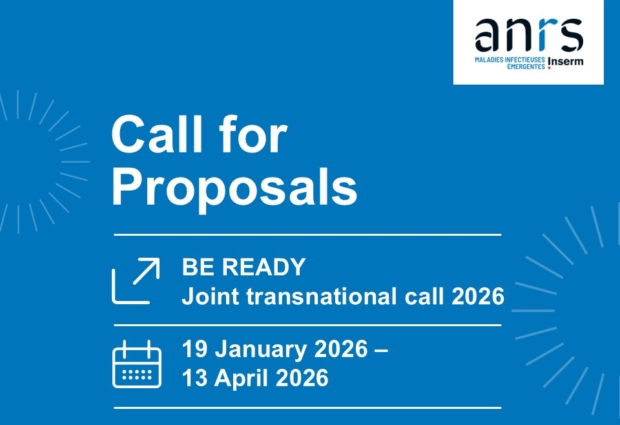
19 January - 13 April 2026
Last updated on 09 February 2026
An informative webinar presenting the call for projects to the scientific community was broadcast on January 28, 2026: you can view it by clicking here. The presentation is available by clicking here.
A frequently asked questions section, containing the most commonly posed questions, has also been created and can be viewed via this link.
An online networking tool, PART FINDER, is also available to help you find partners to apply for this call for projects.
Please note that you can filter your searches with the label “BE READY Partnership,” and that you will need to include this filter in your search ads.
Infectious diseases can quickly escalate into health crises with global impact, as demonstrated by the COVID-19 pandemic and more recent outbreaks of avian influenza (H5N1) and mpox virus. These events have highlighted the close link between environment, human and animal interactions in a “One Health” context, while underscoring the need to strengthen international cooperation in research and development. During these crises, it became evident across Europe that although research efforts were quickly launched, they were not coordinated, leading to a fragmented research landscape.
The European Partnership for Pandemic Preparedness BE READY aims to establish a European research and innovation ecosystem ready to respond quickly and effectively to future health crises caused by infectious diseases. This ecosystem will be capable of responding swiftly and efficiently to such crises and will be fully integrated into the broader European institutional framework for health security.
To achieve this objective, BE READY’s Strategic Research and Innovation Agenda (SRIA) on pandemic preparedness defines the Partnership’s research priorities and scientific objectives. The SRIA is organised around five thematic priorities, and adopts a comprehensive research approach, that encompasses fundamental, technical, epidemiological, and clinical domains, while also incorporating social sciences and humanities, in line with an integrated One Health approach.
To put the SRIA’s research priorities into practice, BE READY is launching its first joint transnational call (JTC), open from January 19 to April 13, 2026, that will fund transnational, interdisciplinary research projects. This call will support innovative, collaborative, interdisciplinary and transnational research projects aimed at better understanding the pandemic potential of emerging pathogens, determining the pathophysiology induced by these pathogens and developing innovative medical countermeasures.
In total, 21 funding organisations have agreed to launch the first JTC in the BE READY Partnership. The participating funding organisations expect to add value to their existing national and regional research activities by pooling their efforts in this JTC, which will be coordinated centrally by the Joint Call Secretariat (JCS) at DLR Projektträger, Germany.
As a national research funding agency, ANRS Emerging infectious diseases (ANRS MIE) has long played a structuring role in the field of infectious disease research by supporting, coordinating and shaping research agendas at national level. Through the European Partnership for Pandemic Preparedness BE READY, which it coordinates, ANRS MIE extends this mission to the European and international scale.
ANRS MIE therefore invites the research community to participate in this first joint transnational call, which embodies a shared ambition to move beyond fragmented initiatives and build a coherent, coordinated and sustainable research ecosystem for pandemic preparedness. By bringing together funding organisations, scientific communities and disciplines across countries, BE READY enables ANRS MIE to amplify its long-standing role as a research funder and strategic actor, fostering alignment of priorities, large-scale collaboration and impactful research capable of anticipating and responding effectively to future infectious disease threats
Further details regarding the scope, the final list of participating funders and the eligibility rules are provided in the call text.
If you have any questions, please send them to the following email address: aap@anrs.fr
Consult the JTC 2026The following funding organizations intend to support the Joint Transnational Call 2026:
|
|
Country/Region |
Funding Organisation |
|
1 |
Austria |
Austrian Science Fund (FWF) |
|
2 |
Belgium (Flandern) |
The Research Foundation – Flanders (FWO) |
|
3 |
Belgium (Wallonia-Brussels Federation) |
Fonds de la Recherche Scientifique-FNRS (F.R.S.-FNRS) |
|
4 |
Belgium (Wallonie) |
Service Public de Wallonie |
|
5 |
Czech Republic |
Ministry of Health of Czech Republic (MZCR) administered by Czech Health Research Council (AZVCR) |
|
6 |
Denmark |
Innovation Fund Denmark (IFD) |
|
7 |
Estonia |
Estonian Research Council) (ETAG) |
|
8 |
France |
ANRS MIE |
|
9 |
Germany |
Bundesministerium für Forschung, Technologie und Raumfahrt (BMFTR) administered by Deutsches Zentrum für Luft- und Raumfahrt e.V. (DLR Projektträger, DLR-PT) |
|
10 |
Greece |
General Secretariat for Research and Innovation (GSRI) |
|
11 |
Hungary |
National Research, Development and Innovation Office (NKFIH) |
|
12 |
Ireland |
Research Ireland |
|
13 |
Italy |
Italian Ministry of Health (IT MoH) |
|
14 |
Moldova |
National Agency for Research and Development (NARD) |
|
15 |
New Zealand |
New Zealand Institute For Public Health and Forensic Science Limited (PHF Science) |
|
16 |
Norway |
The Research Council of Norway (RCN) |
|
17 |
Slovakia |
Slovak Centre of Scientific and Technical Information (CVTI SR) |
|
18 |
Spain |
Instituto De Salud Carlos III (ISCIII) |
|
19 |
Sweden |
Swedish Research Council (SRC) |
|
20 |
The Netherlands |
The Netherlands Organisation for Health Research and Development (ZonMw) |
|
21 |
Turkey |
The Scientific And Technological Research Council Of Türkiye (TUBITAK) |