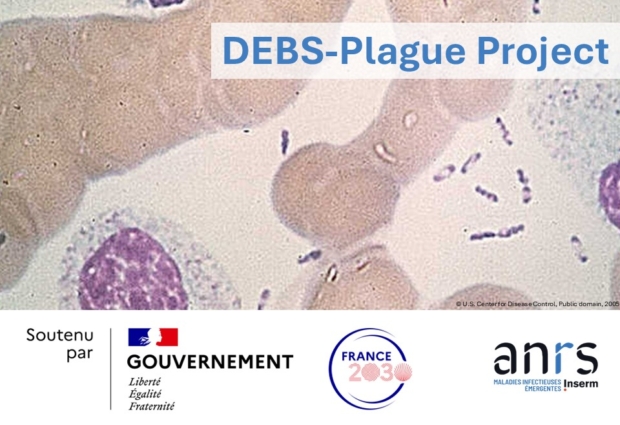
An analysis of the environmental, biological and societal factors governing the risk of the plague re-emerging in France.
Last updated on 14 October 2026
Project type
Scientific study
Funding
PEPR MIE – 2023 Laureate
Allocated funds
2,737 M€
Duration
48 months
Consortium teams
• Institut Pasteur (France et Madagascar)
• Nottingham University (Royaume-Uni)
• Univ. La Réunion
• VetAgro Sup Lyon
• IRD- INRAE
• Univ. Avignon
• Stirling University (Royaume-Uni)
• Univ. Bordeaux
• Univ. Lille
• Universität Tübingen (Allemagne)
• University of Oslo (Norvège)
• Univ. Lyon 2
• Univ. Grenoble
Pathology
Plague (Yersinia pestis)
The DEBS-Plague project analyses the ecological, evolutionary and molecular factors associated with the risk of a resurgence of Yersinia pestis in France. It is based on an interdisciplinary consortium bringing together history, archaeology, ecology, genomics, experimental biology, modelling and engineering.
The plague, caused by the bacterium Yersinia pestis, is a fatal disease of rodents that spreads mainly via fleas and occasionally infects humans. The possibility of the re-emergence of persistent plague foci in France, as in the rest of Europe, due to natural or anthropogenic causes (including terrorism or acts of war) is a major concern.
However, the conditions favouring such a resurgence are unknown in the overseas territories (Réunion and Mayotte) and are the subject of heated debate on the mainland, highlighting a certain lack of understanding of the environmental, ecological and molecular mechanisms governing the dynamics of the plague. This observation calls for holistic investigations aimed at generating new knowledge.
The DEBS-Plague research project is based on an international interdisciplinary consortium bringing together, for the first time, historians, archaeologists, biologists, soil scientists, engineers and mathematicians, some of whom are French and European specialists in the plague.
Historians and archaeologists are tasked with identifying the regions of France where the plague circulated regularly, in order to guide the other members of the consortium in identifying areas at risk, beyond those sites that can be readily identified using contemporary information. Furthermore, mammalogists and entomologists are also studying sites in mainland France and the overseas territories, already considered to be at risk, to determine whether these sites harbour animal reservoirs capable of sustaining and spreading Y. pestis.
Field investigations in France and Madagascar focus on collecting the skeletons of medieval French rodents, soil samples, and fleas found exclusively in France. These samples are used by three teams:
Microbiologists analyse genetic, soil and animal reservoir data to decipher, using flea and murine models, the links within the dynamics of the plague between the microevolution of the bacillus, soil characteristics and the diversity of animal reservoirs. They thus aim to elucidate the molecular aspects associated with the links that will be established. This work is made possible in part by the development, by engineers, of automated systems capable of generating biological information with unrivalled speed and volume.
Finally, mathematicians use historical and experimental data, as well as field investigations, to generate holistic epidemiological models that predict the re–emergence of the plague in France.
This project aims to anticipate the risk of the plague re-emerging in France through an interdisciplinary approach. It forms part of a strategy to prepare for crises and to establish a sustainable framework for research into emerging zoonoses.
The DEBS–Plague project is therefore intended to:
Against a backdrop of emerging infectious diseases, climate change and biological risks, the re-emergence of the plague represents a major health, ecological and socio-economic challenge. DEBS-Plague aligns with the objectives of France 2030 by strengthening preparedness for health crises, characterising the risk of plague in France and establishing a sustainable framework for innovative interdisciplinary research that develops surveillance, modelling and control tools transferable to other emerging zoonoses, including Disease X.
Carcauzon, Victoria, et al. « Emergence, Global Dispersal, and Local Adaptations of Yersinia Pestis , the Agent of Plague ». Applied and Environmental Microbiology, édité par Edward G. Dudley, mars 2026, p. e01658-25. DOI.org (Crossref), https://doi.org/10.1128/aem.01658-25.
Sebbane, Florent, et al. « La peste à l’ère moderne, comprendre la transmission de la bactérie Yersinia pestis par les puces ». médecine/sciences, vol. 41, nos 6 7, juin 2025, p. 578 84. www.medecinesciences.org, https://doi.org/10.1051/medsci/2025096.
Carcauzon, Victoria, et al. « Malagasy Flea Microbiota Results from a Combination of Vertically Transmitted and Environmentally Acquired Microbes ». Scientific Reports, vol. 15, no 1, mars 2025, p. 8461. www.nature.com, https://doi.org/10.1038/s41598-025-90670-4.
The DEBS-Plague project is one of the eleven successful applicants in the 2023 call for proposals under the Priority Research Programme and Equipment for Emerging Infectious Diseases (PEPR MIE).
Led and managed by the ANRS MIE, the PEPR MIE forms part of Measure 2 of the National Strategy for Accelerating Action on Emerging Infectious Diseases (MIE) and Nuclear, Radiological, Biological and Chemical Threats (MN).
It comprises four calls for proposals in 2023, 2024, 2025 and 2026. Each is structured around three strands: accelerating the acquisition of fundamental knowledge on emerging infectious diseases; promoting innovation and developing new treatments, vaccines and other tools for prevention, diagnosis and surveillance of emerging infectious diseases; and enabling public policy-makers and society to cope with epidemic crises.
The PEPR MIE calls for proposals are aimed at large–scale, interdisciplinary and multi–partner research projects lasting between two and three years. The total budget allocated by the France 2030 plan to this scheme is €70 million.
Analysis of volatile organic compounds in exhaled air for rapid diagnosis of emerging respiratory infections.
24 February 2026

Pandemic preparedness for respiratory virus X: integrative modelling from early cases to early health countermeasures.
24 February 2026
Determinants of severe dengue fever in the French overseas territories
23 January 2025